• TalkBass has been independent since 1998. Add your voice.
    Create a free account to reply to discussions, view embedded media, and browse with fewer display ads.
    Join freeLog in
    Want zero display ads or expanded classifieds tools? Compare plans.

Graphite stiffening VS dual truss rods?

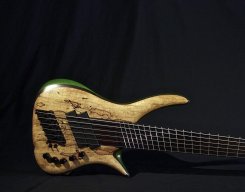
Eleven laminates of maple and purpleheart, two graphite bars and two truss rods. This one is about as stable as they come, and very near indestructable...
View attachment 1281408View attachment 1281412
With a combination of laminates and graphite I would think a stable neck with a thin profile is achievable. This one has an angled headstock, but given it's construction the headstock is quite strong. A sister to this bass received poor treatment from a stage hand a number of years ago. It was knocked off the stand and the tip of the headstock hit the drum riser. There's a nasty ding in the headstock, but it didn't crack and was only slightly out of tune.
So ya thinking North Korea is going to nuke that bass? lol!!! Man that sounds like one stiff neck! I love it :)
 
  • Like
Reactions: reverendrally
3. I have worked with epoxy/polyester resin with fibre glass and kevlar in the past on car projects. I really didn't enjoy the process or the chemicals. I have similar dislike for spray finishes.

Having worked with both, I'd just like to say that there is a WORLD of difference between polyester resin and epoxies. Polyester is by far more unpleasant (of course, it's also by far cheaper...)
 
Earlier @mapleglo mentioned aluminum. Wouldn't that be a less expensive solution that would be easier to work with for stiffening rods?

Yep, I've used thin aluminum plates to stiffen up necks, and it works very well. I think it's a better solution than the commercial carbon fiber bars, and not just for lower cost. I've written a fair amount about my experiments in a few other old threads. It may take some digging to find them.
 
Having worked with both, I'd just like to say that there is a WORLD of difference between polyester resin and epoxies. Polyester is by far more unpleasant (of course, it's also by far cheaper...)

I agree. I use West Systems epoxy indoors in my shop every day, and I don't think that it has much of an odor at all. Polyester-based products will stink you out of the building and make you sick.
 
Yep, I've used thin aluminum plates to stiffen up necks, and it works very well. I think it's a better solution than the commercial carbon fiber bars, and not just for lower cost. I've written a fair amount about my experiments in a few other old threads. It may take some digging to find them.

Thanks Bruce. I've ordered some 6x4mm bars today. They'll go in with 1 truss rod I think. :)
 
Yes, but I'm not ever going to do that for a few reasons.
1. I'm very committed to building instruments where the timber and structure are sufficiently compromised to actually effect the sound. I want the sound of the timber.
2. I have a serious concerns about the amount of petrol-chemicals used in composite materials as is. I can justify using small amounts, but I think a whole neck is unnecessarily extravagant. It's also impossible to recycle, where timber can be shredded/chipped etc and repurposed.
3. I have worked with epoxy/polyester resin with fibre glass and kevlar in the past on car projects. I really didn't enjoy the process or the chemicals. I have similar dislike for spray finishes.
I understand your feelings about it. I will say I have found there are no negative effects from graphite. It sounds similar to Ebony, but has sustain forever. I know Zon has done a mix of wood and graphite to get a more "timber" effect. Also, I designed my bass around the neck by choosing tone woods that would compliment and keep in check the graphite. My neck is pretty thin and strong, so if you are going with wood, I think the graphite stiffening bars would help with strength in the longer scale and thinner neck. Good luck with your project.:thumbsup:
 
  • Like
Reactions: reverendrally
I'll be watching this with some interest. I also have plans for a sixer that I'd rather not be going the dual truss route with either.
I can relate on the petrochemicals and spray finish side of things there @reverendrally , hence my preference for oil finishes and the like. Despite this though I have a stash of carbon cloth left over from years back that I'm leaning towards using as a laminate with the neck timber in a similar vein to the purpleheart stringers above. Hoping to completely go without a truss rod on this one if I can, but there will obviously be some extra engineering needed to make that happen.

I've personally found working with epoxy to be quite a pleasant experience as far noxiousness is concerned though, polyester resin on the other hand... If you want to give the carbon laminate a tinker anytime, there was a place down near Manly that had the goods for a decent price.
 
My brother used to repair boats for a living, and he's a wizard with fiberglass, but never admits it, lest somebody asks him to do it! Anything that requires MEKP to make it kick is BAD. I've done it just enough to get a headache thinking about it. West epoxy doesn't bother me at all, smells like some unspecified food to me. Short of a completely rigid neck with some built in relief, how does a no trussrod neck work? What if you change string guages?
 
So, talk me through the pluses and minuses of these two.
With single truss rod and 2 reinforcement bars It is easier to adjust the neck without worrying that one truss rod is tighter than the other, which could potentially twist the neck overtime.

I also get my carbon fibre bars from BestBassGear.
I came across the link you posted before, but I haven't bought anything from them yet. My guess, price wise it might be similar (or more expensive, like anything sold in here), but shipping would be cheaper and a lot faster.
BBG requires you to spend 100 USD or more to get a free shipping. It used to be 50.

P.s. I'm also curious about the upside/downside of heal adjusted vs headstock adjusted truss rods.
I personally prefer the heel truss rod adjustment. From my past builds, I could remove more wood under the first 2 frets, which can give you a feeling that the neck is significantly thinner.
The reason for this is, the truss rod nut will need a significantly deeper channel. Placing the adjustment on the headstock will require you to route a deeper channel under the nut, which means more chances for a carve through (please don't ask me how I know this ;)).

I generally do asymmetrical neck profile, which is similar to profile 3 and 4 on the image below
Q8AYsbKobR_oYvi_ws8viEw0FhMUijfqVo-LYT7tq0LqvZtvIDBDXMUIhqbYnkZC555kmM6Lc2nmKCnoOvY=w384-h383-nc.png
 
Last edited: