
Looks to be different construction materials, hardware and dimensions.Can someone tell me about the differences between the Ibanez PNB14E and the AVNB1E? What makes the latter twice the price as the former?

TalkBass has been independent since 1998. Add your voice.
Create a free account to reply to discussions, view embedded media, and browse with fewer display ads.
Join free Log in
Want zero display ads or expanded classifieds tools? Compare plans.
Looks to be different construction materials, hardware and dimensions.Can someone tell me about the differences between the Ibanez PNB14E and the AVNB1E? What makes the latter twice the price as the former?
Can someone tell me about the differences between the Ibanez PNB14E and the AVNB1E? What makes the latter twice the price as the former?

Short version:Can someone tell me about the differences between the Ibanez PNB14E and the AVNB1E? What makes the latter twice the price as the former?
Nice chart! The website used to show the AVNB1E as being 5" deep. Also a mistake.I wish I could tell you how they compare in sound and playability, but I haven't found an AVN bass to try out. The attached image shows my Short Scale Bass comparison spreadsheet for the 25" scale Ibanez basses. So you can see the spec differences anyway. Main ones are electronics, solid top and types of wood used. Curiously the specs on the Ibanez website say the AVNB2E is almost an inch deeper than the AVNB1E. I wonder if this is a mistake.
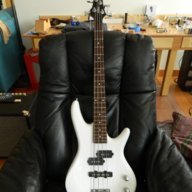
That said, for home/travel use, I probably would have been nearly as happy with the PNB. Also, I wouldn't be as concerned about heat/humidity, because of the laminated top.

As with most musical instruments, the relationship between price and performance isn't close to linear. As you go higher in quality and price, it seems to get exponentially harder to claw out every percentage point of improvement.
My $2,400 Dingwall (replacement cost would be $3,600 just 6 years later) isn't 4x better than the heavily-modded Squier in my icon. The Squier cost me $600 plus labour, and while the Dingwall is definitely better in every way, I doubt that it's much more than 15-20% better in any particular respect.
Audiences never complained about the Squier, but most FOH techs and musicians I play with notice the difference, and always ask for the Dingwall. That's why the Squier is gone, yet the ABZ is still around!
This is fantastic! It really helps. It's basically better woods, solid top, bone nut/saddle instead of plastic, better piezo, nice flat radius, and an upgrade all around. Thanks!I wish I could tell you how they compare in sound and playability, but I haven't found an AVN bass to try out. The attached image shows my Short Scale Bass comparison spreadsheet for the 25" scale Ibanez basses. So you can see the spec differences anyway. Main ones are electronics, solid top and types of wood used. Curiously the specs on the Ibanez website say the AVNB2E is almost an inch deeper than the AVNB1E. I wonder if this is a mistake.
View attachment 3336748
This is fantastic! It really helps. It's basically better woods, solid top, bone nut/saddle instead of plastic, better piezo, nice flat radius, and an upgrade all around. Thanks!

You're welcome.
I'm still trying to figure out what your profile pic is saying about my home state.
Not if each instrument is well constructed.Would the laminated top be stronger and resist bridge pull?
I think the variation in quality of sound has more to do with the hit or miss of the pickup. I went thru at least 3 or 4 that all sounded the same acoustically but plugged in was a different story. The biggest problem that I had was finding one that played uniformly from string to string. The one I finally brought home is a little weak on the D string but run thru a compressor, nobody seems to notice. Finding a good one may be a little more like an Easter egg hunt than with the higher dollar basses. If I had the money, I might have gone for the Guild.Hi guys - new member here. I have a couple of questions about purchasing an acoustic bass. My background - played electric bass a little in high school (messing around with garage band) and about 20 year ago purchased a Martin B-1 which I hung onto for about 5 years when I sold it to move on to other hobbies (still kicking myself about that). Looking to start playing again and want an acoustic to keep the "getting started" cost down.
I'm in a metro area with access to 5 or 6 guitar stores, so I'm able to test out a variety of basses and even multiple of the same model. I really like the sound and feel of the short scale bases and these are the ones on my list (in this order or preference):
- Ibanez PNB14E (I would love to try the AVNB1E but can't find one locally)
- Guild Jumbo Junior (great feel and sound but twice the cost of the Ibanez)
- Gold Tone Microbass (love this guitar but too quiet and don't have access to one with the Silverback strings)
- Taylor GS Mini-e (too expensive and the scale feels too short)
The Ibanez will probably win out because of the price - such a great value.
Here are my questions:
I've played 3 or 4 of the Ibanez basses and notice significant differences in the sound and feel. I think this is due to the condition of the strings, but I'm not sure. How do you go about judging the sound/quality of a guitar when you have to play display-model strings? Should I choose the one that looks best knowing that a new set of strings will make them all sound the same? Or pick one that sounds/feels best when played in the store?
And related questions: Should I choose the model based on playing the floor instrument but then find a "new" one in stock so that I can get one with a fresh set of strings? A $30 set of strings is ~10% the cost of the guitar. Is it too risky to buy unseen when you have the option to pick a floor instrument? Or are they all pretty much the same, and buying a floor model is basically throwing away $30? I can see that some of these strings have visible wear, discoloration and in some cases oxidation.
Thanks for any advice!
I think the variation in quality of sound has more to do with the hit or miss of the pickup. I went thru at least 3 or 4 that all sounded the same acoustically but plugged in was a different story. The biggest problem that I had was finding one that played uniformly from string to string. The one I finally brought home is a little weak on the D string but run thru a compressor, nobody seems to notice. Finding a good one may be a little more like an Easter egg hunt than with the higher dollar basses. If I had the money, I might have gone for the Guild.
I've had the guitar since September and I do really like it. I like the tone of the bronze strings and can get a lot of different sounds by playing closer or further from the bridge. I play in an acoustic trio right now and have tried a few different basses and everybody seems to like the baby ibby the best.
There's no need to accept any imbalance in the plugged-in tone, at least with the major brands.
On a piezo-equipped instrument, uneven response from string to string is usually the result of poor prep.
A good guitar tech can generally fix it by flattening the bottom of the saddle, and/or levelling the bottom of the slot in the bridge. If that process lowers the action too much, it's just a matter of making a shim.
There's nothing special about doing this work on an ABG vs an acoustic guitar.
Cost should be minimal, as long as there isn't a lot of other work to be done.
I still haven't seen a Guild yet, but everything else is generally solid on Goldtone, Ibanez, and Taylor- good fretwork, clean glue joints, well-fitted nuts, etc.
My biggest concern with Taylor, would be the fact that I haven't seen one with good intonation yet. Intonation adjustments are difficult on fixed bridges, especially with a narrow saddle.