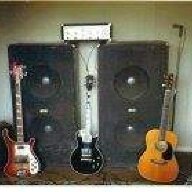
I strongly recommend that you read up on what actually goes into making a good cabinet before jumping into this. Especially since it seems that you don't know what you actually want.
I would echo this. You seem to be unsure about fairly basic things like what a horn does in a cab, since nobody seems to have answered I'll give it a go. All speakers drivers are designed to work best across a certain range of frequencies. The speakers that work well at low frequencies such as 15 inch, 12 inch and 10 inch speakers start to become less efficient at higher frequencies and their response starts to fall away (typically at around 4-5khz). Some bass styles, such as slap bass, benefit from having a bit of top end sizzle going on, so in this case, designers add a tweeter (sometimes but not always a horn loaded one) to extend the frequency of the overall cab design.
This is more complex because you then need a crossover circuit so that you feed the low frequencies to the big speakers and not to the tweeter, and vice versa. Some even more sophisticated designs such as the Greenboy cabinets use a 3 way crossover, so that you have separate drivers for lows, mids and highs. This allows you to use drivers that are optimised for their task, so you can use a 3012LF, crossed over to a 6" mid driver and then (if you need it) crossing over again to a tweeter. It is the crossovers job to make sure the frequencies are all handled nice and smoothly at the frequencies that they crossover at. A design like this will give you the broadest frequency range from really deep to really high; but you may not need it if your playing style and taste is different. If you don't need such a broad frequency range you would be better off making a simpler cab, perhaps with just one or two speakers that each carry the full range of frequencies you need. In this case you would be better off getting a 3012HO (the LF in the 3012 range stands for Low Frequency and this speaker really needs to hand over to a mid range speaker wheras the 3012HO is 'full range').
No disrespect to Arturo, but in the 40 years that have passed since we were all making ourselves huge, really heavy wardrobe sized cabinets (usually without any thought of porting or tuning) made of MDF or Chipboard, the world of cab design has come on a long way. The wood that a cab is made from doesn't make any difference to the sound as long as it is strong enough that the panels don't resonate. This used to be achieved by using really heavyweight materials such as 3/4 inch chipboard or 3/4 plywood, but the smart thing to do nowadays is to get some high quality Baltic Birch plywood and make cabs out of lighter 1/2 inch (12mm) ply. Since this is thinner material it needs internal braces to add stiffness without weight.
Making cabs is not 'cheap', and you can easily buy cabs for a similar price as ones you can make...the difference is that you can usually get a cab built for your exact needs, loaded with far better speakers for the same price.
So the choice is yours. If you want the widest frequency range, go for one of the Greenboy designs, if you want a simple 212 one of the easiest to build is Bill Fitzmaurice's simplex design...but do work from existing plans because making cabs is the easy bit, designing them is what takes years of study and experience.


 )
)