Oh man, if I keep getting these guilt trips I may have to start drinking again.

Enjoy the benefits of a premium membership!
Upgrade Account
-
TalkBass has been independent since 1998. Add your voice.
Create a free account to reply to discussions, view embedded media, and browse with fewer display ads.
Join free Log in
Want zero display ads or expanded classifieds tools? Compare plans.
You are using an out of date browser. It may not display this or other websites correctly.
You should upgrade or use an alternative browser.
You should upgrade or use an alternative browser.
Harrison inspired 4001 ric build
- Thread starter Verner
- Start date
More options
Who Replied?


- Apr 18, 2008
- 16,011
- 1
- 31,711
- Disclosures
- I'm highly opinionated and extremely self-assured
Sorry not sorry.
That walnut is just too pretty, and plastic is just so tacky.
(This helps explain why I despise most Fender designs, btw)
But this is, as they say, your party.
That walnut is just too pretty, and plastic is just so tacky.
(This helps explain why I despise most Fender designs, btw)
But this is, as they say, your party.
The stock bridge height reqires the centerline of fingerboard to be almost 1/2" off the body, I'm using a Schaller bridge on the Lemmy, so it's more or less just the fingerboard thickness (just over 1/4") above the body. As @ctmullins said, it's your party, but in your shoes I'd take some more meat off the fingerboard/neck beam joint, rolling the "C" shape to right up just below the fret ends. That would make the whole neck feel thinner. I'd also cut the heel a lot closer to the body, one of the main (only?) advantage of neck-through is that you can carve the heel to get better upper fret access. Hope I don;t come off as Mr. Knowitall, it's taken me three Ric clone builds to feel like I have a handle on it, purchased with lots of screw-ups and things I wish I did better. It's not an easy build, Rics are one big Quirk, as you have surely realized. I bagged the pickguard on my Hossenfeffer II build, whcih is pretty unforgiving. If you screw up the pickup routes, there's no fixing it cosmetically. I got away with it, you can too if you are willing to chance it. Thing is, you could route it for exposed body-mount pickups with no guard, and if it doesn't come out good, go back to Plan A, with the pickguard covering any mishaps. Win/Win!
Aesthetically I totally understand what you are saying. Not only that, but I respect the hell out of both of you, not only are you both accomplished builders who make some of the most beautiful instruments I’ve seen on this forum, you were both extremely generous with invaluable advice and guidance. The very idea that I’ve done a good enough job that you both want me to show off more of it is a point of pride for me, seriously grateful.
That being said, my original goal was to meld two Rossmeisl designs, and I want to see that through. I’m not lacking in walnut, and I definitely see a 3 pickup/no plastic in my future.
That being said, my original goal was to meld two Rossmeisl designs, and I want to see that through. I’m not lacking in walnut, and I definitely see a 3 pickup/no plastic in my future.
Yeah, this bass is a very quirky beast. It’s funny how much you learn building an instrument. If you want all stock parts, you really have no choice with certain design features.The stock bridge height reqires the centerline of fingerboard to be almost 1/2" off the body, I'm using a Schaller bridge on the Lemmy, so it's more or less just the fingerboard thickness (just over 1/4") above the body. As @ctmullins said, it's your party, but in your shoes I'd take some more meat off the fingerboard/neck beam joint, rolling the "C" shape to right up just below the fret ends. That would make the whole neck feel thinner. I'd also cut the heel a lot closer to the body, one of the main (only?) advantage of neck-through is that you can carve the heel to get better upper fret access. Hope I don;t come off as Mr. Knowitall, it's taken me three Ric clone builds to feel like I have a handle on it, purchased with lots of screw-ups and things I wish I did better. It's not an easy build, Rics are one big Quirk, as you have surely realized. I bagged the pickguard on my Hossenfeffer II build, whcih is pretty unforgiving. If you screw up the pickup routes, there's no fixing it cosmetically. I got away with it, you can too if you are willing to chance it. Thing is, you could route it for exposed body-mount pickups with no guard, and if it doesn't come out good, go back to Plan A, with the pickguard covering any mishaps. Win/Win!
I did roll the neck edges right up, and brought the thickness as thin as I dared (3/16” under the rod), but it is still a thicker neck than I generally like, and there isn’t much to be done about it.
The next one of these I put together will take some of your latest build’s engineering, like the sunk pickups and different bridge, so it won’t need that 1/2” rise over the body. That was some clever stuff.
- Apr 18, 2008
- 16,011
- 1
- 31,711
- Disclosures
- I'm highly opinionated and extremely self-assured
Well it is looking fantastic! Carve that neck heel down some, yeah, but this is fine, clean work.
So I sat with the bass just playing with how it feels to hold, very interesting. Thinking about that heel suggestion, and I wanted to offer my thoughts as a string player. I teach orchestra, middle through high school, and bowed strings are my day job. Violin, viola, cello, and upright bass consume most of my day, and I am very comfortable playing professionally on all four.
Now a neat thing about them is they are all precisely scaled across the range. Where the neck heel starts to curve lies 4th position (for instance, if you are playing on an A string, directly across from the heel curve is the note E, four note name changes from the A). This gives a positive stop on every instrument, anywhere else is blank wood with a string over it.
So the high heel feels a bit like an upright in a way, allowing me to index where I am on the neck in that position, using the thumb as a pivot point to extend to the last fret. Not saying unfettered upper access is any better or worse, after teaching music for 21 years I have learned that I can’t feel what other people feel any more than I can tell them why yellow is better than blue. But for me, I have a toolkit for this and it actually feels pretty comfortable.
Kind of makes me wonder if anyone has tried indexing a neck at common frets like 5, 7, 9, and 12 to help facilitate fretboard accuracy using more tactile and less visual function. At the very least it would help perfect the uncomfortable guitar salesman stare while the ‘test an axe for you’.
Now a neat thing about them is they are all precisely scaled across the range. Where the neck heel starts to curve lies 4th position (for instance, if you are playing on an A string, directly across from the heel curve is the note E, four note name changes from the A). This gives a positive stop on every instrument, anywhere else is blank wood with a string over it.
So the high heel feels a bit like an upright in a way, allowing me to index where I am on the neck in that position, using the thumb as a pivot point to extend to the last fret. Not saying unfettered upper access is any better or worse, after teaching music for 21 years I have learned that I can’t feel what other people feel any more than I can tell them why yellow is better than blue. But for me, I have a toolkit for this and it actually feels pretty comfortable.
Kind of makes me wonder if anyone has tried indexing a neck at common frets like 5, 7, 9, and 12 to help facilitate fretboard accuracy using more tactile and less visual function. At the very least it would help perfect the uncomfortable guitar salesman stare while the ‘test an axe for you’.
- Apr 18, 2008
- 16,011
- 1
- 31,711
- Disclosures
- I'm highly opinionated and extremely self-assured
Well that’s an interesting perspective.
I have always approached it as “the minimum amount of wood getting in the way of my fretting hand”. And yes, I rely on side dots for positioning accuracy. Although with enough practice I can land where I want to be just through muscle memory.
It’s a matter of ergonomics for me, with a large neck heel physically impeding the freedom of my fretting hand.
I have always approached it as “the minimum amount of wood getting in the way of my fretting hand”. And yes, I rely on side dots for positioning accuracy. Although with enough practice I can land where I want to be just through muscle memory.
It’s a matter of ergonomics for me, with a large neck heel physically impeding the freedom of my fretting hand.
How about a form of braille dots on the back of the neck? Would give a tactile register point.So I sat with the bass just playing with how it feels to hold, very interesting. Thinking about that heel suggestion, and I wanted to offer my thoughts as a string player. I teach orchestra, middle through high school, and bowed strings are my day job. Violin, viola, cello, and upright bass consume most of my day, and I am very comfortable playing professionally on all four.
Now a neat thing about them is they are all precisely scaled across the range. Where the neck heel starts to curve lies 4th position (for instance, if you are playing on an A string, directly across from the heel curve is the note E, four note name changes from the A). This gives a positive stop on every instrument, anywhere else is blank wood with a string over it.
So the high heel feels a bit like an upright in a way, allowing me to index where I am on the neck in that position, using the thumb as a pivot point to extend to the last fret. Not saying unfettered upper access is any better or worse, after teaching music for 21 years I have learned that I can’t feel what other people feel any more than I can tell them why yellow is better than blue. But for me, I have a toolkit for this and it actually feels pretty comfortable.
Kind of makes me wonder if anyone has tried indexing a neck at common frets like 5, 7, 9, and 12 to help facilitate fretboard accuracy using more tactile and less visual function. At the very least it would help perfect the uncomfortable guitar salesman stare while the ‘test an axe for you’.
I'm pretty sure I first read about it here, but for years now I line up my volute such that when I touch it with my thumb, my first finger is just behind the first fret, so I can index without looking and know exactly where I am. From there my pinky's reach will be over the 5th fret, so I'm basically indexed to the money zone on the bass quickly from touching the volute. IMHO, this is up there with LED fret markers with regards to playing utility. 
Yeah, there may be something to that, and it would be pretty unobtrusive.How about a form of braille dots on the back of the neck? Would give a tactile register point.
At the end of the day, if it feels right, it IS right. Any change of heart on the heel length would be conveniently subtractive, I haven't mastered the art of putting wood back on myself, but some of these Wood Savants could probably pull it off.  Another advantage to an oil finish is the ability to shave the neck later as needed and then just sand it out and add more oil. Not so easy on a painted finish. I thought about using this sort of "hybrid" heel they did on some (all?) Lemmy 4oo4 LK, but ended up doing a more traditional rounded heel, albeit slightly closer to the body than standard factory 4003. I never was able to make "thumb position" work on an electric, my fingers are too stoopid.
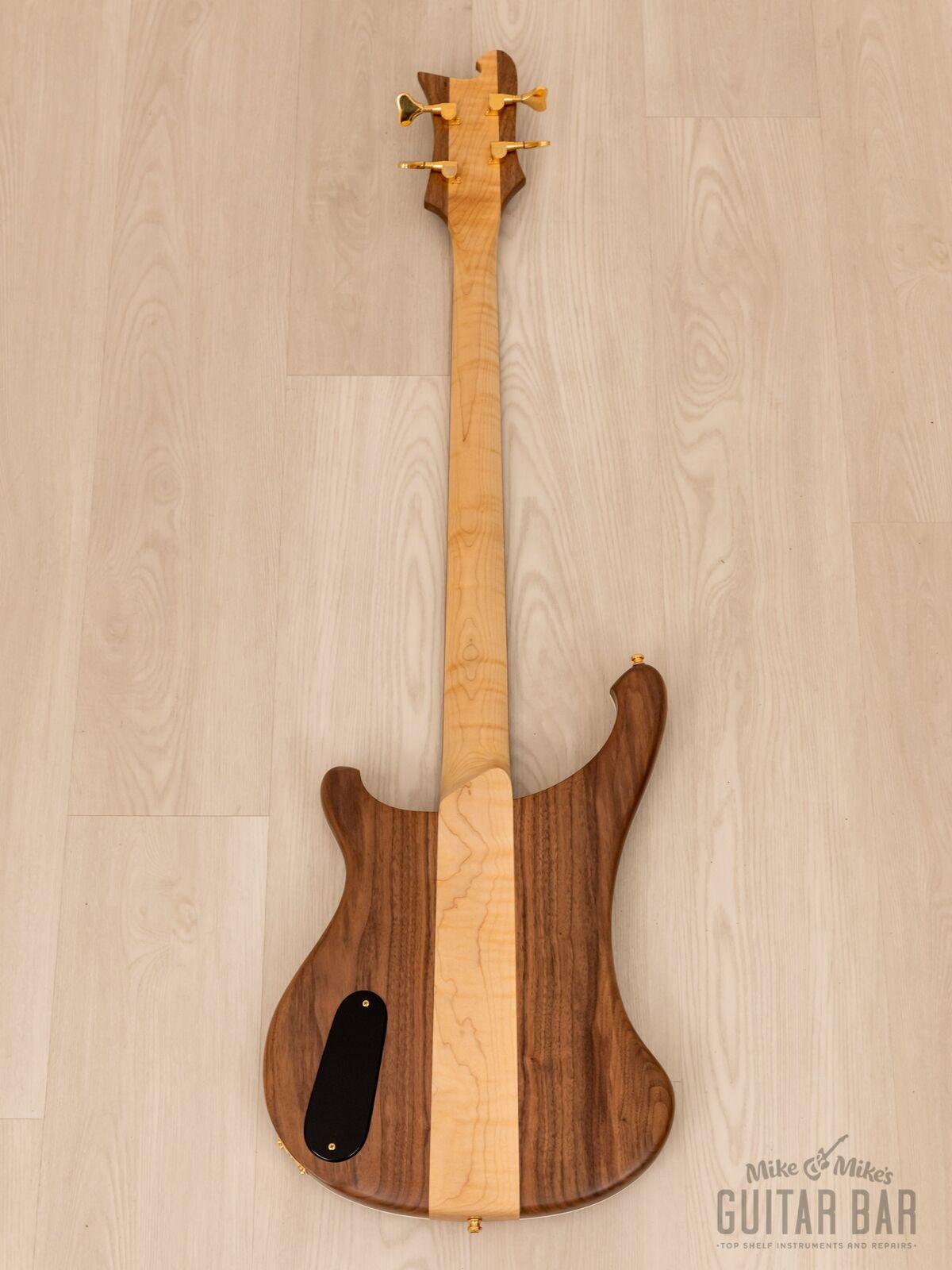
Another advantage to an oil finish is the ability to shave the neck later as needed and then just sand it out and add more oil. Not so easy on a painted finish. I thought about using this sort of "hybrid" heel they did on some (all?) Lemmy 4oo4 LK, but ended up doing a more traditional rounded heel, albeit slightly closer to the body than standard factory 4003. I never was able to make "thumb position" work on an electric, my fingers are too stoopid.

Why would you want to put wood back on yourself?At the end of the day, if it feels right, it IS right. Any change of heart on the heel length would be conveniently subtractive, I haven't mastered the art of putting wood back on myself, but some of these Wood Savants could probably pull it off.
Listen man, it's 2024, stop judging him!Why would you want to put wood back on yourself?
Had a good start on the routing, but then my daughter’s friend who slept over called to let us know he left his boots, so I have to stop for now. Also, even though it is April, we had a bunch of wet heavy snow today. As I was standing by our minivan the weight of the snow snapped the rear wiper off. So that will be my next thing.
But the first routs went well!
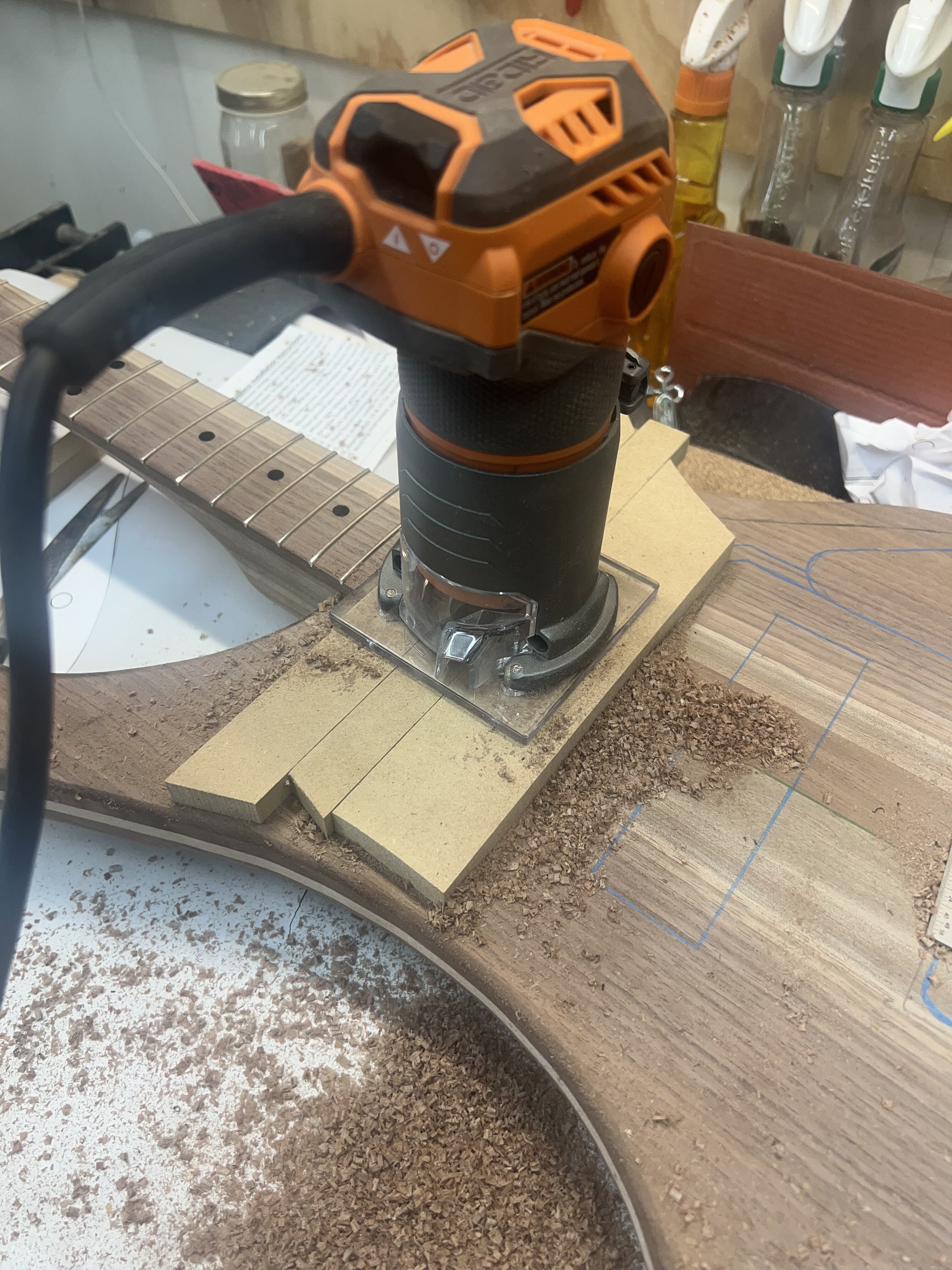
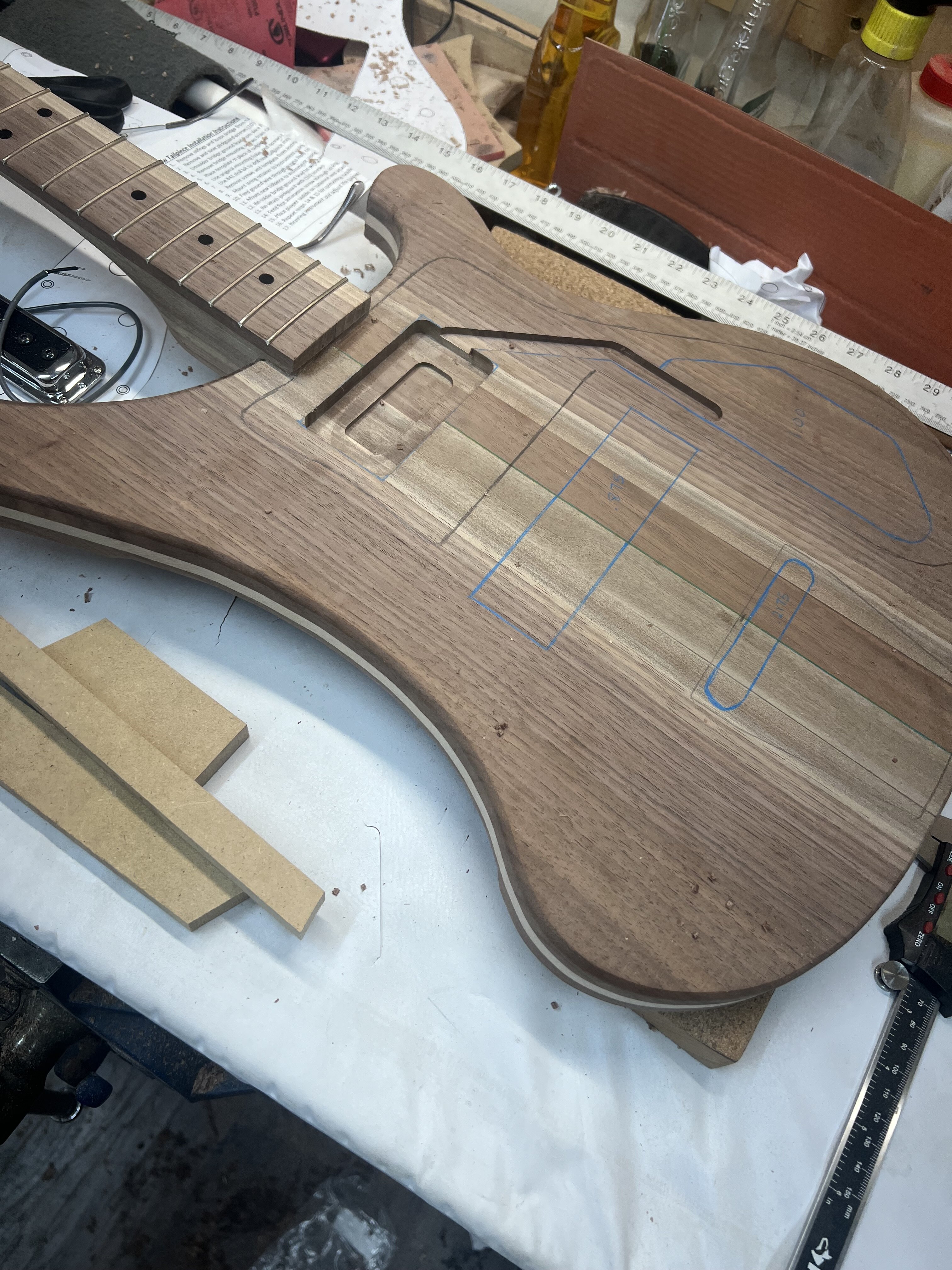
But the first routs went well!
Maybe this never happens to you, but I bet it will now: Diana Ross singing “I’m hoggin’ out” while you hog out a cavity. Cool bass line.
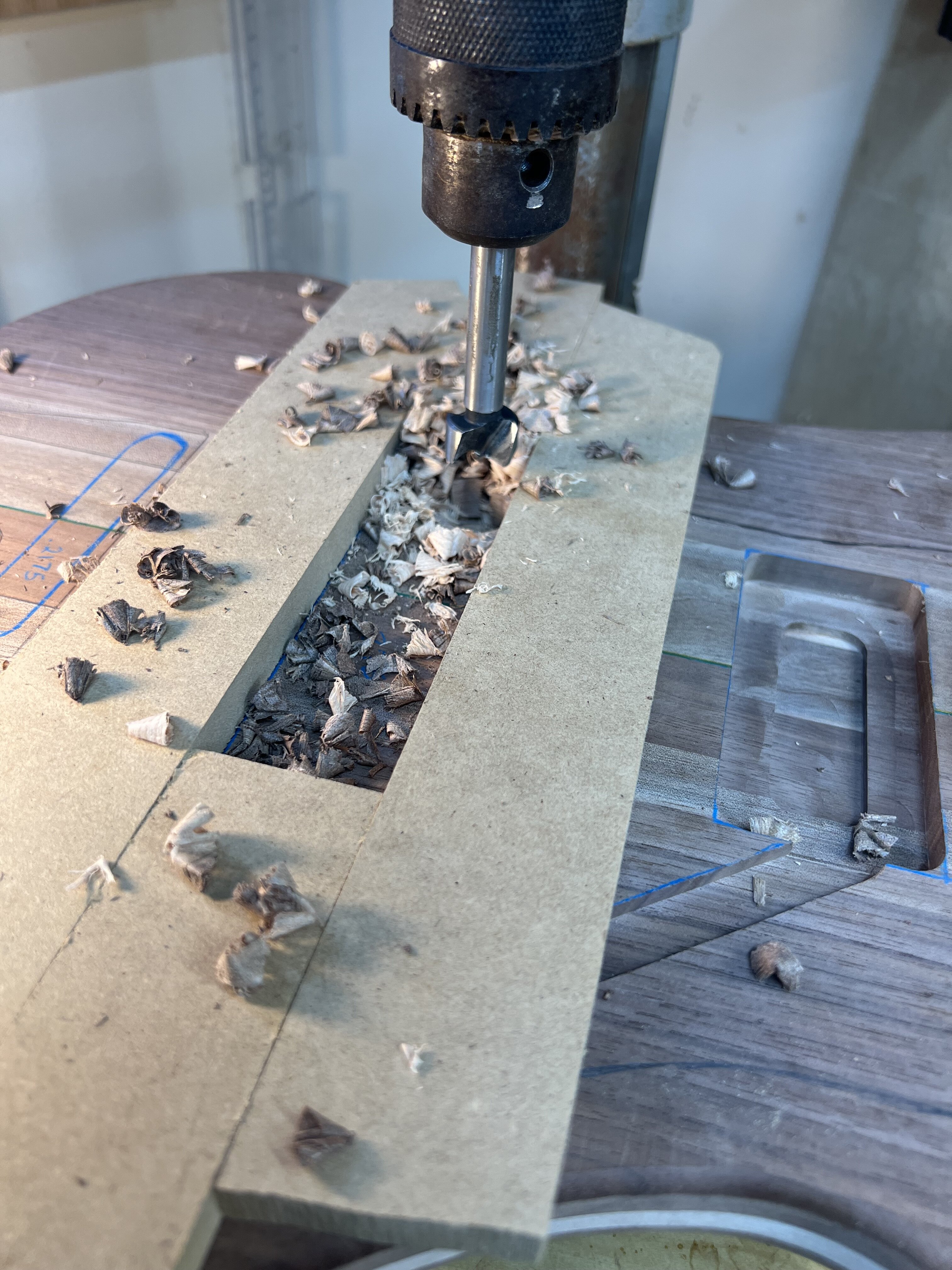
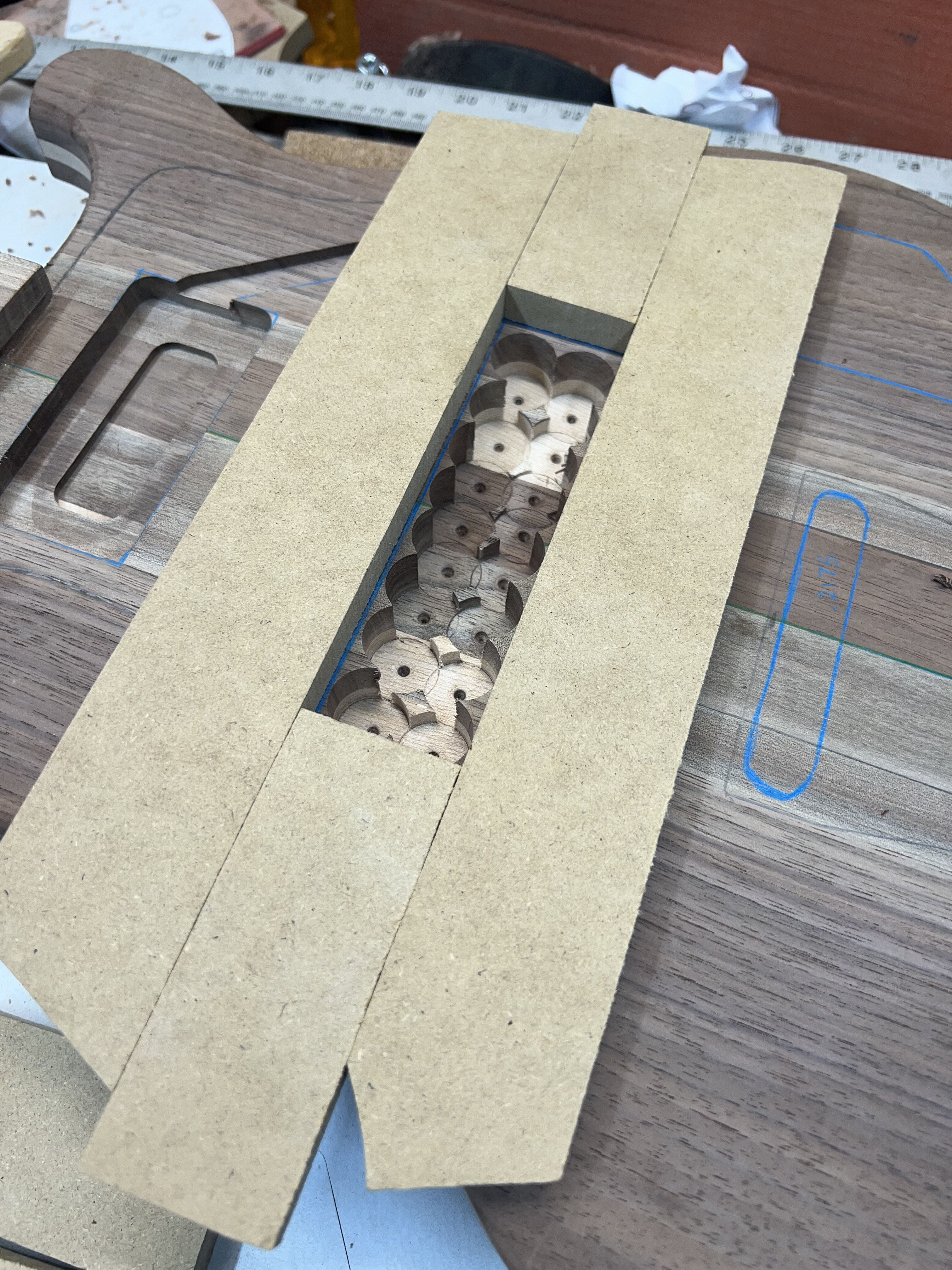
Got all the straight cavities routed, pickups have plenty of room and the bridge seems to be right on, mute and all!
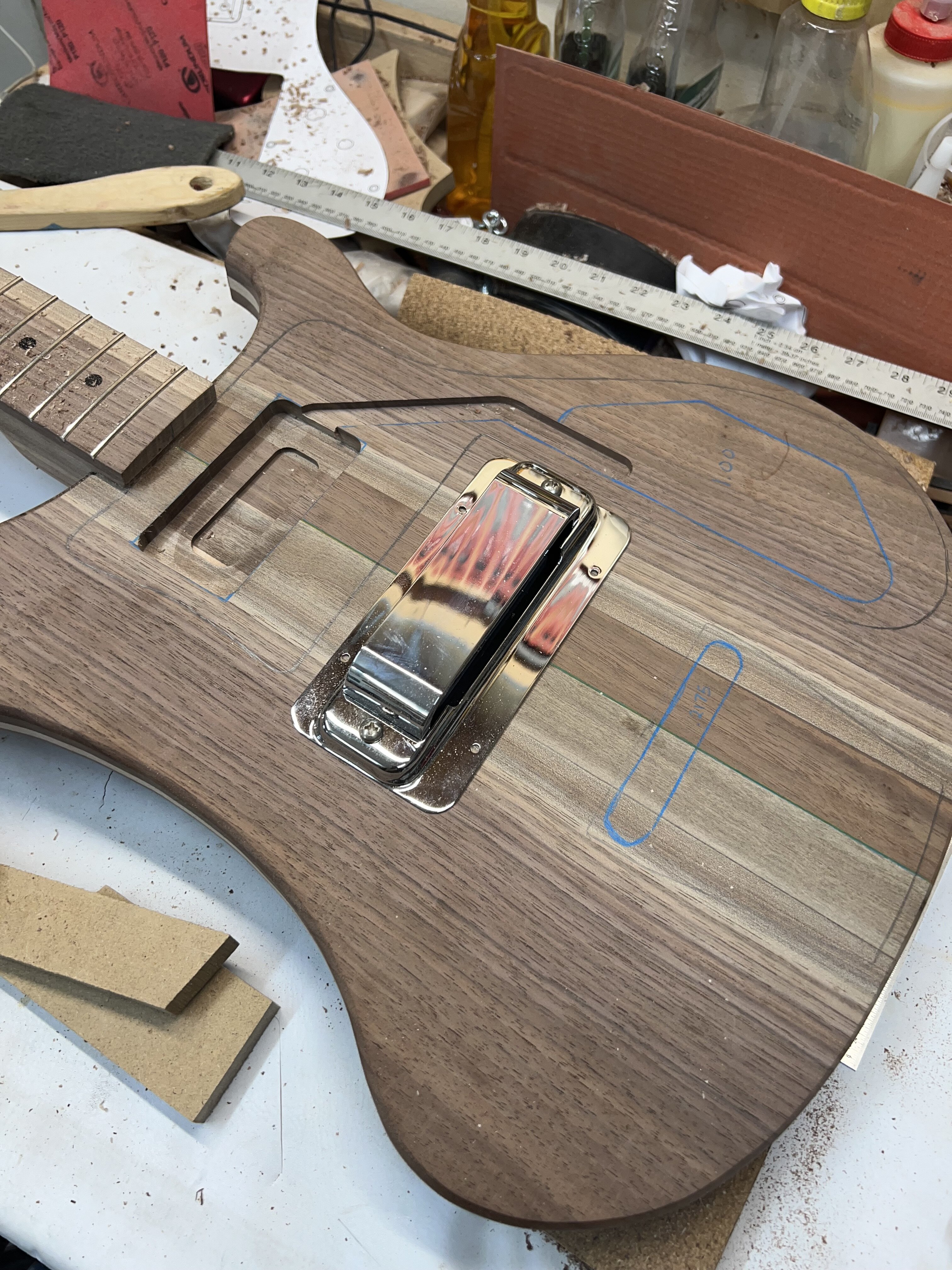
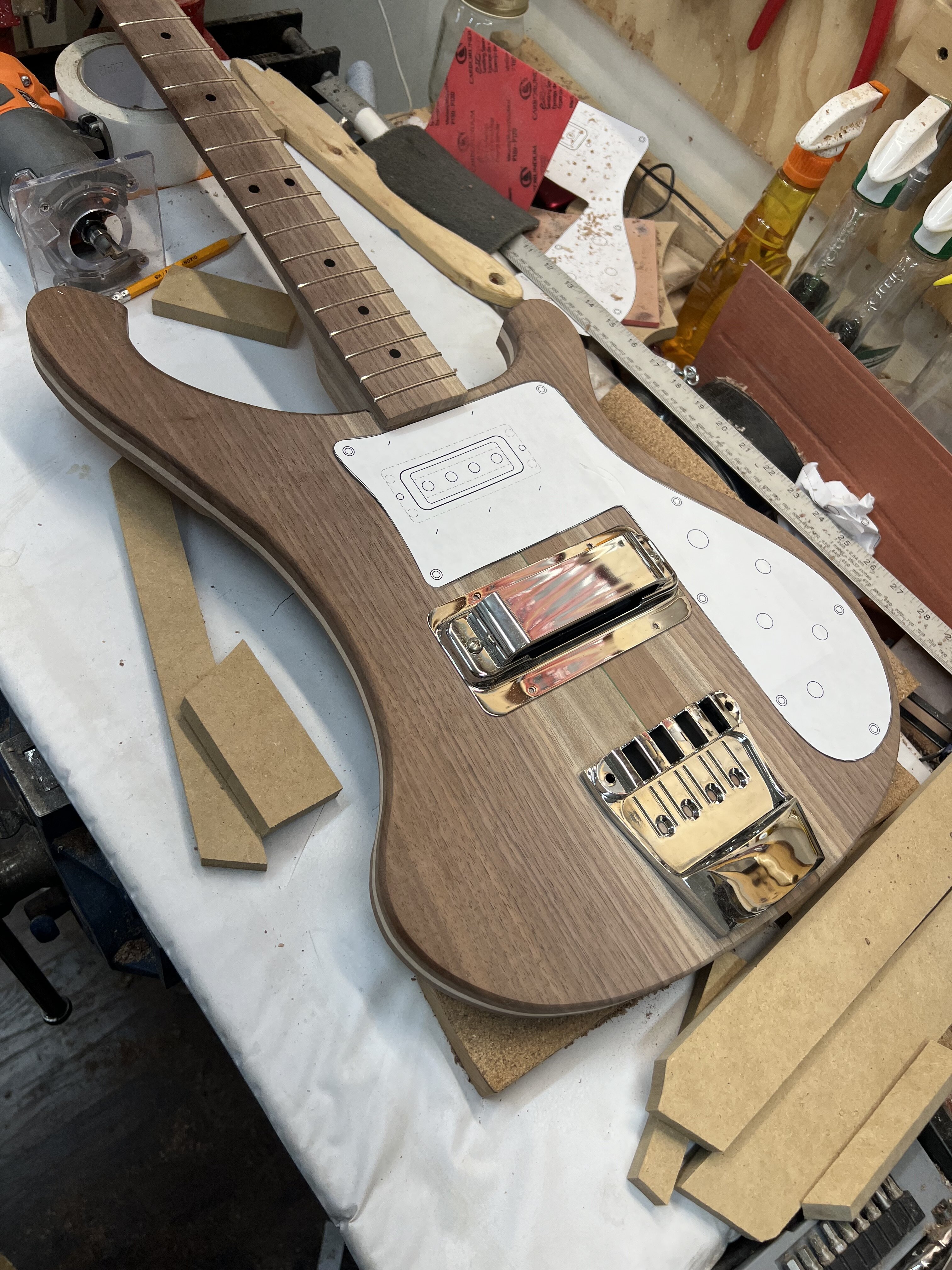
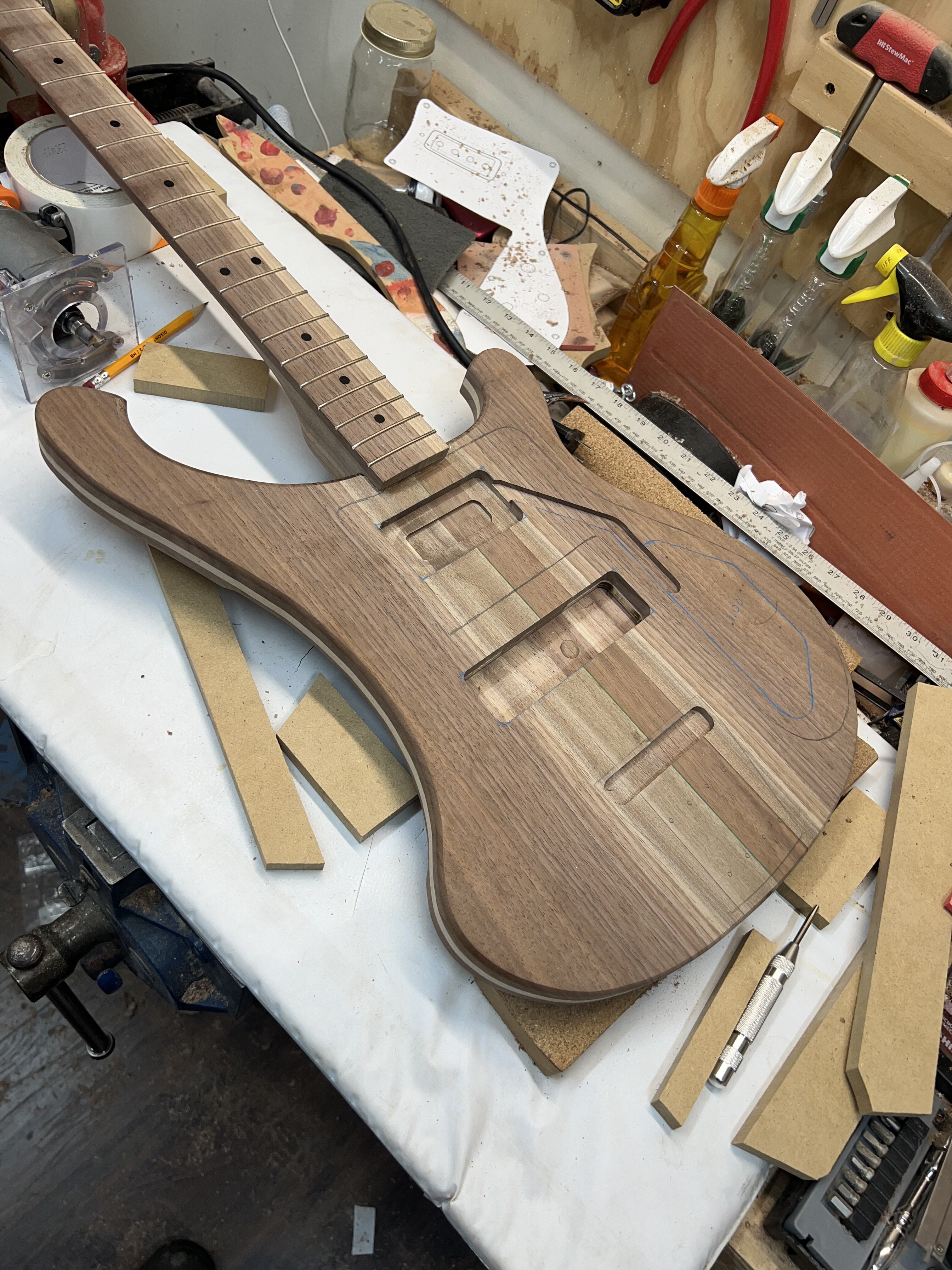
Time to put in some family time, not much left on this before the finishing stuff. I have to make a cavity template, slightly enlarged to go with the slightly enlarged pickguard. Then I can get the tuner holes drilled. Hopefully the rest of my supplies get here before Sunday, might be able to string this thing up and make sure all lines up before the eternal sanding begins.
If I can do that, I can take it to softball practices to sand. All the dads get a kick out of that.
Got all the straight cavities routed, pickups have plenty of room and the bridge seems to be right on, mute and all!
Time to put in some family time, not much left on this before the finishing stuff. I have to make a cavity template, slightly enlarged to go with the slightly enlarged pickguard. Then I can get the tuner holes drilled. Hopefully the rest of my supplies get here before Sunday, might be able to string this thing up and make sure all lines up before the eternal sanding begins.
If I can do that, I can take it to softball practices to sand. All the dads get a kick out of that.
- Apr 18, 2008
- 16,011
- 1
- 31,711
- Disclosures
- I'm highly opinionated and extremely self-assured
When I made the EB3L I couldn’t believe the size of the mudbucker rout, how that thing holds defies logic.Nice. I love that you left the neck pickup route quite shallow.

Kind of makes me wonder if anyone has tried indexing a neck at common frets like 5, 7, 9, and 12 to help facilitate fretboard accuracy using more tactile and less visual function. At the very least it would help perfect the uncomfortable guitar salesman stare while the ‘test an axe for you’.
How about a form of braille dots on the back of the neck? Would give a tactile register point.
I can't remember who it was, but I once read about a big name upright bass player who drove finishing nails into the back of his neck and left them just over flush as a tactile reference.


