• TalkBass has been independent since 1998. Add your voice.
    Create a free account to reply to discussions, view embedded media, and browse with fewer display ads.
    Join freeLog in
    Want zero display ads or expanded classifieds tools? Compare plans.

Harrison inspired 4001 ric build

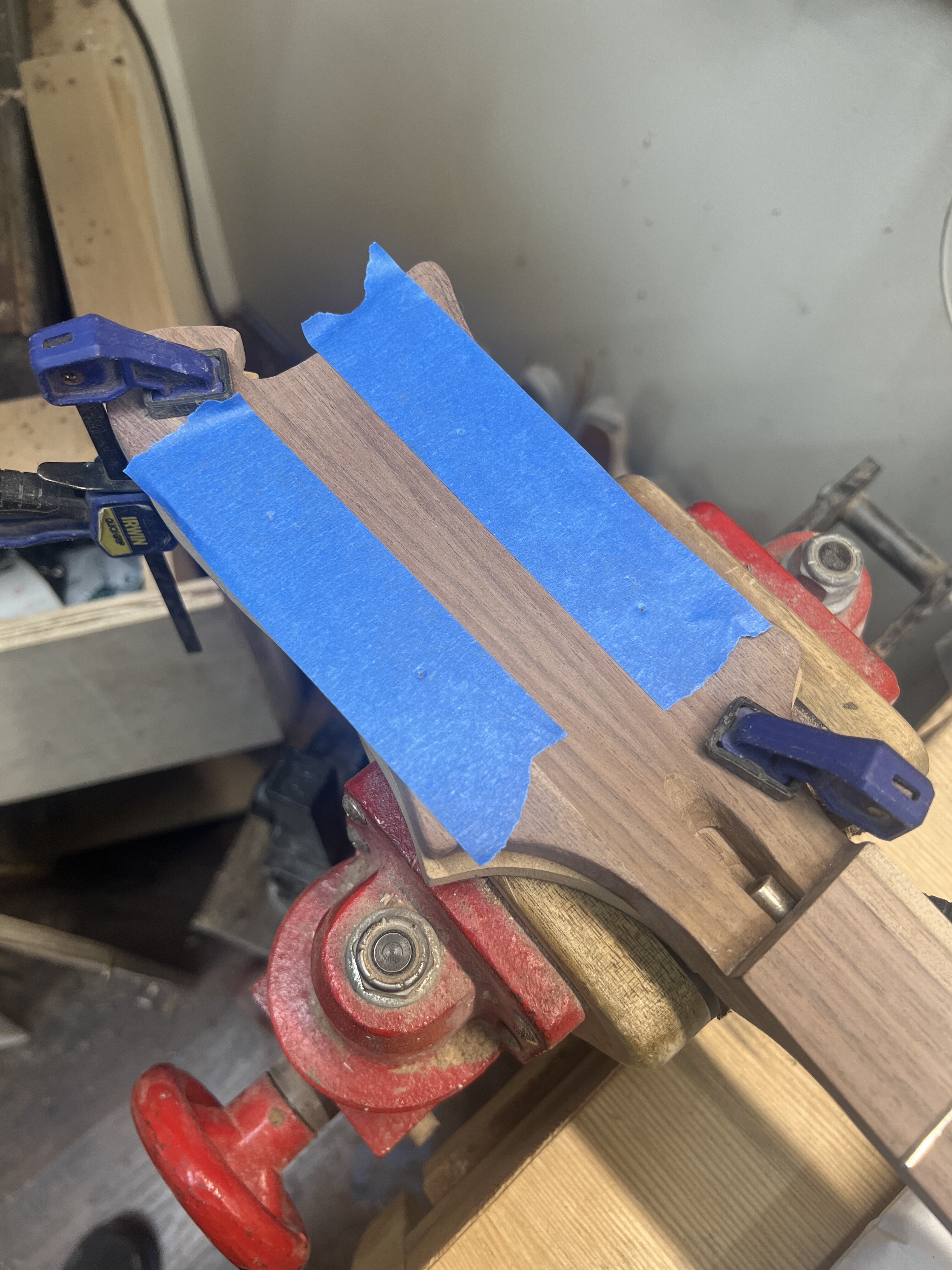
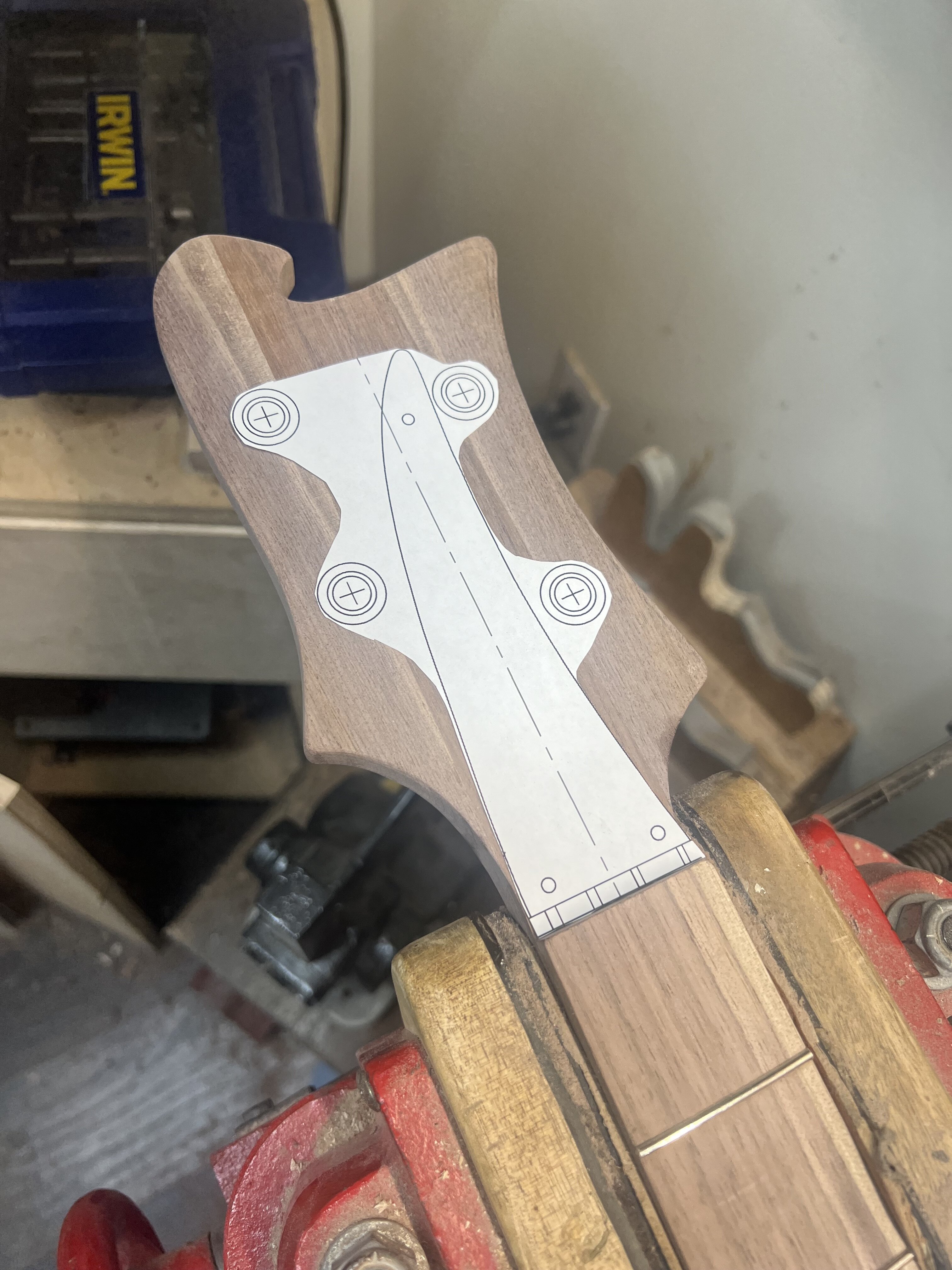
While I am waiting for my templates to dry I took care of the tuner holes. I read a tip about running the forstner bit backwards to sever the wood fibers on the top before proceeding with the drilling, and it was a very clean hole with no issues.
IMG_9693.jpeg
IMG_9694.jpeg
IMG_9695.jpeg
IMG_9696.jpeg
IMG_9697.jpeg
IMG_9698.jpeg


I like the functionality of the ultralite tuners but always thought they looked funny on the back.
 
Last edited:
Might have to borrow that forstner trick. I drill right through with a small twist drill and go in half way with a forstner from each side, using the small pilot hole to center the bit, so it doesn’t blow out coming through. They gotta be sharp too, I found out the hard way that a dull forstner bit will wander!
 
  • Like
Reactions: Lo-E and Verner
Whenever I rout a deep cavity, it always brings me back to the first guitar I ever made. It was a tele style, and I didn’t do much in the way of research. I took my big router, non-plunge, and drove the bit down to full depth. I then proceeded to clear the cavity at full depth thinking “routers aren’t very good at their job, it’s really struggling to get through this”.

How I survived with all fingers is a mystery..
 
I keep forgetting to update my Ric drawing to show the right hand side (as seen in your photo) of the control cavity, extending it a little farther out towards the body edge, so the input jack(s) and wiring don't have so far to travel. It may be fine as-is, might as well drill your jack hole(s) and see how it looks. You can always expand the cavity route later if needed, as long as it's still covered by the pickguard. Are you going mono, or ROS? Routes looks super clean and precise, nice job of it. Your wire route looks a little shallow, but see if the pup wires will lay flat in it, might be fine as is.
 
I keep forgetting to update my Ric drawing to show the right hand side (as seen in your photo) of the control cavity, extending it a little farther out towards the body edge, so the input jack(s) and wiring don't have so far to travel. It may be fine as-is, might as well drill your jack hole(s) and see how it looks. You can always expand the cavity route later if needed, as long as it's still covered by the pickguard. Are you going mono, or ROS? Routes looks super clean and precise, nice job of it. Your wire route looks a little shallow, but see if the pup wires will lay flat in it, might be fine as is.
ROS all the way! The wiring looks intimidating to be honest, but I can’t wait to try it out.

Yeah, I tried to keep it shallow, seems like the wire has 1/16” to spare, and I’ll probably carve a bit of a ramp at either end so the wire doesn’t ride the sharp end.

I have to re-pursue your builds and other 4003 builds, did you use a 7/8” forstner for the dual outputs? Thats what I used for my EB3L, which also has that thin 1 1/4” body. Doesn’t leave room for error!

If I remember correctly, I drilled in long enough for the jack, and finished it with a smaller bit to the cavity for the wires.
 
I'd think hard about going with a single stereo jack and an adapter harness when you actually want both outputs...
So you think drilling an extra hole through the majority of an already thin bass side for a feature I will only use twice is a bad idea? That is rational, to be fair.

However, I am trapped, because I already ordered and received my dual-output plate. If I don’t use it I’ll be out like 8$.
 
So you think drilling an extra hole through the majority of an already thin bass side for a feature I will only use twice is a bad idea? That is rational, to be fair.

However, I am trapped, because I already ordered and received my dual-output plate. If I don’t use it I’ll be out like 8$.


Ok… see… the way to solve that problem is to also purchase a factory Rickenbacker then you’ll have the jack plate as a spare for that and won’t have wasted $8. :D:thumbsup:
 
The downside of two outputs so close together is that it weakens the whole jack area. A TB Ric guru @Aceonbass makes custom Ric wiring harnesses that will output mono or stereo through one output jack with a push/pull pot to switch between them. He uses high quality parts and carefully matched pots. I think he charges around $90 last time I checked, might be worth PM'img him. Kinda wish I'd bought one off him. I had a hard time finding a double jack plate, and Ric charges something ridiculous for them. Another source is Winfield Vintage, also expensive. The cheaper one I used has the Jack's spaced closer together than Ric OEM, so it's more like two overlapping holes than two separate ones. I worry long term if my ROS bass takes a bad hit right over the jack holes, it might break. It also leaves the two Jack's pretty tight together, so they have to be at just the right rotation or they touch and short out. 7/8" forstner sounds right offhand, particularly for the stereo jack.

Edit: whoops, if you already have the double jack plate, might as well use it. ROS is pretty epic, and more practical in the age of lightweight Class D amps, but most people with stereo Rics never use it.
 
Last edited:
  • Like
Reactions: Aceonbass
Th downside of two outputs so close together is that it weakens the whole jack area. A TB Ric guru @Aceonbass makes custom Ric wiring harnesses that will output mono or stereo through one output jack with a push/pull pot to switch between them. He uses high quality parts and carefully matched pots. I think he charges around $90 last time I checked, might be worth PM'img him. Kinda wish I'd bought one off him. I had a hard time finding a double jack plate, and Ric charges something ridiculous for them. Another source is Winfield Vintage, also expensive. The cheaper one I used has the Jack's spaced closer together than Ric OEM, so it's more like two overlapping holes than two separate ones. I worry long term if my ROS bass takes a bad hit right over the jack holes, it might break. It also leaves the two Jack's pretty tight together, so they have to be at just the right rotation or they touch and short out. 7/8" forstner sounds right offhand, particularly for the stereo jack.
That’s interesting, thanks for the insight! I have a few scraps from the body wings, I think I will try it out on the scraps and see how it goes there first.
 
Looking forward toward drilling the jack holes, the non-spec double jack plate I picked up is quite a bit shorter than the spec plate. If I were to use it the giant forstner hole would converge in the body, and who knows how that would go. It also wouldn’t leave much wood between the jacks on the body edge, and I probably want that column of support.

There is no way I am paying $50+ for a stock plate, as cool as it looks.

So one thing I do have is lots of is
sheet steel (rebuilding a ‘64 beetle, very long term project). So I figure I can use materials at hand and just fabricate my own plate. I don’t have the ability to stamp the recesses, but I can live with that.
IMG_9704.jpeg
IMG_9705.jpeg
IMG_9707.jpeg
IMG_9708.jpeg
IMG_9709.jpeg
IMG_9710.jpeg
IMG_9711.jpeg
IMG_9712.jpeg
IMG_9714.jpeg
IMG_9715.jpeg
IMG_9716.jpeg


Very happy with how it came out! I’ll polish it up a bit more later, have to tend to domestic duties.

Man, this little part of the project made a big mess..

*edit

@Gilmourisgod basically said everything I said at the beginning first, should have cited that!
 
Last edited:
Cool! I wonder if you could stamp the recesses by drilling a large forstner hole, centering the piece over it, putting the right size socket over the piece and whack it with a sledge? :D Where there's a will, there's a way.
I may try that on some scrap, but I don’t think it would work without support across the curve, so it would need some sort of fixture to hold the shape. Also, the steel I used is quite a bit thicker (1/16”) than the stock plate. Don’t know if I can do that without some sort of hydraulic press.

I do have some bottle jacks.. Hmm…
 
  • Like
Reactions: Beej
I may try that on some scrap, but I don’t think it would work without support across the curve, so it would need some sort of fixture to hold the shape. Also, the steel I used is quite a bit thicker (1/16”) than the stock plate. Don’t know if I can do that without some sort of hydraulic press.

I do have some bottle jacks.. Hmm…
What about a form underneath, like your existing radius block, with a forstner bit depression, and a hole all the way through. You could stick a bolt through with appropriately sized washer, and tighten it to stretch the dimple into the plate?
 
  • Like
Reactions: Beej and Verner
What about a form underneath, like your existing radius block, with a forstner bit depression, and a hole all the way through. You could stick a bolt through with appropriately sized washer, and tighten it to stretch the dimple into the plate?
That’s a cool idea as well, makes me wonder about the manufacturing process. Like, if the holes are already drilled, would the metal tend to deform or break along that stress point? I don’t know a ton about metalworking.