

Enjoy the benefits of a premium membership!
Upgrade Account
-
TalkBass has been independent since 1998. Add your voice.
Create a free account to reply to discussions, view embedded media, and browse with fewer display ads.
Join free Log in
Want zero display ads or expanded classifieds tools? Compare plans.
You are using an out of date browser. It may not display this or other websites correctly.
You should upgrade or use an alternative browser.
You should upgrade or use an alternative browser.
Has anyone here abandoned their 5 string basses totally for 4 strings?
- Thread starter HalfManHalfBass
- Start date
More options
Who Replied?Glad you asked, and refreshing to read all the posts! I have a good Spector Euro 5. For some reason I felt if I did not get one at some pointing was missing out. Lol nothing could be further from the truth. I "like" it but the four string feels so much better for me! To me the five feels like I am playing a much larger and awkward instrument. Then I scratch my head and play one of my sweet feeling fours and set the five down again. To each their own. I will probably keep the five justso I don't Jones for one, but doubt I will ever love one like I do my fours! Thanks again for the thread.

Yep! I sold everything except a four string fretted and a 4 string fretless. I lasted all of 6 months before I sold them for 5 strings versions of both!
I found out that I am definitely a 5 string player, but I recommend doing what feels good to you!
...you can always add a d-tuner to get the extended range!
I found out that I am definitely a 5 string player, but I recommend doing what feels good to you!
...you can always add a d-tuner to get the extended range!

I switched over to 5 bangers ~10 years ago. I'm a bit of a pattern player and find the addt'l positioning options beneficial. I've also spent a lot of time finding the right equipment which complements the extended scale concept.
Riis
Riis

I switched over to 5 bangers ~10 years ago. I'm a bit of a pattern player and find the addt'l positioning options beneficial. I've also spent a lot of time finding the right equipment which complements the extended scale concept.
Riis
I think there's a lot of truth to the equipment component of the extended range. It took me a lot of trial and error. To be honest, the local 5-6 string basses I had tried in the 90's had very modest low Bs. Until I got my first Cirrus 5, I had no interest whatsoever in a bass with a low B. It probably didn't help that basses with a weak B were also being tuned to dropped A!


Quite the contrary... 
For years and years, I resisted moving on up to the five-string. Whenever I tried one out, I could never get used to the feel or tone of the "B" string. I could never seem to control it adequately, and the "B" was so low that it hardly seemed to have any tonality. (This problem is 10 times more severe with a low F# string, IMO. But I won't go there. For now... )
)
However...
Much more recently, I have found myself craving lower notes than a standard four-string can provide. And using an extender device on the "E" string is an incomplete solution, at best, so far as I'm concerned. More to the point, the kind of music to which I'm gradually evolving really calls for deeper notes, more low end in general, and plenty of it.
Enter my new five-string bass guitars - all five of them, for now. Yes, I've gone all in on fivers, and am determined to make them work for me. But I'm retaining both of my four-string bass guitars as well, and may well pick up a few more of those in time.
MM
For years and years, I resisted moving on up to the five-string. Whenever I tried one out, I could never get used to the feel or tone of the "B" string. I could never seem to control it adequately, and the "B" was so low that it hardly seemed to have any tonality. (This problem is 10 times more severe with a low F# string, IMO. But I won't go there. For now...
)However...
Much more recently, I have found myself craving lower notes than a standard four-string can provide. And using an extender device on the "E" string is an incomplete solution, at best, so far as I'm concerned. More to the point, the kind of music to which I'm gradually evolving really calls for deeper notes, more low end in general, and plenty of it.
Enter my new five-string bass guitars - all five of them, for now. Yes, I've gone all in on fivers, and am determined to make them work for me. But I'm retaining both of my four-string bass guitars as well, and may well pick up a few more of those in time.
MM
If you want to know where the fashion of bass is headed, don't ask a bass player -- ask someone who plays with bass players.
15 years ago, you couldn't do a session without being asked if you played 5 string. Today, more and more guys are saying THANK GOD, you play a FOUR string!
And of course, this was making the rounds for a while and still holds true.
Ode To The Five String Bass
by Nelson Montana
(My apologies in advance to my 5 string loving brothers)
There once was a time, when 4 strings were fine, and an E was as low as you’d go.
But the desire to go deeper, turned out to be a “keeper” and they added a B – as you know.
I too joined the crowd, the mantra was so loud “The five is the one that will last.”
But after many a gig, trying vainly to go big, my love of the B was soon past.
The notes didn’t speak with the clarity that I‘d seek. And I found that I’d use it less and less.
It just got in the way, I keep thinking an E was an A, Till finally asking… is this for the best?
It wasn’t for James or Jaco or Chris. Victor Wooton and Steve Harris never fell.
Jeff Berlin said “Nay” and hoped it’d just go away and Sir Paul would eschew it as well.
The Ox took a stand, amid the demands – an did John Paul Jones and Flea.
Rocco didn’t veer and Sting just sneered -- unimpressed -- as was Pino and Lee
Claypool went back, and accepted the fact -- it was good enough for Bootsy and Clarke
As did Osborne and Kaye, heading the way, and forever making their mark.
Then again, there was Anthony, who played mighty fancifully -- with even more strings than six!
Yet there are those, who still propose...he should stick to a four and a pick.
Of course there’s a case, within the right space, to add some well placed low “D’s”
But these days if that’s needed, I’ve finally conceded – I’ll just play it on the god damn keys!
15 years ago, you couldn't do a session without being asked if you played 5 string. Today, more and more guys are saying THANK GOD, you play a FOUR string!
And of course, this was making the rounds for a while and still holds true.
Ode To The Five String Bass
by Nelson Montana
(My apologies in advance to my 5 string loving brothers)
There once was a time, when 4 strings were fine, and an E was as low as you’d go.
But the desire to go deeper, turned out to be a “keeper” and they added a B – as you know.
I too joined the crowd, the mantra was so loud “The five is the one that will last.”
But after many a gig, trying vainly to go big, my love of the B was soon past.
The notes didn’t speak with the clarity that I‘d seek. And I found that I’d use it less and less.
It just got in the way, I keep thinking an E was an A, Till finally asking… is this for the best?
It wasn’t for James or Jaco or Chris. Victor Wooton and Steve Harris never fell.
Jeff Berlin said “Nay” and hoped it’d just go away and Sir Paul would eschew it as well.
The Ox took a stand, amid the demands – an did John Paul Jones and Flea.
Rocco didn’t veer and Sting just sneered -- unimpressed -- as was Pino and Lee
Claypool went back, and accepted the fact -- it was good enough for Bootsy and Clarke
As did Osborne and Kaye, heading the way, and forever making their mark.
Then again, there was Anthony, who played mighty fancifully -- with even more strings than six!
Yet there are those, who still propose...he should stick to a four and a pick.
Of course there’s a case, within the right space, to add some well placed low “D’s”
But these days if that’s needed, I’ve finally conceded – I’ll just play it on the god damn keys!

I actually started on a 5er, then went to 6. Then I went to 4 for about a year. Now I've been a 5 string guy for about the last 5 years. My biggest gripe when I started playing was that my low B sounded floppy and farty sounding. When I bought a Tobias 5 years ago I was finally happy with my low B. i bought a callowhill junk5 last year and now I am in low B paradise. What gear I had certainly played into how much I enjoyed playing a five string.
snip
Ignorance is bliss, I guess. That was a pretty stupid POV, gotta say.
Guess it's a good thing I get to decide what I play.
I've owned a couple 5's in the 12 years I've been playing. The main reason I left it was it felt like I had to EQ everything around the B string, usually to the detriment of of the other strings. Also I found the B just wasn't needed for most of the music I like/play.
Then again my opinion probably doesn't mean much because I've been a bedroom bassist for the last 6-7 years.

Then again my opinion probably doesn't mean much because I've been a bedroom bassist for the last 6-7 years.
I think there's a lot of truth to the equipment component of the extended range. It took me a lot of trial and error. To be honest, the local 5-6 string basses I had tried in the 90's had very modest low Bs. Until I got my first Cirrus 5, I had no interest whatsoever in a bass with a low B. It probably didn't help that basses with a weak B were also being tuned to dropped A!
Yep. Then you add into it companies like Circle K who specifically design and make strings to get you much better pitch and accurate notation on those low-low notes, it's win/win for everyone who wants something better than an open low E.

Yep. Then you add into it companies like Circle K who specifically design and make strings to get you much better pitch and accurate notation on those low-low notes, it's win/win for everyone who wants something better than an open low E.
String manufacturers and luthiers have come a long way. I used to swear that 35" scale was THE solution, but my 32" scale Cliff Bordwell has a great B and custom length strings from Curt Mangan.
String manufacturers and luthiers have come a long way. I used to swear that 35" scale was THE solution, but my 32" scale Cliff Bordwell has a great B and custom length strings from Curt Mangan.
Exactly. Used to be, scale length was really one of the only ways to get a more taut B and therefore obtain better pitch/definition. Nowadays, with some CK's my 34" NS-5 hangs with just about anything.
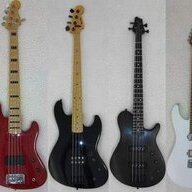
Thanks for all the comments and advice guys-you rule!
Usually my threads sink without trace but this one seems to have created some genuine debate!
Personally, I'm now heading towards the decision to sell my last 5 string and to see that many other people have been in similar situations is very reassuring.
With regards to Victor having a few 5s, I'm pretty sure at least one is tuned with a high 'C' and I also remember reading that he said he feels more comfortable on 4s. But I'm not bashing the 5 string here or arguing what is better:
I'm just asking how useful it truly is if you are a bass player in my position where you can't afford to justify having one around for a 'just in case' scenario.
I'm genuinely interested in people's opinions and findings, let's please not degenerate this into a slagging of extended range instruments and 'Jaco only had 4 strings' rantings!
Usually my threads sink without trace but this one seems to have created some genuine debate!
Personally, I'm now heading towards the decision to sell my last 5 string and to see that many other people have been in similar situations is very reassuring.
With regards to Victor having a few 5s, I'm pretty sure at least one is tuned with a high 'C' and I also remember reading that he said he feels more comfortable on 4s. But I'm not bashing the 5 string here or arguing what is better:
I'm just asking how useful it truly is if you are a bass player in my position where you can't afford to justify having one around for a 'just in case' scenario.
I'm genuinely interested in people's opinions and findings, let's please not degenerate this into a slagging of extended range instruments and 'Jaco only had 4 strings' rantings!

Until very recently I've played only fives, but a few months ago I finally bought my first four. I did that for a few reasons. First, a four is still more or less the "standard" in basses, so I thought that a four is something I should just get comfortable playing. But more importantly, I felt like I could use it as a learning experience. By having fewer position options, I thought I'd have to think differently about what I'm playing, think farther ahead to get me to a position where I could play an upcoming part with the notes I needed, force me to think about ascending where I might have previously descended, etc. So far, I think that's been a good exercise, especially with songs I already know how to play. By playing them on a four, I'm going to different points on the neck and thinking more about the notes rather than just playing patterns from memory. My instructor, a five and six string player, thought that was such a good idea he decided to also buy a four and he's doing the same thing.
I don't see myself completely abandoning fives, in fact I think I still prefer them. However, I'm liking this four string I bought because of what it's doing for my playing. It's fun to try something new and see what you can learn from it. And I'm actually thinking of selling one of my fives to get another four.
I don't see myself completely abandoning fives, in fact I think I still prefer them. However, I'm liking this four string I bought because of what it's doing for my playing. It's fun to try something new and see what you can learn from it. And I'm actually thinking of selling one of my fives to get another four.
I don't get why you think you have to "adjust" your playing or alleged "style" on a 5 between the two. You realize the B doesn't make noise unless you actually play/pluck/hit it, yes...? The other 4 strings are the same. I don't play 100% of my notes on the B, FWIW.
Thanks for all the comments and advice guys-you rule!
Usually my threads sink without trace but this one seems to have created some genuine debate!
Personally, I'm now heading towards the decision to sell my last 5 string and to see that many other people have been in similar situations is very reassuring.
With regards to Victor having a few 5s, I'm pretty sure at least one is tuned with a high 'C' and I also remember reading that he said he feels more comfortable on 4s. But I'm not bashing the 5 string here or arguing what is better:
I'm just asking how useful it truly is if you are a bass player in my position where you can't afford to justify having one around for a 'just in case' scenario.
I'm genuinely interested in people's opinions and findings, let's please not degenerate this into a slagging of extended range instruments and 'Jaco only had 4 strings' rantings!
Victor has a "few" really nice basses. I've heard a few songs where I can distinctly hear a 5 string like Big Country.
We must keep in mind that many of these players spent more time than you or I learning and practicing. At that particular time, they probably didn't have the luxury of trying/owing many basses with more than 4 string. I'd like to think Jaco might have embraced a fretless 6, but he died before there were many great 6ers he could try.
Ignorance is bliss, I guess. That was a pretty stupid POV, gotta say.
Guess it's a good thing I get to decide what I play.[/QUote
It's interesting because usually, thinking a POV is stupid simply for disagreeing with it (without offering any reasoning) is the epitome of ignorance. Go figure.

I don't get why you think you have to "adjust" your playing or alleged "style" on a 5 between the two. You realize the B doesn't make noise unless you actually play/pluck/hit it, yes...? The other 4 strings are the same. I don't play 100% of my notes on the B, FWIW.
It does make a noise - unless you mute it. Hence the change in technique sometimes required.


