Do lot under estimate the effect of acoustics!
The DI sound of a live guitar or bass, on stage, will be quite different if there is loud backline on stage, than if you go IEM! A large, loud backline will couple acoustically with the instrument, so that the "growl", liveliness and sustain increases.
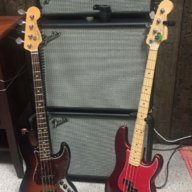
On a good sounding stage, and in loud rock (not extremely so!), my Precision will get much more sustain in the lowest notes, and that is through a single Ampeg SVT-410HLF with a 900W amp. Playing in the higher register, the D and G string will sound (and record!) beefier and with more tonal "texture". In the same way, my Danelectro Longhorn will go from "thump machine" to "regular Precision decay".
I think the prevalence of IEM and modelling can be one reason much new metal sounds a bit "dry and clinical", actually very far from the "sweat and aggression" in older types of hard rock. In some cases, it might be a deliberate decision, but maybe not always.
The DI sound of a live guitar or bass, on stage, will be quite different if there is loud backline on stage, than if you go IEM! A large, loud backline will couple acoustically with the instrument, so that the "growl", liveliness and sustain increases.
On a good sounding stage, and in loud rock (not extremely so!), my Precision will get much more sustain in the lowest notes, and that is through a single Ampeg SVT-410HLF with a 900W amp. Playing in the higher register, the D and G string will sound (and record!) beefier and with more tonal "texture". In the same way, my Danelectro Longhorn will go from "thump machine" to "regular Precision decay".
I think the prevalence of IEM and modelling can be one reason much new metal sounds a bit "dry and clinical", actually very far from the "sweat and aggression" in older types of hard rock. In some cases, it might be a deliberate decision, but maybe not always.