
Those are all sold listings.Of course, those Reverb prices are of the “asking, but not getting” variety....

Enjoy the benefits of a premium membership!
Upgrade Account
-
TalkBass has been independent since 1998. Add your voice.
Create a free account to reply to discussions, view embedded media, and browse with fewer display ads.
Join free Log in
Want zero display ads or expanded classifieds tools? Compare plans.
You are using an out of date browser. It may not display this or other websites correctly.
You should upgrade or use an alternative browser.
You should upgrade or use an alternative browser.
Help me with this Rickenbacker
- Thread starter Komadinic
- Start date
More options
Who Replied?

If you were successful in putting more relief in one side of the neck than the other, the neck would eventually twist.
Have you seen a lot of twisted RIC necks?
A while back I called GC about a Walnut 4004. I really want one of those, they're lighter then the rest.
Well, luckily the salesperson who took the call was honest & told me the neck was twisted.
Except that it doesn’t actually work. What you end up with is a neck where the bulk of the load is carried by one rod while the other is doing little to nothing. If you were successful in putting more relief in one side of the neck than the other, the neck would eventually twist.
Think of it this way. On a typical bass there is usually more tension on the G and D strings than the E and A. Yet where you see uneven relief it’s just as often that there’s less on the G string side than the E string side.
That was always my experience with my rickenbackers. My 4003s I played for some years until I put a new set of strings on it. They were heavier and I noticed the action got a little stiff in the middle of the board after tuning to pitch. So I went in to tighten the rods; one of them was completely loose. Up to that time only one of the rods was doing all the "holding". I worked with it a while until I had the relief back to where it was, with both rods under equal tension.
The neck/fingerboard was fine before and after, and I never would have known one rod was basically "shut off" inside the neck.
I even played with it a little bit on my 4001, as the idea of asymmetric tightening to get rid of a neck twist was around even then (mid 80's). But there was no detectable effect of changing their relative tightness at all that I could observe.
So I've always tightened them equally.
They really do stay in adjustment well, though. My 4003's especially were extremely stable....
L
Something I haven’t seen addressed yet, and needs to be determined is, if this is really an ‘84, what sort of truss rods it has. This is around the time of the changeover from hairpins to compression rods, no? If this bass has hairpin rods, the then OP needs the standard “don’t crank these like a compression rod, they don’t work that way and you can damage your fretboard” warning. And so does whoever his luthier, since to becoming more rare for guitar techs to know about the hairpin rods.

Not my bass in the picture but it looks like this:Something I haven’t seen addressed yet, and needs to be determined is, if this is really an ‘84, what sort of truss rods it has. This is around the time of the changeover from hairpins to compression rods, no? If this bass has hairpin rods, the then OP needs the standard “don’t crank these like a compression rod, they don’t work that way and you can damage your fretboard” warning. And so does whoever his luthier, since to becoming more rare for guitar techs to know about the hairpin rods.
نتيجة بحث Google عن الصور حول https://upload.wikimedia.org/wikipedia/commons/1/16/Rickenbacker_4003_%28SN_9951807%29_Dual_Truss_Rods.jpg
Not my bass in the picture but it looks like this:
نتيجة بحث Google عن الصور حول https://upload.wikimedia.org/wikipedia/commons/1/16/Rickenbacker_4003_%28SN_9951807%29_Dual_Truss_Rods.jpg
Both styles have dual rods and nuts. Does your bass have an aluminum block under the nuts, or does it have a thin steel plate? (I think that’s the visual difference, anyway.) They’re adjusted very differently if the aluminum block.
Aluminum block for sure. I don't know how to adjust it, i played with it but i don't wanna ruin the bass so i gave up. At this point I have to get it to a luthier, it's too valuable to be a guinea pigBoth styles have dual rods and nuts. Does your bass have an aluminum block under the nuts, or does it have a thin steel plate? (I think that’s the visual difference, anyway.) They’re adjusted very differently if the aluminum block.
This is itBoth styles have dual rods and nuts. Does your bass have an aluminum block under the nuts, or does it have a thin steel plate? (I think that’s the visual difference, anyway.) They’re adjusted very differently if the aluminum block.
IMG-20200529-225401
I just wish i knew how to play it properly, i find it attractive as is but I'm not really into bling that muchI'd want the shark fins and binding, but nice score!
This is it
IMG-20200529-225401
Someone will correct me if I’m wrong, but the aluminum block is indicative of the old-style hairpin rods. So-called because, instead of being a solid rod with an anchor at one end and a nut at the other inside a curved channel, these rods are a rod that is folded back on itself. One leg is longer and threaded and has the adjustment nut on it. The other leg is slightly shorter, sharpened a bit, and bears against that aluminum block. The way these rods are adjusted is that you loosen them, move the neck by hand to where you want it, and then tighten the nuts to hold that adjustment. It helps to clamp the body, with appropriate padding, to a table.
What you don’t want to do is to just keep tightening the nut to remove relief, like you would with a regular compression rod. The result in that case would be the short leg of the rod bowing more and more inside the neck channel and possibly forcing the fretboard away from the neck.
Now that you know this, you need to make sure that whoever you get to adjust the action knows it, too. Even back in the day, it wasn’t unusual for an otherwise perfectly competent luthier not to know about Rickenbacker rod differences. These days it’s even more likely that they’re unaware. Always err on the safe side and make sure they know.

My experience with the dual truss rods mirrored what @Turnaround said, it doesn't really work, and if it did, you'd be inducing twist into the neck, a situation most people try to avoid like the plague. No Special Sauce with two rods, just an unnecessarily large chunk of wood removed for two rods and adjuster nuts in the worst possible place, right at the neck/headstock joint. I've been asking new Ric owners who have the new V2 bridge of they have a single rod, so far that looks how it's going. The tides of change move at glacial pace at Ric, but it looks like even they are finally ready to admit that a single modern DA rod is the way to go.
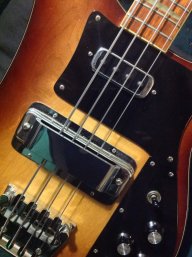
It's possible the OP's bass has the dreaded "negative neck angle" but that usually (but not always) telegraphs as cracks in the finish right around the neck/body joint, not seeing that in the photos, though it does have the notorious "swimming pool" route for the neck pup. Not Rics best engineering decision to hog out way more wood than necessary at a point of maximum stress. Hmmmm..... I sense a theme developing! It's called "bad carpentry". Despite that, most Rics DON'T develop negative neck angle, which says a lot about the rigidity of rock maple. Nice looking bass, I hope a good Luthier can diagnose this and get it playing well. The quickest fix might be filing the saddles down, plenty of extra meat on them, but if the neck is bending at the body joint, that will only be a temporary fix. Hopefully it just needs a complete setup. The solution in the worst case is filling the "swimming pool" with tightly fitted solid maple and then re-routing the minimum practical space for the neck pup, which is about 1/3 smaller than what's there now. That's what they are doing in the newer basses, so far so good.
It's possible the OP's bass has the dreaded "negative neck angle" but that usually (but not always) telegraphs as cracks in the finish right around the neck/body joint, not seeing that in the photos, though it does have the notorious "swimming pool" route for the neck pup. Not Rics best engineering decision to hog out way more wood than necessary at a point of maximum stress. Hmmmm..... I sense a theme developing! It's called "bad carpentry". Despite that, most Rics DON'T develop negative neck angle, which says a lot about the rigidity of rock maple. Nice looking bass, I hope a good Luthier can diagnose this and get it playing well. The quickest fix might be filing the saddles down, plenty of extra meat on them, but if the neck is bending at the body joint, that will only be a temporary fix. Hopefully it just needs a complete setup. The solution in the worst case is filling the "swimming pool" with tightly fitted solid maple and then re-routing the minimum practical space for the neck pup, which is about 1/3 smaller than what's there now. That's what they are doing in the newer basses, so far so good.
I might also mention that many people find the old-style hairpin rods to result in a more stable neck. My ‘83 has them, and after getting it five years ago and adjusting it where I wanted it, I’ve not had to touch it since. It never moves. (My ‘15, with standard compression rods, needs adjustment seasonally.) Some report going decades without needing an adjustment. Unlike most builder’s instruments, too, the rods are removable for repair without having to pull the fretboard off the neck.
I'm a bit scared of doing that for multiple reasons, i emailed 3 luthiers but no one will do it until city reopens which will happen God knows when. I guess ricky and i are stuck for nowSomeone will correct me if I’m wrong, but the aluminum block is indicative of the old-style hairpin rods. So-called because, instead of being a solid rod with an anchor at one end and a nut at the other inside a curved channel, these rods are a rod that is folded back on itself. One leg is longer and threaded and has the adjustment nut on it. The other leg is slightly shorter, sharpened a bit, and bears against that aluminum block. The way these rods are adjusted is that you loosen them, move the neck by hand to where you want it, and then tighten the nuts to hold that adjustment. It helps to clamp the body, with appropriate padding, to a table.
What you don’t want to do is to just keep tightening the nut to remove relief, like you would with a regular compression rod. The result in that case would be the short leg of the rod bowing more and more inside the neck channel and possibly forcing the fretboard away from the neck.
Now that you know this, you need to make sure that whoever you get to adjust the action knows it, too. Even back in the day, it wasn’t unusual for an otherwise perfectly competent luthier not to know about Rickenbacker rod differences. These days it’s even more likely that they’re unaware. Always err on the safe side and make sure they know.
I'll take people at their word on the stability of the hairpin rods, my 78' 4001 had them, and it was no more or less stable than my other single rod basses, still needed seasonal adjustment. The mild steel they used was prone to breakage or bending at the adjusters, Ric must have had some good reasons for abandoning that design. The easily removable rods was indeed a handy feature, particularly since people had a habit of breaking them by inept tightening attempts. That's one downside to all the DA rod designs I've seen, they have a "shoulder" under the nut end that makes it impossible to remove them without taking off the fingerboard, or doing some serious surgery on the headstock. Time will tell if that's worth the tradeoff. Ric seems to think so, or they wouldn't be changing to single rods.
The saddles are zinc , sometimes called "pot metal", any decent set of steel needle files will cut it like butter, so be careful, and take only the minimum out needed. That's a careful trial and error job, if you cut too deep, you can't put it back. If you aren't confident in this, take it to a Pro.
One of the shots the OP provided was of the rods' acorn nuts at the body end of the neck. That means this one has the newer (not the newest now, but that's another story) truss rods. These are NOT the hairpin rods. None of the V63s had hairpin rods. The V63 was introduced in 1984, around the time of the institution of the new rods. Possibly a few of the earliest V63s had the old magnetic-shoe Horseshoe pickups, but I've only seen photos and testimony of one so far. Also, the shape of the heel likely evolved as production progressed. This one is kinda rounded, later ones were straight. This one definitely has the slightly longer headstock - they made them shorter along with the headstocks of the other Rick basses in the early '90s.
Here's what I suggest on adjusting the rods. You'll need a thin-walled ¼" nut driver to fit onto the long standoff nuts. No need to rush this process. If you feel that the neck needs less relief (straighter, lowering the strings a bit), turn each nut ½ turn and let it settle. Try playing it the next day and see how it feels to you. If you get some unwanted fret buzzing, then you may have gone too far. As I recall, most experts suggest setting the relief first, then lowering the bridge. Just go slowly with the adjustments.
The OP showed a picture of the mute removed from the tailpiece. If you don't need a mute, just leave it out. Putting it back in is going to be a hassle. However, there is usually a ground wire soldered to the metal baseplate of the mute. Most likely the previous owner attached the ground wire to the tailpiece assembly somehow. In any case, you have a fine bass and a genuine Rick! Enjoy!
Here's what I suggest on adjusting the rods. You'll need a thin-walled ¼" nut driver to fit onto the long standoff nuts. No need to rush this process. If you feel that the neck needs less relief (straighter, lowering the strings a bit), turn each nut ½ turn and let it settle. Try playing it the next day and see how it feels to you. If you get some unwanted fret buzzing, then you may have gone too far. As I recall, most experts suggest setting the relief first, then lowering the bridge. Just go slowly with the adjustments.
The OP showed a picture of the mute removed from the tailpiece. If you don't need a mute, just leave it out. Putting it back in is going to be a hassle. However, there is usually a ground wire soldered to the metal baseplate of the mute. Most likely the previous owner attached the ground wire to the tailpiece assembly somehow. In any case, you have a fine bass and a genuine Rick! Enjoy!
Thanks for the answer. I wish man, if there was a single luthier in NYC that was working or was a buddy i wouldn't be messing with it i swearThe saddles are zinc , sometimes called "pot metal", any decent set of steel needle files will cut it like butter, so be careful, and take only the minimum out needed. That's a careful trial and error job, if you cut too deep, you can't put it back. If you aren't confident in this, take it to a Pro.
Thank you so much for sharing your knowledge! I'm very grateful to each and every one of you for bearing with me and providing answers to my questions. This bass was made in november of 1984, both the serial number and inside cavity point to this and the pickup cover is definitely magnetic, it does seem a bit weak and probably needs to be charged.One of the shots the OP provided was of the rods' acorn nuts at the body end of the neck. That means this one has the newer (not the newest now, but that's another story) truss rods. These are NOT the hairpin rods. None of the V63s had hairpin rods. The V63 was introduced in 1984, around the time of the institution of the new rods. Possibly a few of the earliest V63s had the old magnetic-shoe Horseshoe pickups, but I've only seen photos and testimony of one so far. Also, the shape of the heel likely evolved as production progressed. This one is kinda rounded, later ones were straight. This one definitely has the slightly longer headstock - they made them shorter along with the headstocks of the other Rick basses in the early '90s.
Here's what I suggest on adjusting the rods. You'll need a thin-walled ¼" nut driver to fit onto the long standoff nuts. No need to rush this process. If you feel that the neck needs less relief (straighter, lowering the strings a bit), turn each nut ½ turn and let it settle. Try playing it the next day and see how it feels to you. If you get some unwanted fret buzzing, then you may have gone too far. As I recall, most experts suggest setting the relief first, then lowering the bridge. Just go slowly with the adjustments.
The OP showed a picture of the mute removed from the tailpiece. If you don't need a mute, just leave it out. Putting it back in is going to be a hassle. However, there is usually a ground wire soldered to the metal baseplate of the mute. Most likely the previous owner attached the ground wire to the tailpiece assembly somehow. In any case, you have a fine bass and a genuine Rick! Enjoy!
I think i should wait for a luthier cause I'm kinda scared of ruining a piece of history. As soon as things open up this bass is going for maintenance. It means a lot that an expert such as yourself would pitch in to my little tread, wonderful Internet


