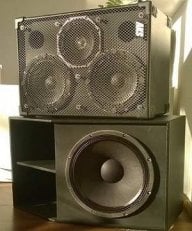
Remember the TB Amps forum credo: Build a cabinet capable of extreme low end reproduction and excursion, then add a HPF to take it all out!!!!!!!
I'm conscious of that point when I design my own speakers. From a "pure engineering" standpoint, if your speaker has too much low end, and you're using aggressive HPF'ing as a tone control, then you could have gotten a speaker that's smaller, cheaper, louder, etc. What seems more typical among electric bassists is to set the HPF to a point near or below the lowest fundamental of the bass, so it's not really serving a tone shaping function in the most familiar sense.
It makes sense to consider amplification as a "system" that consists of amp, speaker, bass, fingers, ears, etc. The design goal is to deliver a system that sounds good and addresses practical tradeoffs. Historically, bass speakers were designed to manage the tradeoff between low frequency reproduction, and protection of the cone and port from signal extremes.
Some folks find that the way historical speakers were designed, defines the "classic" tone of the electric bass. Others find it to be intolerable.

For instance, in the classic Ampeg "fridge" system, 1) the speaker is an electromechanical HPF with cutoff set high enough to control the lowest fundamentals. 2) The preamp doesn't goose the lows. 3) Handling 40 Watts per driver isn't an insurmountable design task. I'm not surprised that Jimmy doesn't need an HPF.
Nowadays, there are other ways to manage speakers as well. Given contemporary technology, electromechanics are big, expensive, and hard to adjust, whereas small-signal electronics are cheap and flexible. By liberating the speaker of having to protect itself from infrasonics, and moving that functionality into the electronics through use of an HPF, the speaker can be pushed towards even higher performance, or (also as a viable option), smaller size and lower cost.
Again, this is all from a "pure engineering" perspective, and doesn't address the wide diversity of preferences for tone quality and other subjective factors that make bass amplification such a fascinating subject.