• TalkBass has been independent since 1998. Add your voice.
    Create a free account to reply to discussions, view embedded media, and browse with fewer display ads.
    Join freeLog in
    Want zero display ads or expanded classifieds tools? Compare plans.

High end copies

I'd agree that one piece necks can be stable. Ultimately, it's difficult to prove either since a one piece neck by one company may have other factors compared to a hippie sammich and vice versa. Realistically, you'd need to build necks that were otherwise identical....and wait an undisclosed amount of time. :hmm:
 
I'd agree that one piece necks can be stable. Ultimately, it's difficult to prove either since a one piece neck by one company may have other factors compared to a hippie sammich and vice versa. Realistically, you'd need to build necks that were otherwise identical....and wait an undisclosed amount of time. :hmm:

+1 all the way there. It's hard to generalize. I was just pointing out that it is possible to build a really good one piece neck, and also a really crappy multilam (and of course, vice versa). The point is, a luthier that really knows what he/she is doing can make pretty much any design stable and make it sing!
 
While I'd agree that they probably don't affect tone, the extended horns certainly help with playability, especially us shorter folk. The multilaminate necks can potentially offer added stability, depending on what the research of the day sIys.

One reason multilaminate necks are used is because, it's getting hard to find quarter sawn lumber that doesn't cost an arm and leg. By using 5, 7 piece necks you can use flat sawn and turn it so the grain goes the right direction, besides it looks cool and yes it's much more stable than a one piece.:rollno: Lets face it not every body likes boutique instruments, but if you ever BUILT one and see the reaction from people, you would never think about a jazz bass again. In my opinion anyway. (more worms from that can coming soon)

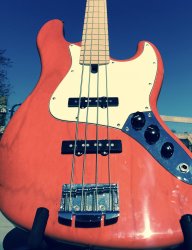
Spade2you, I love your bass! Who made it?
 
In those very 'closed minded' studio's (less and less these days from what I understand), they wouldn't allow the 'hi end copies' in either. So, I reject your hypothesis as to why many of us play an uber quality bass that happens to have the look and feel (and in some cases, the tone) of a more classic instrument:

I read that here on TB. I'll look for the thread.
 
One reason multilaminate necks are used is because, it's getting hard to find quarter sawn lumber that doesn't cost an arm and leg. By using 5, 7 piece necks you can use flat sawn and turn it so the grain goes the right direction, besides it looks cool and yes it's much more stable than a one piece.:rollno: Lets face it not every body likes boutique instruments, but if you ever BUILT one and see the reaction from people, you would never think about a jazz bass again. In my opinion anyway. (more worms from that can coming soon)

You are making my point. It's ALL about the quality of the lumber (flat or quarter... I prefer flat). And, I have no interest in Fender instruments, due to the lack of quality IMO of the ingredients and lack of attention to detail (which of course, is reflected in the lower price... no problem there).

However, I LOVE a J bass feel and tone, and am thrilled with the fact that I can get a J bass tone that is similar to the best recorded J bass tones that I love, in a bass with identical quality to my Fodera, MTD, FBAss and a few others I've owned, along with amazing stability in the flat sawn traditional maple neck... amazingly stiff and hard. This also results in a glorious sounding B string!

That answers your question I believe. If you really dig the feel, look and tone of a Fender bass, but are underwhelmed with the fit and finish, stability, and general quality, there are now FINALLY some quite legitimate options that will give you hand made quality, fit and finish and components all focused on a classic tone. It's a GOOD time to be a bassist:bassist: And, of course, the hippie sandwich basses continue to improve also. Different strokes for different folks, but it is not a 'better or worse' thing IMO.

 
In those very 'closed minded' studio's (less and less these days from what I understand), they wouldn't allow the 'hi end copies' in either. So, I reject your hypothesis as to why many of us play an uber quality bass that happens to have the look and feel (and in some cases, the tone) of a more classic instrument:

I read that here on TB. I'll look for the thread.

+1 Not saying it doesn't happen (I think that was part of the reason Roger Sadowsky kept a more traditional look to his basses way back in the day, if I remember an interview by him many years ago), but it surely is not the 'reason' that most who choose a more vintage looking instrument go that direction (especially today).

Again, as a 'boutique J' fanatic who has owned quite a few of the more high end multilam hippie sandwich type basses, I'm responding to your original post, which asks why some (a lot!) of us go this route.

If you don't like the answer, I understand that, and am not trying to be argumentative. If the point of your thread was to promote your designs, then discussion is a bit useless.

I totally understand those who dig a more modern tone and/or look. I'm just not seeing that as a 'better or worse' sort of thing, regarding looks, tone, quality, feel... anything. It's just another choice.
 
+1 Not saying it doesn't happen, but it surely is not the 'reason' that most who choose a more vintage looking instrument go that direction.

Again, as a 'boutique J' fanatic who has owned quite a few of the more high end multilam hippie sandwich type basses, I'm responding to your original post, which asks why some (a lot!) of us go this route.

If you don't like the answer, I understand that, and am not trying to be argumentative. If the point of your thread was to promote your designs, then discussion is a bit useless.

I totally understand those who dig a more modern tone and/or look. I'm just not seeing that as a 'better or worse' sort of thing, regarding looks, tone, quality, feel... anything. It's just another choice.

I never started this thread to promote my basses, I asked a simple question that I always wanted to ask. (I feel those rocks again), Have you read the whole thread?
 
I'm confussed, are we on the same page? I don't know if you like the "high end copies" or not. It's been a long two days.:help:

:) I love the topic!

Yes, I have moved from my Fodera/MTD's to Sadowsky and Alleva-Coppolos. Pure personal choice. I always loved the tone of a Fender J bass, but never the quality. I was also not impressed with the early attempts at 'super J's'... even the earlier Sadowsky's didn't really do it for me back then.

However, there are a few luthiers who are really doing a great job with more traditionally designed basses. The A-C's for example have in-house wound pickups, and Jimmy, from what I understand, uses VERY old wood and 'updated but traditional' construction methods. As a result (just using the A-C as an example), I have a traditional feeling and sounding bass (and somewhat traditional looking... no one would call that headstock a copy:D) that has a very even and stable neck, and a quality/fit and finish feel that is every bit as good as my previously owned Fodera and MTD, which many put at the very tip top of the luthier's art.

Again, just giving my point of view to this topic that interests me, since I went from 5 piece necks and fancy tops, and somewhat unusual shapes all the way back to a chunk of ash with a chunk of maple bolted to it, and a plastic protector screwed into the top:D
 
:) I love the topic!

Yes, I have moved from my Fodera/MTD's to Sadowsky and Alleva-Coppolos. Pure personal choice. I always loved the tone of a Fender J bass, but never the quality. I was also not impressed with the early attempts at 'super J's'... even the earlier Sadowsky's didn't really do it for me back then.

However, there are a few luthiers who are really doing a great job with more traditionally designed basses. The A-C's for example have in-house wound pickups, and Jimmy, from what I understand, uses VERY old wood and 'updated but traditional' construction methods. As a result (just using the A-C as an example), I have a traditional feeling and sounding bass (and somewhat traditional looking... no one would call that headstock a copy:D) that has a very even and stable neck, and a quality/fit and finish feel that is every bit as good as my previously owned Fodera and MTD, which many put at the very tip top of the luthier's art.

Again, just giving my point of view to this topic that interests me, since I went from 5 piece necks and fancy tops, and somewhat unusual shapes all the way back to a chunk of ash with a chunk of maple bolted to it, and a plastic protector screwed into the top:D

Your the man, thanks for the input.
 
Oh good, I had an angry mob after me the last two days. I don't want to go thier again.:D

It is a bit of an emotionally charged topic for some. You should dip into some of the old Sadowsky threads. Whenever someone posted a 'you have to be an idiot to pay that much for a parts bass', the fireworks REALLY flew:D

Cool discussion, and again, I really do like the look of your basses. I hope I get to play one someday. I love all this stuff!
 
It is a bit of an emotionally charged topic for some. You should dip into some of the old Sadowsky threads. Whenever someone posted a 'you have to be an idiot to pay that much for a parts bass', the fireworks REALLY flew:D

Cool discussion, and again, I really do like the look of your basses. I hope I get to play one someday. I love all this stuff!

Take care, I can hardly wait for the next guy who wonders down this dark path.lol. And thanks for the comps.
 
anyways, I think guys like Steve Swallow, Anthony Jackson, Abraham Laboriel, Chuck Rainey, Stanley Clarke and Ed Lucie have proved that you don't get turned down for gigs because of the way your bass looks. Unless of course you're talking about getting a gig for the Backstreet Boys reunion tour, then by all means carry on. Fortunately there's still music out there that puts less of an emphasis on image and more on the way you sound.

As far as the bass builder here - if you build an incredible bass then it will get played. Aesthetics be damned.
 
I've always wondered why would you spend the money on a high end bass that looks like a jazz bass or any other off the wall of a guitar store. If you spend the cash why not get something that looks unique? I know this will open a can of worms, can we please stick to the topic.

I want to get a boutique builder to do a 3,000 dollar copy of an SX....I guarantee that has never been done before!


:hiding:
 
I'm largely in the same boat as KJung.

I recently decided to order my dream bass, price be damned. I figured I can sell off a few basses to fund one custom made for me.

Over the last few years at various stores and GTGs, I've tried literally hundreds of high end basses of all descriptions, so I feel I have a really good handle on what I like in terms of tone and feel.

Basically, what I like in terms of feel is pretty much a J bass in form (neck profile, body shape). What I like in terms of tone are single coils in the J position. While I generally tend to favor passive basses, I do love the Sadowsky preamp. Sadly, the one bass I haven't had the chance to try is an Alleva-Coppolo, but I'm OK with that.

So I ordered a burl maple-topped Sadowsky J bass (actually, a Will Lee, but it would look to most people just like a Jazz). I tried one at the shop and fell in love.

I'm glad there are lots of luthiers out there like you trying different designs and things. But I've found what I like. And yes, it looks like a Fender copy.