You are right. It all seems geared towards guitar mid humping on the website. ...Guitar players are such shameless mid humpers.Seems more like band passing as an effect, since the HPF only goes down to 100hz

Enjoy the benefits of a premium membership!
Upgrade Account
-
TalkBass has been independent since 1998. Add your voice.
Create a free account to reply to discussions, view embedded media, and browse with fewer display ads.
Join free Log in
Want zero display ads or expanded classifieds tools? Compare plans.
You are using an out of date browser. It may not display this or other websites correctly.
You should upgrade or use an alternative browser.
You should upgrade or use an alternative browser.
More options
Who Replied?
You are right. It all seems geared towards guitar mid humping on the website. ...Guitar players are such shameless mid humpers.
Our guitarist was so obsessed with low end I may as well have not even come to half our practices. This sounded fine when we were in metal bands together in our 20s, but not so much for the classic rock cover band in our 30s.
No amount of coaching, pleading, constructive criticism, or tweaking his amp settings when he wasn't looking would make a difference. It was to the point where I even bought a Tubescreamer and gifted it to him in hopes that he would like it, which he didn't because "it sucked out all his tone". A sfx Microthump appeared in my local classifieds last month and I was going to buy it and try and hide it inside his amp/FX loop, but I couldn't think of a way to power it without him noticing...
When I did some mixes for some basement recordings we did, I took immense pleasure in high passing the guitars as high as I possibly could without compromising the tone in the mix. This was usually somewhere between 100-200 Hz or so. Having him tell me that mixes sounded good was all the validation I needed.
Last edited:

Al Kraft
Supporting Member
- May 2, 2016
- 10,768
- 40,438
- Disclosures
- Mesa Boogie beta product tester and player support
The HPF range looks to me as if it would be more useful/better suited to guitar than bass.Anybody familiar with this unit? They seem to really like pass filtering.
VFE Pinball tilt
Link Removed
View attachment 2949968

- Mar 8, 2011
- 12,232
- 51,187
- Disclosures
- Authorized greenboy designs builder/Owner of BNA Audio
The HPF range looks to me as if it would be more useful/better suited to guitar than bass.
Clever name for a pedal though


A sfx Microthump appeared in my local classifieds last month and I was going to buy it and try and hide it inside his amp/FX loop, but I couldn't think of a way to power it without him noticing...
Love it! This is how I plan to use an fDeck for the bass amp at church to keep some others from frying another one...
Love it! This is how I plan to use an fDeck for the bass amp at church to keep some others from frying another one...
I’m being a little facetious, but the thought did cross my mind. Obviously the HPF on the Microthumpinator isn’t high enough for guitars!

I’m being a little facetious, but the thought did cross my mind. Obviously the HPF on the Microthumpinator isn’t high enough for guitars!
O... I’m being quite serious. Lol I do plan to add one to my guitar pedalboard as well, I’ll let you know which one works out best for guitar.
For posterity in this thread, The Microthumpinator cutoff is in the range of 20-30 Hz and non-adjustable.
On a practical note, how would us mere mortal bassists evaluate the effectiveness of specific HPF devices - especially when it's hard or impossible to hear when "correctly" configured? Seems like a slippery slope of variables... I'm not questioning the value. Just wondering how to know if it's the right one?
While the speaker efficiency argument is a good one, my main reason for buying an FDeck HPF was to audibly tighten up the low end. I can hear the difference. I don't agree that the only "correct" configuration for an HPF is when it makes no discernible difference.
On a practical note, how would us mere mortal bassists evaluate the effectiveness of specific HPF devices - especially when it's hard or impossible to hear when "correctly" configured? Seems like a slippery slope of variables... I'm not questioning the value. Just wondering how to know if it's the right one?
While the speaker efficiency argument is a good one, my main reason for buying an FDeck HPF was to audibly tighten up the low end. I can hear the difference. I don't agree that the only "correct" configuration for an HPF is when it makes no discernible difference.
Here is a good example of where your first thought should be. What do I want the HPF to do? Just add some speaker protection, or actually tighten up the sound. For just protection get one that’s fixed at a lower frequency, if you want to protect your speakers and adjust your tone, get a variable one.
I imagine that the most audible effect of the pass filters would be at high volume levels when the speakers need efficiency for projection and clarity. It might make more of a difference for the audience, and they probably wouldn't know it was a little utility pedal cleaning up the bass and opening up the band mix.
Here is a good example of where your first thought should be. What do I want the HPF to do? Just add some speaker protection, or actually tighten up the sound. For just protection get one that’s fixed at a lower frequency, if you want to protect your speakers and adjust your tone, get a variable one.
I can see value of speaker protection, however this seems like something that is mainly useful for loud volume. Some of us do not gig at high volume (Americana, acoustic, folk, dinner jazz etc.).
There are multiple ways to approach getting a "tighter sound." My preference is to use a Malekko Sneak Attack pedal to adjust the attack and decay slopes and durations. This has been enormously beneficial and very easy to hear - especially with my acoustic bass. But it's also clearly audible with electric bass. My experience with Fdeck's HPFs brought some of this latter benefit, but it was way less audible than varying attack/decay settings.
Other factors can affect "tightness."
But back to the question: how to evaluate HPFs? Are they all basically the same (aside from varying the cut point and slope)? Seems to be hovering on the border of snake oil but I'm willing to learn.

- Feb 12, 2006
- 60,963
- 5
- 220,650
- Disclosures
- Development Engineer-Mesa Boogie, Development Engineer-Genzler (pedals), Product Support-Genz Benz
Best way to evaluate a HPF is to listen to them. The effects of a HPF are straight forward and obvious.
Snake oil? They have been used in the pro audio industry for decades on bass guitar, yes even variable ones.
Snake oil? They have been used in the pro audio industry for decades on bass guitar, yes even variable ones.
They are pretty much the same. However, I strongly advise you to go for those we talk about in this thread as it's tried and trusted. To me the HPF must be totally transparent too. If you decide to buy a cheap one or build yourself one (unless you have a good knowledge in electronics), you might end up with a device that will alter you tone. My Broughton variable HPF is absolutely transparent.how to evaluate HPFs?
Yes, it's much more noticeable at high volumeI imagine that the most audible effect of the pass filters would be at high volume levels when the speakers need efficiency for projection and clarity.
Last edited:
But back to the question: how to evaluate HPFs? Are they all basically the same (aside from varying the cut point and slope)? Seems to be hovering on the border of snake oil but I'm willing to learn.
I have not looked at all the different options and their specs. But it looks like the Broughton offerings and fDeck are 12 dB per octave. Looks like the difference is the fixed 35 hz filter on the fDeck. Aside from that, the choice is yours.

On a practical note, how would us mere mortal bassists evaluate the effectiveness of specific HPF devices - especially when it's hard or impossible to hear when "correctly" configured? Seems like a slippery slope of variables... I'm not questioning the value. Just wondering how to know if it's the right one?
I'd think you could get by with a variable freq HPF, turn it up until it starts to sound like it's limiting your tone, then back off a bit. Or if the tone starts to sound better as you turn it up, set it where it sounds best.
Best way to evaluate a HPF is to listen to them. The effects of a HPF are straight forward and obvious.
Snake oil? They have been used in the pro audio industry for decades on bass guitar, yes even variable ones.
They are snake oil to those who enjoy loosing amp and cab overhead to frequencies they can't hear or the speaker can't reach

Passinwind
I know nothing.
- Dec 3, 2003
- 23,045
- 45,909
- Disclosures
- Designer/Toaster Tech @ Passinwind Electronics
I agree. I was questioning the wisdom of boosting bass below 100Hz. If the bassist does that at the beginning of the chain, the clashing result will be mud no matter what the sound person does. Esp if the sound person favors the heavy kick approach.
Kick? What's that? Miked kick...double what. Maybe a few times a year in what passes for my world these days.
As usual, IME it just depends. At home or on a a big band gig with BG and no FOH reinforcement (for anyone) I pretty much always use some low bass boost somewhere in my chain, usually right on the instrument. And as I showed, a variable HPF can actually enhance that ability quite a bit if used with that intent. With upright, whole new set of choices and tradeoffs, usually.
I don't use a HPF in my current setup, but when I would use it I would set it at a frequency 1/4th below that of the tuning frequency if the cab is ported. E.g. if the port is tuned to 50hz I would set the HPF to approx 38hz. It also depends on the steepness of the HPF (12, 24 or 48 dB/oct).
Good call if protection below the "unloading" frequency of the box is your goal. In some cases a small bump in the HPF curve just above the rolloff point may keep things sounding more like a "bass amp" too, assuming one finds that desirable.
Last edited:
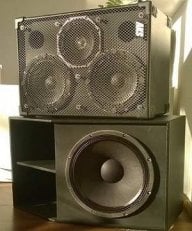
True, I did that years ago with my ol' setup. I had different cabs (15" + 5") back then and I used this Bell 9024 poweramp (sounded amazing). This amp had three boost frequencies (20, 30 & 40hz +5/+10dB) and also a crossover mode that could be used as a HPF which could start at 30hz. So I set the HPF to 30hz and the boost at 40, worked pretty wellGood call if protection below the "unloading" frequency of the box is your goal. In some cases a small bump in the HPF curve just above the rolloff point cab may keep things sounding more like a "bass amp" too, assuming one finds that desirable.


