
They would not stay in tune for very long and intonation was quirky.Why did you have to replace them?

TalkBass has been independent since 1998. Add your voice.
Create a free account to reply to discussions, view embedded media, and browse with fewer display ads.
Join free Log in
Want zero display ads or expanded classifieds tools? Compare plans.
They would not stay in tune for very long and intonation was quirky.Why did you have to replace them?

An absolutely +1Funny thing about strings, they might sound killer on one particular instrument, not so hot on another. It's almost like there needs to be chemistry between the two...


Old thread, but I'm new here (first post). I have been using roundwounds since 1983, but I have recently become interested in roundwounds. I was about to buy some Fender 9050 45 flatwounds from Amazon, but I'm a bit nervous with all this talk about high tension and warping. My bass is a 2018 Squier Jazz Affinity. Should I be more worried about neck warpage than a higher level Squier or Fender?
Thanks.

Since this is one of the threads that got me interested in trying out the Fender 9050 flats, I'm here to share a few of my initial impressions.
When I acquired my 2008 Fender Highway One Jazz five and a half years ago, I had it set up with a set of D'Addario Chromes (40-60-80-100), which stayed on it for the first four years. Then eighteen months ago, I (foolishly) decided to go on a string journey (ie detour) by flirting with rounds. Now, I'm very happy to be back with flats again.
Fender 9050L (45-60-80-100): (Keep in mind these are less than two weeks old.)
- Clear and articulate tone with good sustain.
- Nice playing feel in terms of overall tension - not too stiff, not too loose, just right. (Not quite as stiff as the Chromes.)
- Not any harder to play on than the D'Addario EXL170BT set they replaced, except so much smoother as any flats should be. (Contrary to a few comments I've read, they are not "rough" in any way.)
- Going from D'A Nickel Rounds (45-60-80-107) to this set, my bass needed very little adjustments in terms of setup - not even any truss rod tweak.
- The 45G balances better with the rest both in terms of tension and tone. I didn't like the way the 40G on the Chromes stayed noticeably brighter than the rest even after four years.
- I was quite upset when Fender decided to discontinue the 9050CL set (45-60-80-105) a short while ago as I thought it was the best-balanced set. So, I was a little concerned about the 100E on this new set at first, but pleasantly surprised at how strong it actually is. Slightly better note definition than the 100E on my old Chromes as well.
- And last but not least, I like the way they fit my bass properly. (Gorgeous in Green)
[Invalid or Expired Link Removed]
How do you folks think about loosening the strings when storing the bass? I have customarily done that. Wouldn't that reduce the chances of warpage? Does it prematurely wear out the tuning hardware?
Weight and counter-weight... The truss rod works in a way it counteracts the pulling force of the strings by providing counter balance. Loosening the strings would actually have an adverse effect of disrupting the equilibrium achieved by the truss rod. It's not advisable.
I always make sure my basses are tuned to proper pitch before putting them away.
The guitar shop I bought my bass from said that they would set up my bass for me. Maybe they can balance out the flatwounds, since I have no idea what I'm doing.

Fender 9050L (45-60-80-100) has similar overall tension (as in pulling weight on the neck) as a typical medium-gauge rounds 45-65-85-105. So, no worries about your Squier's neck.
Keep in mind that when people talk about the "high tension" of flats, they're mostly referring to "stiffness" (as in playing feel). Due to the tightly-wound flat ribbon wire, flats tend to be more rigid (less pliable) so it is important you do a proper setup on your bass when switching from rounds to flats. The nice thing about the stiffness of flats is they allow a nice low action without buzzing issues.
I'm a fan of Fender 9050L myself, especially for my Fender Jazz.
Fender 9050L (45-60-80-100) has similar overall tension (as in pulling weight on the neck) as a typical medium-gauge rounds 45-65-85-105. So, no worries about your Squier's neck.
Keep in mind that when people talk about the "high tension" of flats, they're mostly referring to "stiffness" (as in playing feel). Due to the tightly-wound flat ribbon wire, flats tend to be more rigid (less pliable) so it is important you do a proper setup on your bass when switching from rounds to flats. The nice thing about the stiffness of flats is they allow a nice low action without buzzing issues.
I'm a fan of Fender 9050L myself, especially for my Fender Jazz.
 When I originally posted in this thread, I said that I was happy with the 9050s on my old P-Bass, and was expecting good things from them when they finally broke in. Well, they did, and I'll admit that I was pretty happy with them... for a while. I haven't gotten around to it yet, but they are coming off the P-Bass pretty soon. Nothing against the strings; if they haven't been cut too short, they're fer sure going on a different bass. And the reason they're coming off? Nice as they are, they just aren't quite Old School Thumpy enough. I have a whole bunch of basses, so I don't need a bass to be versatile. They can be specialists; I play the P-Bass with the mute in the bridge cover, and I want that Jamerson kind of thump from this bass. Can't quite get it with the 9050s... so, off they come. But, as for flats warping your neck?
 You should be fine...
Thanks, but are you sure the guy in the ad photo is flatwound?
Nothing against the strings; if they haven't been cut too short, they're fer sure going on a different bass. And the reason they're coming off? Nice as they are, they just aren't quite Old School Thumpy enough...
...I play the P-Bass with the mute in the bridge cover, and I want that Jamerson kind of thump from this bass. Can't quite get it with the 9050s... so, off they come.
are you sure the guy in the ad photo is flatwound?

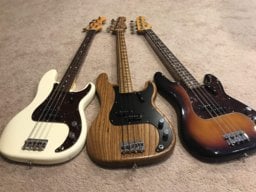

I have Fender flats on all of my electric basses as of right now.
3a) Chromes start off with high-mids that wear down to a thump in a few months, whereas the Fenders wear down from a high-mid zing to a low-mid snarl, making them sound very much like roundwounds.
I just received my Fender roundwounds, installed them, and they already sound great before even being broken-in. I played some Carol Kaye, James Jamerson, and John Paul Jones.
Thank you. Corrected.Fender roundwounds? I thought this was a thread about Fender 9050 flatwound...
Thank you. Corrected.

I wish I had gone to roundwounds (and Jazz bass) years ago...


