
Enjoy the benefits of a premium membership!
Upgrade Account
-
TalkBass has been independent since 1998. Add your voice.
Create a free account to reply to discussions, view embedded media, and browse with fewer display ads.
Join free Log in
Want zero display ads or expanded classifieds tools? Compare plans.
You are using an out of date browser. It may not display this or other websites correctly.
You should upgrade or use an alternative browser.
You should upgrade or use an alternative browser.
"How bad is it?" Silvertone Hornet resurrection
- Thread starter JIO
- Start date
More options
Who Replied?


- Jun 30, 2010
- 49,612
- 222,129
- Disclosures
- musician/artist/owner - Gildaxe
Scanning my thread on distressed finishes (started 6 years ago/142 pages/2821 -posts!) - here's some things I found which are relative to the Silvertone -
View attachment 2390467View attachment 2390468View attachment 2390469View attachment 2390470
View attachment 2557581
View attachment 2557582
and a good reference for a very played neck in the money positions -
View attachment 2982670
Neck heal wear -
View attachment 3184499
Noting staining the exposed wood darker to stand out more -
View attachment 3223800
backside -
View attachment 3538278
minimal distressing - similar colour -
View attachment 3549557
Thinking mine will look very close to this after adding an amber-glaze -
View attachment 3568541
View attachment 2390467View attachment 2390468View attachment 2390469View attachment 2390470
View attachment 2557581
View attachment 2557582
and a good reference for a very played neck in the money positions -
View attachment 2982670
Neck heal wear -
View attachment 3184499
Noting staining the exposed wood darker to stand out more -
View attachment 3223800
backside -
View attachment 3538278
minimal distressing - similar colour -
View attachment 3549557
Thinking mine will look very close to this after adding an amber-glaze -
View attachment 3568541
- Jun 30, 2010
- 49,612
- 222,129
- Disclosures
- musician/artist/owner - Gildaxe
That is turning out quite nicely!
I never doubted you for a second.
 Thanks! I shot the last Lava soap colour earlier - looks pretty good considering what a mess I started with! I used most of the spray-can on it. It's out basking in another sunny day - I lucked out timing wise. The final satin lacquer coats will be thin and fast once it's all been effected. I considered doing a glitter-blast dusting, but I think this one is ok w/o adding such.
Wasn't aware of the different coloured wrapper for "Professional Line" - also found "Industrial Line" (same wrapping) I've only seen the red (consumer?) wrapper for sale.
Last edited:
- Jun 30, 2010
- 49,612
- 222,129
- Disclosures
- musician/artist/owner - Gildaxe
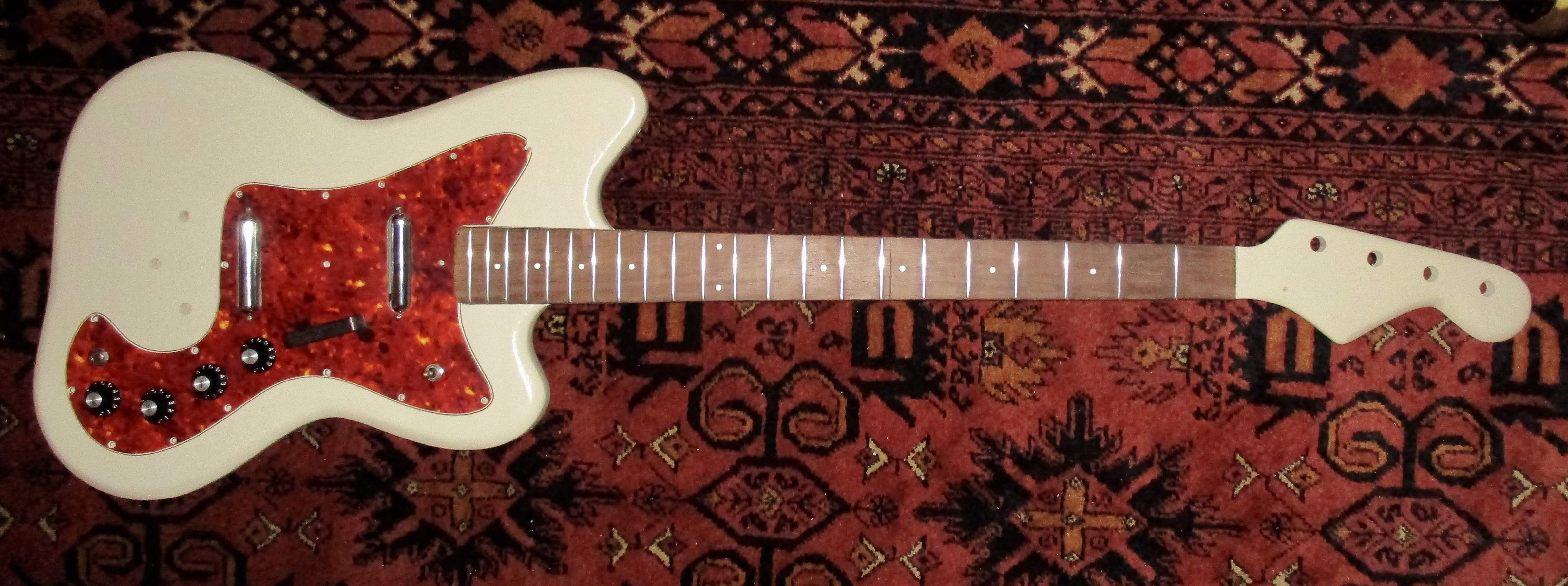
End of the day mock-up (flash) shot ... tomorrow the relic-ing/distressing begins!
- Jun 30, 2010
- 49,612
- 222,129
- Disclosures
- musician/artist/owner - Gildaxe
So I finally got around to updating my Gildaxe fb page last night with my newest projects including this one. If on the evil fb and interested, type in Gildaxe. If not my more involved step-by-step's are always here and here first. So I posted the same 'end-of-day' pic (above) of my Lava Hornet and two responders said - leave it as is. As you can see looking at that pic - it shows no real detail. I could try to take pics that show exactly what the surface looks like - but I can tell you it's far from smooth and flat. I mean, some sections are, but others are not - whoever removed the original finish did it with a butter knife blindfolded. However, it looks 100% better now - just not what I would call a 'factory' finish. I like it now also - but I will like it even more once I give it some character. When I play my Coral at shows, if anyone notices it (at all  ) I imagine they assume it is old and a bit beat-up. My intent is not to 'fool' them into thinking I played it so much that it ended up looking like that. I really could care less what anyone thinks about it mostly because to imagine that anyone cares would be projection on my part. No, I do it as an artistic endeavor. Part of that is making it look 'right' - like what it should look like after being played for 50+ yrs. When you see a '60s bass in pristine condition - chances are it has been in its case for most of those years. That's cool if you are willing to pay for a time-capsule bass (and pay large) but chances are also that it doesn't really sound as good as a bass that's been worked for the same number of years. The "mojo" thing which for me translates to a bass with a soul - that 'soul' given to it by the hard work and dedication of the player who played it day-in-and-day-out for many years. Why would it look like that if the player didn't like the way it sounded?
Unless someone asks me about a finish I did, relic'd or not (so far no-one has) I don't go out of my way to offer that information. The only real notice I've gotten from my basses (basses I've made/finished like the Coral, Teiscobird, or Deadlybird) is from a 20-something sound-guy who liked it (the Coral) because it looked old-school and sounded good, and a couple of fellow musician who knew what it was. Usually if I get any comments at all they are about my playing, not the bass. At the end of the day we do these things for ourselves - and if another appreciates it... gravy.
Now.., if that someone who 'loved it' as it is right now was interested in purchasing it, I would be happy to oblige their request of 'leaving it alone'.
Please excuse my rant - After recently scanning through my distressed basses thread I found a few examples of my thoughts on creative relic-ing. If interested they are extrapolated in posts #362, #1580, #1873, and #2821. Just the educator in me attempting to explain what so many people dismiss due to various biases, and what it (relic-ing/distressing - artistic rendering) can offer if approached with open eyes.
) I imagine they assume it is old and a bit beat-up. My intent is not to 'fool' them into thinking I played it so much that it ended up looking like that. I really could care less what anyone thinks about it mostly because to imagine that anyone cares would be projection on my part. No, I do it as an artistic endeavor. Part of that is making it look 'right' - like what it should look like after being played for 50+ yrs. When you see a '60s bass in pristine condition - chances are it has been in its case for most of those years. That's cool if you are willing to pay for a time-capsule bass (and pay large) but chances are also that it doesn't really sound as good as a bass that's been worked for the same number of years. The "mojo" thing which for me translates to a bass with a soul - that 'soul' given to it by the hard work and dedication of the player who played it day-in-and-day-out for many years. Why would it look like that if the player didn't like the way it sounded? Unless someone asks me about a finish I did, relic'd or not (so far no-one has) I don't go out of my way to offer that information. The only real notice I've gotten from my basses (basses I've made/finished like the Coral, Teiscobird, or Deadlybird) is from a 20-something sound-guy who liked it (the Coral) because it looked old-school and sounded good, and a couple of fellow musician who knew what it was. Usually if I get any comments at all they are about my playing, not the bass. At the end of the day we do these things for ourselves - and if another appreciates it... gravy.
Now.., if that someone who 'loved it' as it is right now was interested in purchasing it, I would be happy to oblige their request of 'leaving it alone'.
Please excuse my rant -
After recently scanning through my distressed basses thread I found a few examples of my thoughts on creative relic-ing. If interested they are extrapolated in posts #362, #1580, #1873, and #2821. Just the educator in me attempting to explain what so many people dismiss due to various biases, and what it (relic-ing/distressing - artistic rendering) can offer if approached with open eyes.
So I finally got around to updating my Gildaxe fb page last night with my newest projects including this one. If on the evil fb and interested, type in Gildaxe. If not my more involved step-by-step's are always here and here first. So I posted the same 'end-of-day' pic (above) of my Lava Hornet and two responders said - leave it as is. As you can see looking at that pic - it shows no real detail. I could try to take pics that show exactly what the surface looks like - but I can tell you it's far from smooth and flat. I mean, some sections are, but others are not - whoever removed the original finish did it with a butter knife blindfolded. However, it looks 100% better now - just not what I would call a 'factory' finish. I like it now also - but I will like it even more once I give it some character. When I play my Coral at shows, if anyone notices it (at all
Unless someone asks me about a finish I did, relic'd or not (so far no-one has) I don't go out of my way to offer that information. The only real notice I've gotten from my basses (basses I've made/finished like the Coral, Teiscobird, or Deadlybird) is from a 20-something sound-guy who liked it (the Coral) because it looked old-school and sounded good, and a couple of fellow musician who knew what it was. Usually if I get any comments at all they are about my playing, not the bass. At the end of the day we do these things for ourselves - and if another appreciates it... gravy.
Now.., if that someone who 'loved it' as it is right now was interested in purchasing it, I would be happy to oblige their request of 'leaving it alone'.
Please excuse my rant -
 ...
...
- Jun 30, 2010
- 49,612
- 222,129
- Disclosures
- musician/artist/owner - Gildaxe
Actually, I never wanted to be an artist or musician... I wanted to be a lumberjack!
- Jun 30, 2010
- 49,612
- 222,129
- Disclosures
- musician/artist/owner - Gildaxe
Down the Dano rabbit-hole - as a fairly new convert to Dano-Technology, I wasn't aware of these late '60s gems - the Hawk guitar and bass. I love the one-colour crackle finish! I've used this technique a number of times in my decorative arts biz for furniture and murals - but never one colour. (so cool!) Most likely this was a budget model - but everything about it is nicely minimal and ... perfect! The bridge is a marvel of manufacturing simplicity - surpassing Leo's bent-plate design. Red body - red knobs - white pg - lipstick pu - 1966 design perfection. The shape of the pg is sublime!

And a 2 pu version in black with slightly different pg to accommodate for the bridge pu & switch - no 'shaping' on this model = minimal production... Dano Technology.

And a 1 pu Hawk bass - couldn't find a 2 pu version... maybe it only came w/1. (and no texture finish) Note a similar bridge but the strings loop around it! But wait... 15 frets? (is this some sort of toy bass?)

And a 2 pu version in black with slightly different pg to accommodate for the bridge pu & switch - no 'shaping' on this model = minimal production... Dano Technology.
And a 1 pu Hawk bass - couldn't find a 2 pu version... maybe it only came w/1. (and no texture finish) Note a similar bridge but the strings loop around it! But wait... 15 frets?
(is this some sort of toy bass?) 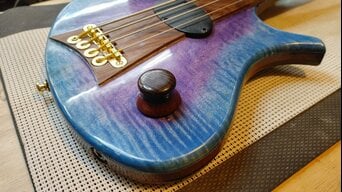
Actually, I never wanted to be an artist or musician... I wanted to be a lumberjack!
View attachment 3647929
- Jun 30, 2010
- 49,612
- 222,129
- Disclosures
- musician/artist/owner - Gildaxe
Bodies done - will shoot the satin lacquer this morning. (another sunny day!) Once I do that I'll start working on the neck. My tact for relic'ing the body was this; I studied all the examples on my Distressed Finishes thread - every single one. I basically internalized the examples that would relate and once working on the finish, relied on my eye to guide me. That and logic - where are guitar bodies most interfaced, bumped, dinged, scratched, worn etc. Looking at any relic-job, seeing wear in an unlikely place will break the visual acceptance that it could be real. Granted there are some somewhat mysterious examples out there - and I would love to see it being played by the person who caused it to understand how it appears where it does. But this is what makes player-wear so individual. So other than creating wear in generally universal places on the body - I also slat it to how I play my basses. I ride them higher than the central "belly bevel" so wear happens over the upper horn area. I also play over the bridge pu so that is also taken in to consideration. As this bass has a pg that surrounds both pu's, I minimized that. I also left the elbow bout more clean as I usually don't have my elbow there.
After doing the relic'ing, I rubbed oak-stain over all of the body. It alludes to the amber'ing that is common on old nitro finishes. I left the pg on when I did this, and you can see the subtle difference when the pg is off. Left that to cure overnight, and this morning rubbed some of it off on that elbow bout area and a few other locations where constant playing interface would remove the amber'ing.
Here's the result - the amber glaze is pretty subtle, but that was my intent. As always, it looks better in person but these pics are pretty accurate once I tweeted them a bit.
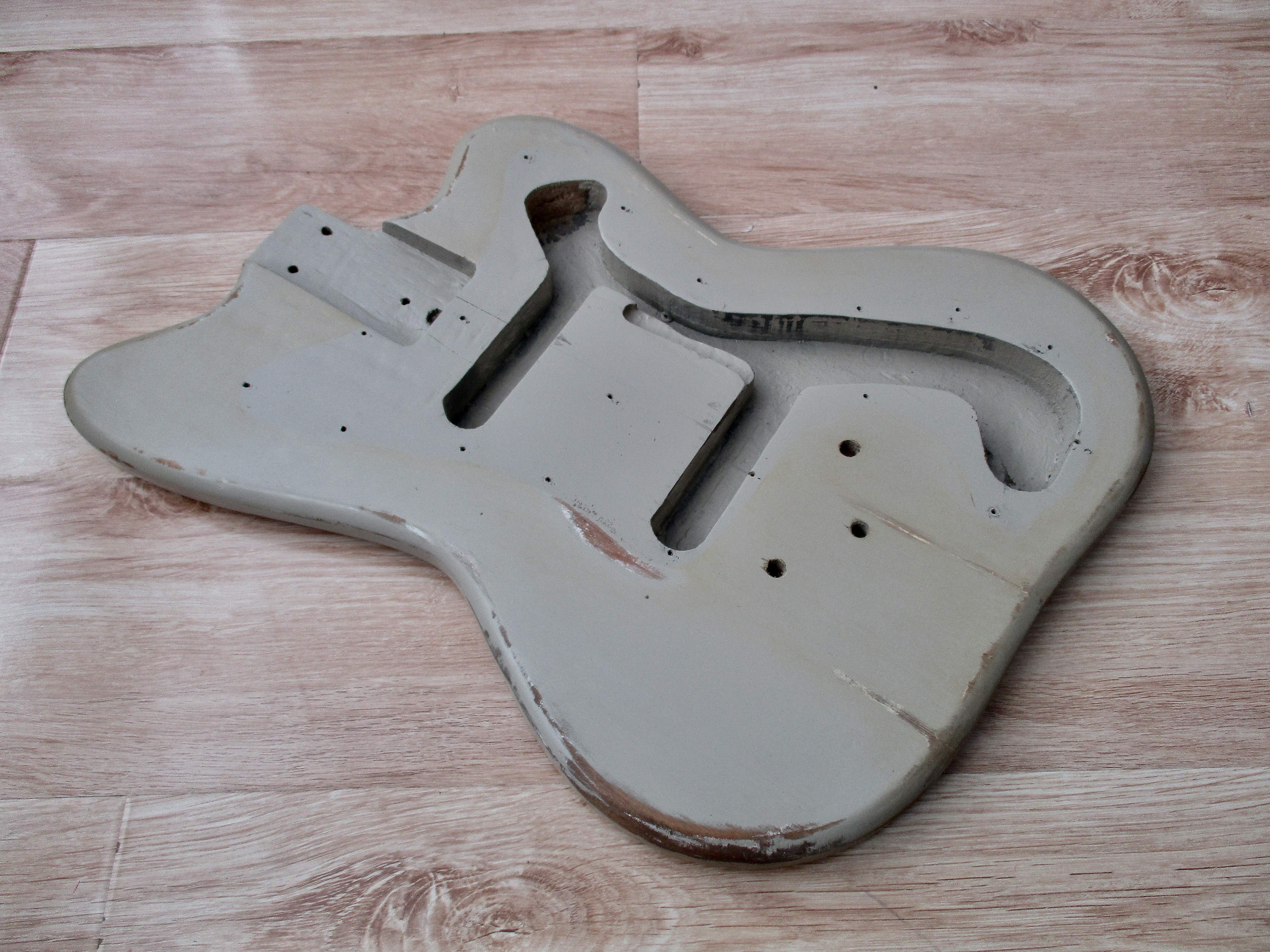
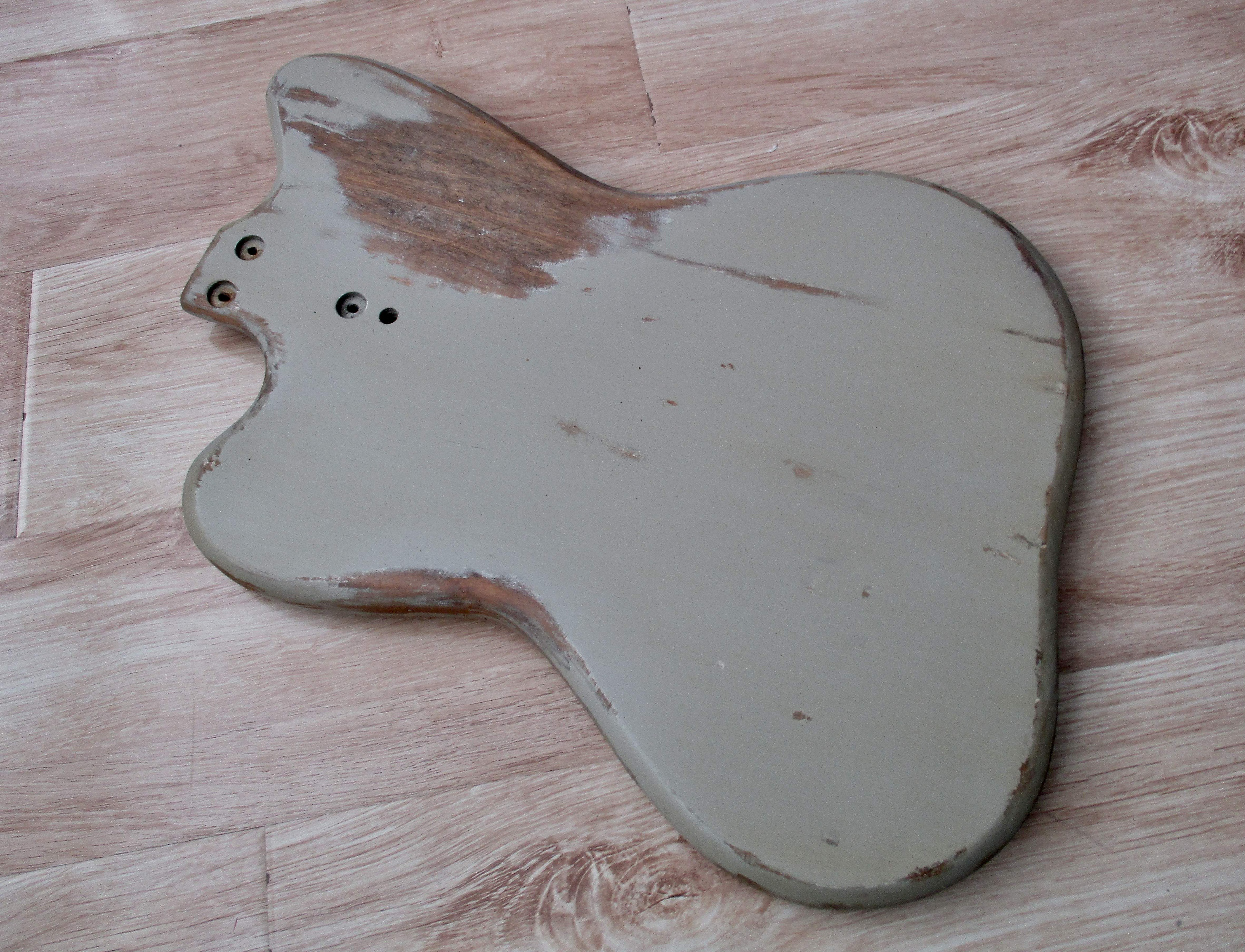
I rubbed a charcoal stain into the exposed wood on the back and wiped it with thinner so it soaked in and looked natural.
The satin nitro will make a very smooth surface and will bring out the subtlety of colour. It's a perfect 'topper' on such a finish as it gets shinier where interfaced over time.
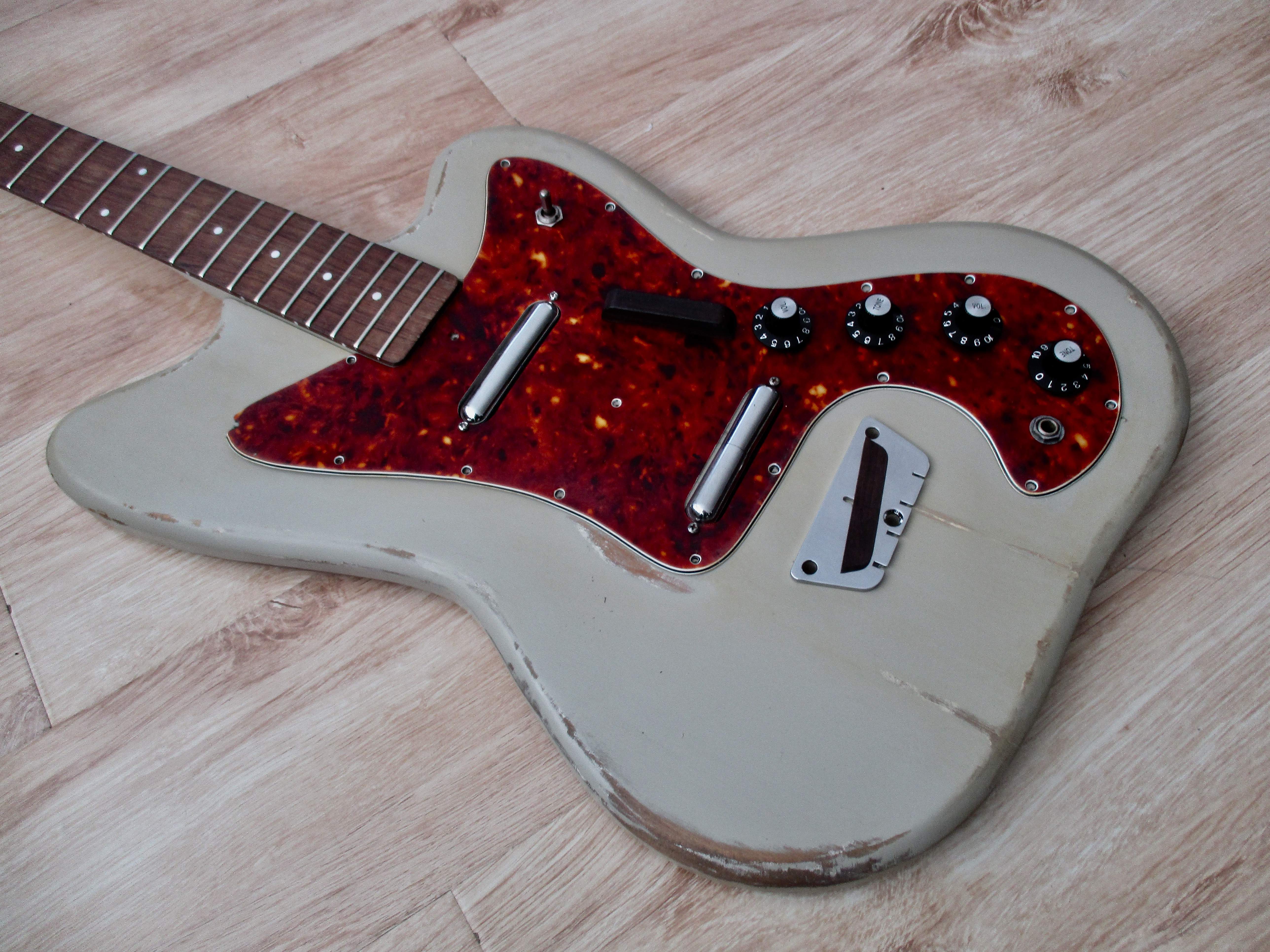
I also created wear at the places on the body that already had imperfections and depressions - to 'enhance' their imperfection, not to hide them.
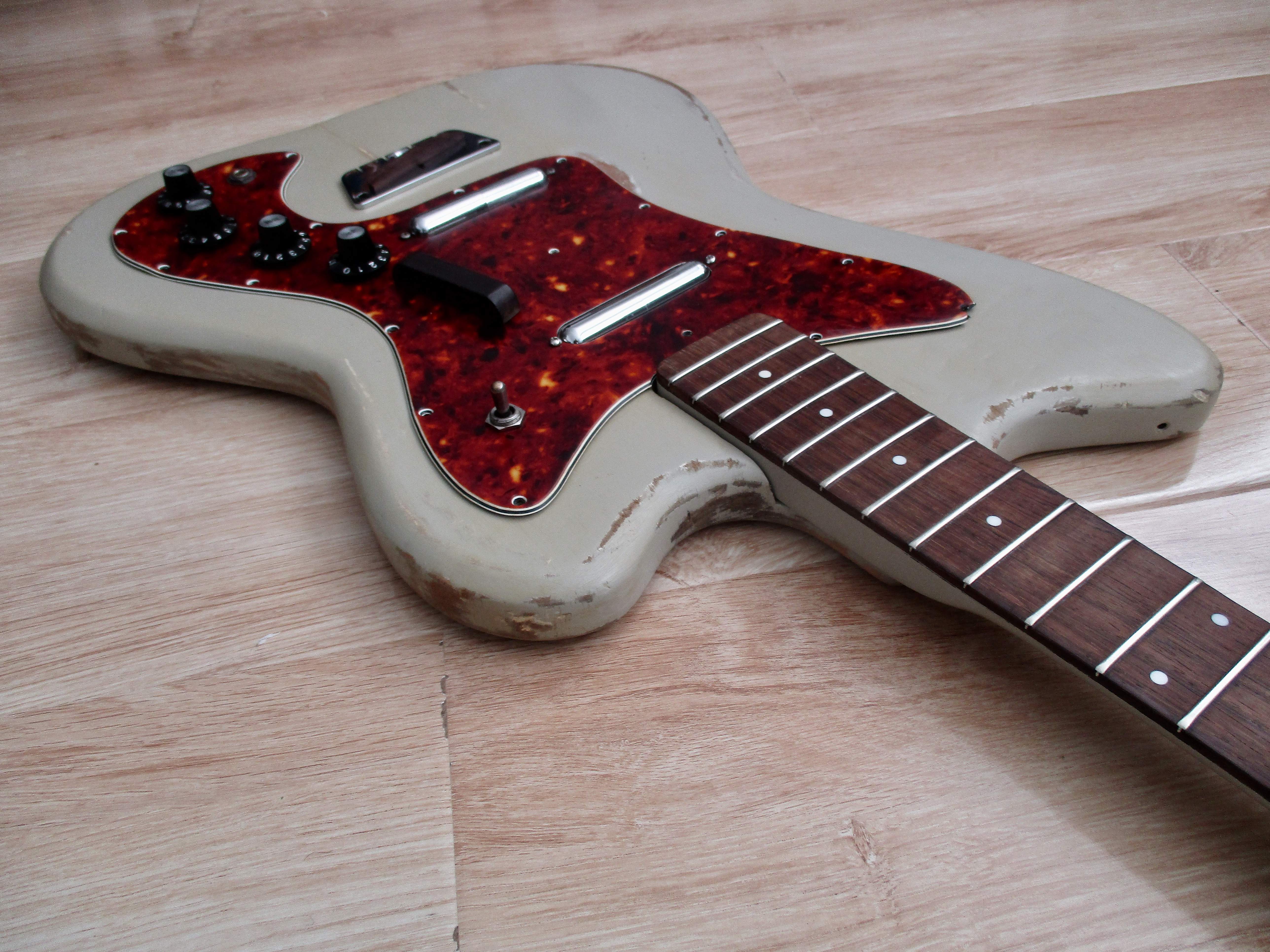
Another big aid when working on such a finish is seeing it in pictures (like these) It's a certain objectifier that helps 'see' your progress. After seeing these pics - I'm satisfied.
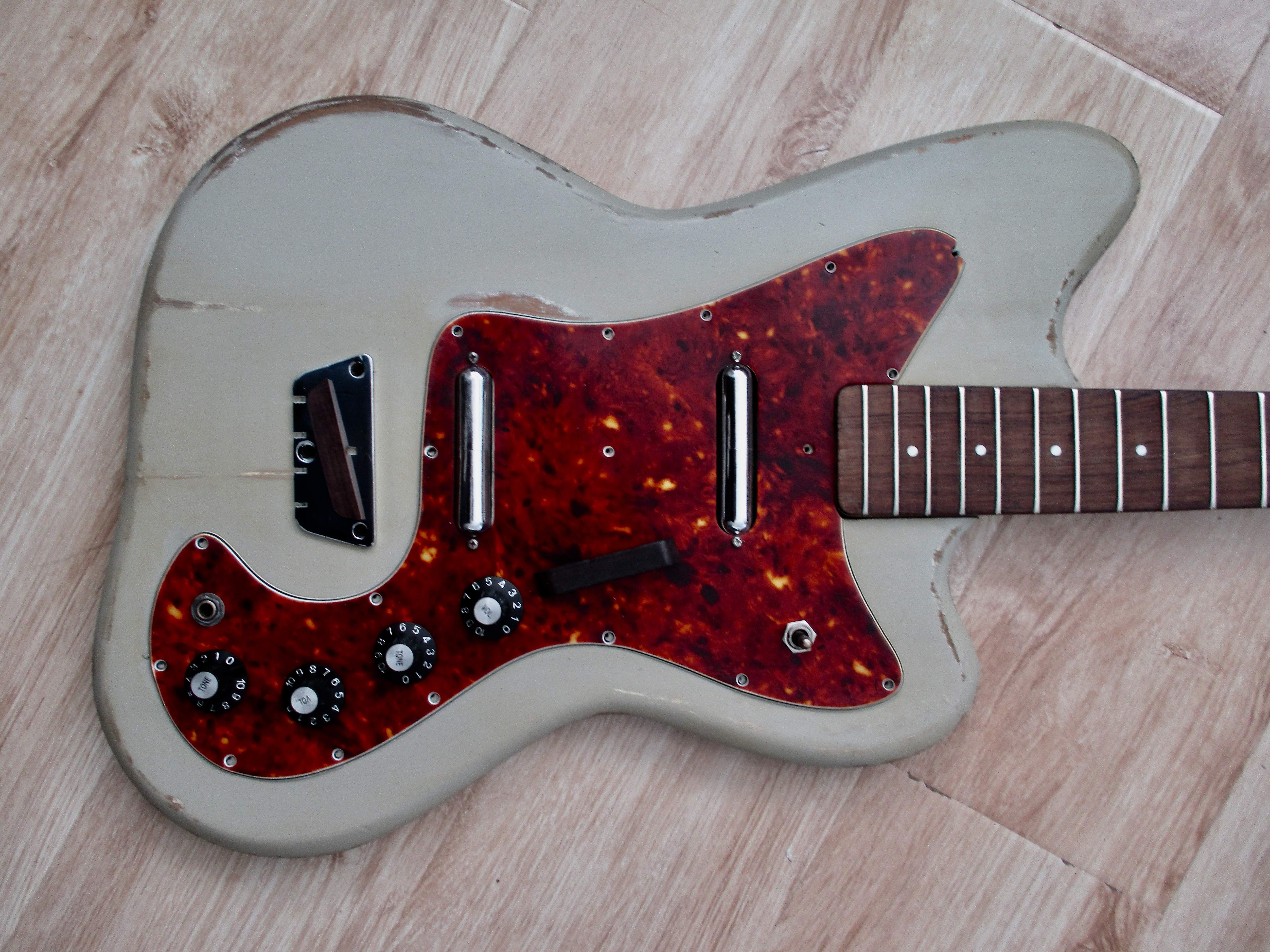
After doing the relic'ing, I rubbed oak-stain over all of the body. It alludes to the amber'ing that is common on old nitro finishes. I left the pg on when I did this, and you can see the subtle difference when the pg is off. Left that to cure overnight, and this morning rubbed some of it off on that elbow bout area and a few other locations where constant playing interface would remove the amber'ing.
Here's the result - the amber glaze is pretty subtle, but that was my intent. As always, it looks better in person but these pics are pretty accurate once I tweeted them a bit.
I rubbed a charcoal stain into the exposed wood on the back and wiped it with thinner so it soaked in and looked natural.
The satin nitro will make a very smooth surface and will bring out the subtlety of colour. It's a perfect 'topper' on such a finish as it gets shinier where interfaced over time.
I also created wear at the places on the body that already had imperfections and depressions - to 'enhance' their imperfection, not to hide them.
Another big aid when working on such a finish is seeing it in pictures (like these) It's a certain objectifier that helps 'see' your progress. After seeing these pics - I'm satisfied.
- Jun 30, 2010
- 49,612
- 222,129
- Disclosures
- musician/artist/owner - Gildaxe
Chain-saw solo - gotta be a first. (BC Rich sounds crunchy-cool!)


- Jun 30, 2010
- 49,612
- 222,129
- Disclosures
- musician/artist/owner - Gildaxe
Looks great! Do you ever work things like the knobs as well?
Thanks! I always go into an artful technique with a bit of trepidation. I've been doing such all my life so you'd think it would now be with full authority, but that's the nature of stepping into the unknown. There's usually a point within the process when I start to feel more confident that my visualization is on track. Pretty much the same starting a canvas - the early involvement is automatic/pure instinct. As far as the other bits - I have and probably will so new parts don't stand out. The shiny new bridge-plate for sure needs some aging.

- Jun 30, 2010
- 49,612
- 222,129
- Disclosures
- musician/artist/owner - Gildaxe
Frankly there are a number of them out there for sale. That's a good price as it sounds like it's in VGC. It also has the bridge cover, which is always a plus. Even more if it comes in its OHSC, as they are pretty long and don't fit a Fender P or J case. Those 3 yrs ('66-'68) were the last of Dano's many offerings under different badges. The Corals were made then also. '66 was the start of the decline in sales of guitars/basses that surged in production though the early-mid '60s and peaked in '65. Those years are when I bought my first bass ('66) and have become my favorite years of basses.

Interesting how the bridge cover has to be tucked under the pickguard... and I wonder if those aluminum(?) knobs are original. I also thought the flower sticker on the headstock was a nice touch.Frankly there are a number of them out there for sale. That's a good price as it sounds like it's in VGC. It also has the bridge cover, which is always a plus. Even more if it comes in its OHSC, as they are pretty long and don't fit a Fender P or J case. Those 3 yrs ('66-'68) were the last of Dano's many offerings under different badges. The Corals were made then also. '66 was the start of the decline in sales of guitars/basses that surged in production though the early-mid '60s and peaked in '65. Those years are when I bought my first bass ('66) and have become my favorite years of basses.
- Jun 30, 2010
- 49,612
- 222,129
- Disclosures
- musician/artist/owner - Gildaxe
I've done some relicing in the past and some faux aging as well (ie, my old steampunk guitar shared here), but man, it's so obvious that your artist's skills and eye are so much superior to mine, that it's not even funny...
Artists are a bit like detectives - we observe/study the worlds details and see if we can translate them in a stylistic way to replicate natural beauty. In this case the players who created these beautiful war-horses gave no thought to their axes visual de-evolution. So it's like nature and how it affects everything on earth with wear/aging - including ourselves!
Ask Columbo - there's a kind of beauty in solving the perfect crime!
- Jun 30, 2010
- 49,612
- 222,129
- Disclosures
- musician/artist/owner - Gildaxe
Interesting how the bridge cover has to be tucked under the pickguard... and I wonder if those aluminum(?) knobs are original. I also thought the flower sticker on the headstock was a nice touch.
Aluminum 'upside-down bucket' knobs are original. And the cover isn't under the pg, it's chopped at the pg edge. Kinda clumsy design, but again - Dano-technology was all about minimal fussing.


