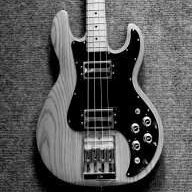
A Mapleglo is on my bucket list. I've been buying Ibanez for 35 years. I've been very fortunate that all economy and higher end models were very well made. Kind of like McDonalds. Consistent from burger to burger. Now I'm wanting a new Ibby with Nordstrand pickups. That makes one Ibanez and one Rickenbacker Maplego on my list!
On Rickenbackers-- regardless of the discussion of QC and whether declining or always been, Rickenbacker is an important part of our American and pop music history. Tom Petty with a PRS? No way!!!! Roger McGuinn on an Ibanez George Benson?? You get the picture.
I think Ric's are like Harley-Davidsons. They are very uniquely American, and when a Harley is headed your way you know it before you see it. And yes, like Harley's, you need to maintain a Ric. So if you buy one, know what you're buying and learn to benefit what you learn maintaining it.
I hope that Rickenbacker keeps their QC at a reasonable level, and I hope through my life they will always be. I can't imagine a world without Ric's -- or Harley's!
On that note, a quick lesson on how Harleys get their unique sound:
So why does the Harley-Davidson V-Twin have such a unique rhythm?
[Invalid or Expired Link Removed]
Engine noise is produced by the compressed gases exiting the cylinders though the exhaust valves and then through the exhaust system where they are either muffled or amplified depending on your exhaust system and muffler setup. In a typical two cylinder motor the crankshaft has two separate pins for the pistons' connecting rods and the spark plugs are positioned 180° from each other. Each piston fires on every other rotation of the crankshaft and with the sparks plugs at 180° from each other; this provides a smooth, even rhythm sound.
However Harley-Davidson two cylinder v-twin engine is designed differently. The H-D v-twin has a single pin connecting the pistons, which was originally done to reduce manufacturing cost. To make this unique configuration work the spark plugs were positioned in a 45° arc. So after the first cylinder fires there is 315° of rotation before the second cylinder fires and then 405° until the first fires again, and so on, and so on, giving the non-symmetrical distinct potato-potato-potato sound.





 I have owned 2 32" scale basses (both were Alembics) and 2 shorties (Höfner 500/1V63, and mid '90s CIJ Fender Mustang Bass); I don't remember about the Alembics or the Mustang Bass whether they had DSs or not (doesn't matter anyway as I have long ago sold them) but the Höfner did have a very pronounced dead spot at the 17th fret on the G string!