• TalkBass has been independent since 1998. Add your voice.
    Create a free account to reply to discussions, view embedded media, and browse with fewer display ads.
    Join freeLog in
    Want zero display ads or expanded classifieds tools? Compare plans.

How heavy is too heavy for a b string?

Jul 22, 2022
106
53
Tldr: How high gauge can a b string be? Currently using 148 and want higher tension.

Hello everyone. For a few years now I’ve mainly been playing 6 string basses and for about a year before I was playing a 5. For that time I’ve always had trouble finding a B string that doesn’t just sound like a floppy mess of fret buzz. Eventually that lead me to start using a Dingwall multi scale and then progressive tension strings. Ive also always preferred high tension strings and higher action. I used labella jamersons on my p bass for a long time before starting to get into extended range. So with all that in mind, what is too heavy for a low b string. Im currently using a 148 but id like to go higher. Im just worried about damaging the neck. Thanks.
 
Tldr: How high gauge can a b string be? Currently using 148 and want higher tension.

Hello everyone. For a few years now I’ve mainly been playing 6 string basses and for about a year before I was playing a 5. For that time I’ve always had trouble finding a B string that doesn’t just sound like a floppy mess of fret buzz. Eventually that lead me to start using a Dingwall multi scale and then progressive tension strings. Ive also always preferred high tension strings and higher action. I used labella jamersons on my p bass for a long time before starting to get into extended range. So with all that in mind, what is too heavy for a low b string. Im currently using a 148 but id like to go higher. Im just worried about damaging the neck. Thanks.
Kalium round wound 148 right? Stainless or hybrid? What are the other gauges? And what specific Dingwall MS are the strings on?
 
Last edited:
Kalium round wound 148 right? Stainless or hybrid? What are the other gauges?
Yeah kalium. Gauges are 148 110 82 61 45 33. Im thinking about switching to 160 114 82 59 43 31. But I don't want to damage the neck on my Dingwall considering how expensive they are. Ive also tried newtone strings since they also do custom sizes and got the same gauge as what I listed at the top and they were quite good.
 
Tldr: How high gauge can a b string be? Currently using 148 and want higher tension.

Hello everyone. For a few years now I’ve mainly been playing 6 string basses and for about a year before I was playing a 5. For that time I’ve always had trouble finding a B string that doesn’t just sound like a floppy mess of fret buzz. Eventually that lead me to start using a Dingwall multi scale and then progressive tension strings. Ive also always preferred high tension strings and higher action. I used labella jamersons on my p bass for a long time before starting to get into extended range. So with all that in mind, what is too heavy for a low b string. Im currently using a 148 but id like to go higher. Im just worried about damaging the neck. Thanks.
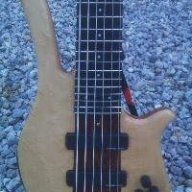
No worry, dingwall heck can handle 40+ lbs B string which has similar tension as both D and G string.
 
I prefer mine to be no bigger than 130 but it needs to be tapered. The taper is what gets rid of the floppy sound IMHO. I currently use a tapered 128 which is quite punchy.
Ive always had the opposite experience and found heavier strings gave me a tighter less floppy sound. And I always go with tapered strings just out of convenience.
 
  • Like
Reactions: 31HZ
In my opinion, on a 34" scale bass- a .125, sounds considerably better than a .130 or .135. Why? Thinner strings simply produce more pure harmonics. That Dingwall has longer lower pitched strings for a good reason. A piano tech showed me this, and I've never forgot it. He went over to a baby grand piano- I think it was a 6' or 8'. He played the low notes, and then one individual note- possibly a low 'B'.. but it might have been a 'C' Then, he went over to a concert piano, with a much longer harp. He pointed out the difference in the string diameter, of the note he played. The short piano used a much thicker string. He played the longer piano, and the note. The difference was incredible. The short piano produced a quick, tubby, and 'bonky' note. The longer piano with thinner low strings, produced a deep, clear and great sounding low note. THIS is why you see fourteen foot Bosendorfer pianos in Classical concert halls..
Going heavier will likely make things worse.
 
In my opinion, on a 34" scale bass- a .125, sounds considerably better than a .130 or .135. Why? Thinner strings simply produce more pure harmonics. That Dingwall has longer lower pitched strings for a good reason. A piano tech showed me this, and I've never forgot it. He went over to a baby grand piano- I think it was a 6' or 8'. He played the low notes, and then one individual note- possibly a low 'B'.. but it might have been a 'C' Then, he went over to a concert piano, with a much longer harp. He pointed out the difference in the string diameter, of the note he played. The short piano used a much thicker string. He played the longer piano, and the note. The difference was incredible. The short piano produced a quick, tubby, and 'bonky' note. The longer piano with thinner low strings, produced a deep, clear and great sounding low note. THIS is why you see fourteen foot Bosendorfer pianos in Classical concert halls..
Going heavier will likely make things worse.
Yep, they sound out of tune as well when fretted up high in fact weird overtones start at Eb and that's no good The benefit of less shifting goes out of the window when you can't use the B for as low as E and notes above from fret 5 all the way to the end of the fretboard.

Also everyone seem to want a 1 mm or less action, when low B can really benefit from being raised. The strings need some space to oscillate. and breath. if it is too low, you cannot pluck it to punch. Do some nut and saddle work , so that the B sits nicely , Use a zero fret, so may ways to improve the feel of the B. I personally like it at .120 although I will compromise at .125, I will not go thicker than that.


So for salsa and latin using an EUB or an acoustic, the way to get that punch tumbao is to udr solo strings ( which should be tuned to F#-B-E-A) Essentially thinner strings but set the actio0n a bit higher. You need that to get feet moving and hips swaying. Thin strings higher action, more oomph and cut
 
Last edited:
  • Like
Reactions: Dust2Dust
A 148 B at 37 inch scale is 55 pounds. A 160 is 63 pounds - that's quite a lot. Kalium's tension calculator does not have any limits on tension - it just calculates a value; whether or not it's too much they don't say.

If, however, you look at the GHS tension charts for bass guitar strings, they show tunings for every string up until... they go into the high 50's for tension, but not a single string has a tuning/tension listed at 60 or more pounds. I used to have a tension calculator app, and when the tension went above 60, ir showed the value in red (not recommended).

I'd say a 160 is pushing it.
 
In my opinion, on a 34" scale bass- a .125, sounds considerably better than a .130 or .135. Why? Thinner strings simply produce more pure harmonics. That Dingwall has longer lower pitched strings for a good reason. A piano tech showed me this, and I've never forgot it. He went over to a baby grand piano- I think it was a 6' or 8'. He played the low notes, and then one individual note- possibly a low 'B'.. but it might have been a 'C' Then, he went over to a concert piano, with a much longer harp. He pointed out the difference in the string diameter, of the note he played. The short piano used a much thicker string. He played the longer piano, and the note. The difference was incredible. The short piano produced a quick, tubby, and 'bonky' note. The longer piano with thinner low strings, produced a deep, clear and great sounding low note. THIS is why you see fourteen foot Bosendorfer pianos in Classical concert halls..
Going heavier will likely make things worse.
There is a reason the shorter piano didn't have skinny strings. Skinny strings are not the answer for any scale length.

The concert grand piano is probably 10x the price of the baby grand. There are a whole lot of variables there, not just string diameter - you're attributing the sonic difference of two very different things to one of many variables, which is myopic....at best.
 
Last edited:
Oh and its a 33.25-37 multi scale
Okie doke.
Here are Kaliums own string tension calc numbers based on multiscale lengths in inches from low to high
37 36.25 35.5 34.75 34 33.25
I’m assuming the .033 you list as part of the current .148 arrangement is not a typo and you didn’t mean the .031 that is in the desired 160 arrangement.


Screen grab 1 with 33-148 gauge input
IMG_0946.jpeg

Total Tension = 297lbf


Screen grab 2 with 31-160 gauge input
IMG_0945.jpeg

Total Tension = 298lbf

Seeing as you have upped some gauges but downed some others, the difference is only 1lbf overall. Your neck won’t notice.
Full steam ahead!
 
Last edited: