• TalkBass has been independent since 1998. Add your voice.
    Create a free account to reply to discussions, view embedded media, and browse with fewer display ads.
    Join freeLog in
    Want zero display ads or expanded classifieds tools? Compare plans.

How important it is to have 24 frets?

Reasons I like 24 frets:

1. Even 2 octaves per string. Whatever I do down the octave can be 100% moved up.

2. Easier access to the 20-22 frets due to the deeper cutaway

3. More chord options. Also more tapping options for melodies, which I play ~ 40% of the time.

4. Gives a good benchmark for notes past the neck when playing false harmonics.

I have basses with 21, 22 and 24 and play them pretty equally, but if I could, I would have 24 frets on all of them providing I didn't have to move pickups. Also, it's nice having a little buffer on each side. I rarely play an open low B0 or a C6, but having them there is nice in case I do.

Isn't there an old adage that says something about having something and not needing it is better than needing it and not having it?
 
  • Like
Reactions: HowieD72
IME, the correct instrument range configuration entirely depends on the gig.

Sure, many tunes do not call for the bass to play in the upper register.

But, it’s non-zero. For example, “A Remark You Made” is a lovely Zawinul composition, that used to get covered from time to time. It features prominent bass lyrical sections, which do include the high F and G on the G string. I’ve always wondered how Jaco covered it in the studio. Every live rendition has him fudging the part with false harmonics, which doesn’t work at all. LOL. Of course you could also transpose the last part of the relevant phrase down; but, that also ruins the melodic line.

Also, if you play much Jazz (and I recognize it’s getting fashionable to consider Jazz passé; but whatever), you may want to play some of the heads. Heads for tunes like Take 5 are definitely best in the upper register.

Of course, if you want to dumb the bass down into a convenient pigeon hole; then, of course, feel free to condemn everyone else’s choices. No doubt, Sweet Home Alabama or Staring at your Sneakers don’t require any more than 20 frets. Case closed.
 
There were 12 tones in the musical alphabet 60 years ago, and there are 12 tones in the musical alphabet today.

Playing a note in a higher or lower octave, outside the standard range of the instrument, is a cool effect but doesn't change the musical function of the bass line. There is a concept in music theory called "octave equivalence." An example would be, blues in Eb, some players would tune down a half-step and use the low open Eb, while other players would stay in standard tuning. Even though their Eb's are an octave apart, both types of players are perfectly well laying down the harmonic progression of 12 bar blues, and both are getting paid at the end of the night for a job well done.

For the record, I'm not a naysayer. I am a huge fan of alternate tunings, extended range instruments, multi-string basses, pitch-shifting effects, etc. But specifically in answer to the OP's "how important is it to have 24 frets?" question, my answer in this case is, "not very; while the extra frets extend your pitch range, they don't increase your musical vocabulary."

By using the concept of octave equivalency and transposing passages up or down as necessary, we can play any song in standard EADG tuning. Sure, if your favorite bass player has a 39-fret 7-string tuned to drop A#, it is cool to get your own bass just like your hero's (and if you are in a tribute band, owning one may be a job requirement). But if all you have is a standard P or J style bass, don't worry that you aren't "allowed" to play that song because your bass has the "wrong" number of strings or frets. I'd hate for any beginner who just bought their first bass (maybe a nice Squier Vintage Modified for example) get the impression they can't or shouldn't start learning their favorite songs because they don't own an extended-range instrument. Learn the notes and rhythm for now, and don't worry if you're not in the same octave as the recording; you're still learning and growing as a musician.

But by your logic, we could play any song in BEAD tuning with 24 frets. Or F#BEA tuning with 12 frets...

The octave is much more important than you think! My favorite song has lots of open low B's in the bass line, and there is absolutely no way that I can do it justice on an EADG bass.
 
1. There's one song I play in one of my bands that needs a 21st fret. I've never needed more than that in 30 years of playing.
2. Normally 5 strings give you 5 lower notes than a 4 string, not higher ones. You could tune it EADGC, but you would need to use different strings.
3. Having two of anything is more complicated than having one of anything.

Personally I don't like 24 frets because there's less room between the end of the fretboard and the front pickup. But that's me.

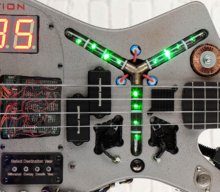
Other people like lots of frets, otherwise this wouldn't exist:
View attachment 3001614
That would just confuse me. I made it up to about the 18th fret, and got a nosebleed. Never wanted to do that again.
 
It really depends on what you're going to do with it.. I very rarely go that high up on the neck for most of the stuff I play. And I know it's cheesy but I like slapping still and anything with more than 22 frets feels uncomfortable.

That being said, I have a 24-fret yamaha that I'm considering to convert to a tenor bass and put light gauge strings on it. That'd be my fun bass that I can play melodies/chords etc.
 
I've got 26.. so I can't chime in.
View attachment 3001723

I see your bass and raise you one....

Wing-Bass-4-620x354.jpg


:p :whistle:
 
I like 24 for frets for a lot of tapping stuff makes it sound nice and it's a nice even spot for me. I dont use those high notes for anything else but tapping if it's a high g its most likely on the 12th. Its funny every one says Jaco didn't need it but on the other hand Les Claypools first Carl was 27 frets I think? I just know I prefer 32 scale so nice to play
 
I have a sadowsky 24 fret. Its only played above the 18th fret (high C#) this month in Little Shop of horrors when there is a high line. I've never needed a higher note in a professional situation. i want the extra range because I want to have it there if I ever do need it. Thats the same reason I have a 5 string. I can tune down to D but if I need lower I have it.
 
I make it work pretty well on a four-string, 21-fret bass, though a 24-fret six-string was my main for eight years.

A few years ago I made the transition back to four after determining that my style didn't call for all that extra range. The slimmer neck is comfortable and much easier to play on. I won't discount the useful nature of extended range basses, but it just isn't for me anymore.

If I do get nostalgic, though, C-F-Bb-Eb just to have fun. :D
 
I play the A above the E string 12th fret two times right at the end of one song. It's just the start of a plucked gliss down to the A on the 5th fret – three-finger triplets plucked at a fast tempo. I could do it on the A string if I had to. But it would be more difficult due to the E string getting in the way. It's easier to play the "gallop" with nothing behind your right hand fingers. Also, the open A is a less "meaty" sounding than the fretted A. So, I do prefer having that 17th fret on the E string, but if I had to, I could avoid it.

I briefly play F# on the G string 11th fret in one song (that we haven't played in a long time, and likely never will again).

I can't think of any other time that I go much beyond the 9th fret or thereabout. Probably 80–90 percent of my playing is from the 3rd–9th frets.

In other words, I could get by easily with 12 frets if I had to.
 
Last edited: