• TalkBass has been independent since 1998. Add your voice.
    Create a free account to reply to discussions, view embedded media, and browse with fewer display ads.
    Join freeLog in
    Want zero display ads or expanded classifieds tools? Compare plans.

How Is Fender USA Quality Control Soooo Horrible?

Status
Not open for further replies.
it’s funny, you can do a simple search and every image you see they are not exact.
even on Fender website this is just how they are. Been like this for centuries.
View attachment 5472271
Here's a Lakland. The width is spot on! But.....then there's a gap in the center:laugh:
lakie jazz.jpg
 
Well, is a waterjet a ‘machine?’ It is certainly CNC controlled. And it would likely be cheaper to lay one big sheet over the table and cut, say, 100 Jazz plates at a time than to invest in the tool and die to stamp them from a blank one at a time.

Plus, you could just change the program when you had enough on hand and make any other flat component you needed (Telecaster plates, for example).

Worth considering
They’re stamped, cut with a die. Always have been.
Same as every other plate part. It’s way more cost effective.
 
  • Like
Reactions: SuperTheBass
This thread can actually be very useful.

Make a list of everyone who can't see (or refuses to care about) the defect, then when one of those people either sells something on here (or builds something for sale), you can weigh their level of attention to detail and take that into consideration when they describe something as "perfect" or "mint", etc.
 
Squier (*by Fender) can figure it out for 1/4 of the price new using a lot of the same components and supplies.
IMG_0093.jpeg IMG_0094.jpeg

Of course, Squier has its own QC issues.

Had a friend who bought a Fender Jazz Ultra, and then was talking about how he needed to shim the neck because the action is a little high but the saddles were bottomed out, and that shimming is a perfectly normal acceptable thing to do for a bass. And like, yeah, maybe shimming is a perfectly reasonable repair, but on a brand new instrument, right out the factory, for the price of a Fender Ultra?

But also Fender can get away with it, because as long as they put that Fender sticker on the headstock, people will buy them and refuse to buy anything else because "Fender is the best" regardless of the actual quality of the instruments. {shrugs}
 
Like just about any average Jazz Bass. Nothing special.
that's too bad...but it's a fender! ;) you might be expecting too much from the fender brand. OTOH, as with any brand: you can get lucky and the perfect player falls into your lap. hope your next fender is better. good luck! :thumbsup:

Here’s some jazzes I’ve had over the years, some of em were a perfect fit some weren’t. All sounded and played pretty darn good though, for what that’s worth.
:thumbsup: that's great...and they're fenders! :bassist:

...it's a Fender, the way Fenders have always been. The problem is the price is too high.
:thumbsup: agreed, for what they are = price is too high!
 
  • Like
Reactions: LadyLoveStingRay5
This thread can actually be very useful.

Make a list of everyone who can't see (or refuses to care about) the defect, then when one of those people either sells something on here (or builds something for sale), you can weigh their level of attention to detail and take that into consideration when they describe something as "perfect" or "mint", etc.
Had this conversation too many times in my life:
"It's in mint condition!"
No. It's not dude. Mint condition means the exact condition it was minted in. The condition it would be in if you walked into the mint/factory/shop and grabbed the newly finished product. This is excellent condition at best, maybe very good condition, because of all these blemishes and you modified it.
"You don't know what you're talking about! This bass is in mint condition, and my modifications are upgrades that improve the price!"
A modified bass can't be "mint." Anything altered isn't mint.
"You don't know anything!"
Ok. Have fun selling it. :whistle::p;)
 
I sent a Telecaster back to Sweetwater because the pickguard and bridge were misaligned. So, little things like this do bother me, too.

That said, this thread is typical TB hyperbole. "Non-existent quality control". I appreciate the high standards you have, but...really?

When I sold pianos years ago, a customer custom ordered a >$200k grand piano from Steinway and they shipped it out with the huge engraved "Steinway & Sons" lettering *very* crooked on the fallboard. It could not have been missed. Probably 20 people signed off on that. All of our sales staff were baffled. It still baffles me to this day.

That to me is an unforgivable manufacturing error. I would not tolerate that on even the cheapest new piano.
Wait just a darn second. How did this get by the 55 point inspection performed by a highly trained Sales Engineer?
 
Wait just a darn second. How did this get by the 55 point inspection performed by a highly trained Sales Engineer?

Actually, I did experience a major Sweetwater mishap.

They shipped a new Fender bass to me that they Plek'ed with a very low fret.

It was a terribly obvious mistake had they actually played the bass. It fretted out so bad that there was no note when you played anything above the xx fret (whichever fret it was).

They really dragged their feat on correcting the issue. They were happy to take my money and ship the bass out asap when I purchased it. However, when it came time to correct their mistake, they moved me to the end of the queue, so I had to call and raise hell about it. Sweetwater is also capable of poor customer service sometimes, unfortunately.
 
I like how it's so bad, that OP had to zoom in to make sure we all noticed.

THIS is the most TELLING post in this thread.

You are actually complaining at the level of detail in my original post.

You seem a bit miffed that I included detailed up-close shots at different angles to highlight the defects for those who can't (or refuse to) see them (or care about them).

And, you liked the person's post who couldn't see anything amiss stating, "It looks ok to me."

20240607_160734.jpg


Attention to detail is a great thing.
 
Last edited:
If everything is CNC today, how do end up being that far off?

Simple answer is tolerance stacking.

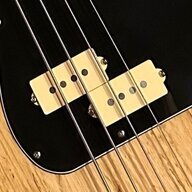
Longer answer is still tolerance stacking, but with more words. Every single screw hole has a dimension from one or more surfaces on the body of the bass. So does the neck pocket, and the routing for the pickups, control cavity, etc.

All of these have an amount +/- they can deviate from that dimension. The tighter that tolerance, the more time and cost you incur holding that tolerance. A CNC machine is very good at holding tolerances, but it is not, nor can it ever be, perfect.

So as a designer* we have to decide what areas need to be held closest, and which ones can vary. In the case of a Jazz bass, I'd try to nail the neck pocket, and the pickups and bridge will all be based on that pocket, because those are more location critical based on distance from the frets, alignment with the neck, and so on. The control cavity can more or less be wherever, so who cares.

The pickguard is kind of the same. By itself it's really of no importance, except that here, you have a choice to make. It's relieved to go around the pickup, and to fit around the control plate. So which do you favor? Well, since the pickup is an important piece, you probably want the pickup opening to be favored, which means that the control plate isn't.

So, you have a tolerance for the neck pocket, which impacts the pickup position which itself has a tolerance, which impacts both location and angle of the pickguard, and it's interface with the control plate, which of course has it's own location tolerance.

And this doesn't even get into the fact that both pickguard and control plate have their own overall dimensional tolerances from their separate manufacturing processes that will impact all of the above. For example, even if all the above mentioned holes and routings in the bass body are 100% accurate with no deviation, if the opening in the pickguard is off and at a slight angle, then it's interface with the control plate will be off.

Some of this can be helped with order of operations, like maybe not drill the screw holes for the pickguard until the pickup placement is set (using a template over the pickup, perhaps) or by doing some final fit/finish work by hand, like trimming a bit off the pickguard so it doesn't look out of place, or reshaping the end of the control plate, etc. But that takes a lot of extra time and ends up with bespoke parts that can't always be easily replaced later, as any replacement would need to be fitted as well.

TL : DR- Tolerances impact tolerances, machines aren't perfect, and getting as close as one can will cost more in time, money, or both.

*- I'm a mechanical designer who has done work with stamped, bent, machined, etc bits of metal and plastic. There is almost always an option to hold tighter tolerances, but cost is a big factor. If nothing else, the machine runs slower to keep those tolerances. Some machines are better than others of course, but those usually also cost more. Always about the $$.
 
*- I'm a mechanical designer who has done work with stamped, bent, machined, etc bits of metal and plastic.

Oh my God...you're a designer and you couldn't see anything wrong with my bass???!!!?!???

Wow.

You have completely validated my previous post about making a list of people who think this is acceptable quality for $2000:

"This thread can actually be very useful.

Make a list of everyone who can't see (or refuses to care about) the defect, then when one of those people either sells something on here (or builds something for sale), you can weigh their level of attention to detail and take that into consideration when they describe something as 'perfect' or 'mint', etc."


Thank you.

I'm out.
 
Last edited:
Status
Not open for further replies.

Latest posts