
Enjoy the benefits of a premium membership!
Upgrade Account
-
TalkBass has been independent since 1998. Add your voice.
Create a free account to reply to discussions, view embedded media, and browse with fewer display ads.
Join free Log in
Want zero display ads or expanded classifieds tools? Compare plans.
You are using an out of date browser. It may not display this or other websites correctly.
You should upgrade or use an alternative browser.
You should upgrade or use an alternative browser.
How is the sound from a Gibson EB2?
- Thread starter v man
- Start date
More options
Who Replied?
They sound terrible. Boomy, muddy, but with no definition. The last time I played one of these on stage (last year), the sound guy came up and told me there was something wrong with my amp. There wasn't, of course. It was that bass.


They sound terrible. Boomy, muddy, but with no definition. The last time I played one of these on stage (last year), the sound guy came up and told me there was something wrong with my amp. There wasn't, of course. It was that bass.
Beat me to it... But wait! Here comes the F L A M E S!
thick chocolatey toned
"Chocolatey" isn't the word I'd use to describe the tone of an EB-2. You're not far off, though. It'd be a different substance, the same color as chocolate, but with a far different aroma.


I believe the Epiphone Rivoli and Gibson EB2 are virtually the same instrument/same tones, barring a few cosmetic differences. Nothing wrong with Chas Chandler's tone with his Rivoli on one of the most famous basslines in rock history:
Using a pick is essential, IMO.
Using a pick is essential, IMO.

Ric5
Inactive
- Jan 29, 2008
- 29,772
- 30,452
- Disclosures
- I like 5, 8, 10, and 12 string basses
Listen to Jethro Tull Benefit
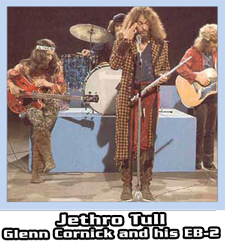
These basses can sound very good if you set the bass flat and boost the mids.
These basses can sound very good if you set the bass flat and boost the mids.

- Feb 16, 2008
- 21,240
- 23,636
- Disclosures
- John K Custom Basses

Wow... awful lot of bashing going on. I'm not a hollowbody Gibson scale fan, but I'm sure plenty of usable sounds can be gotten out of one of these basses. I just got a '77 Ibby dbl neck Gibson copy (bass/guitar) EB-3/SG that (after some pickup install work) will definitely see some gig time.

Remember, bass tone is made up of numerous elements all working together as a package.
body construction
strings
pickups
pre-amp/processors
amp
cabinet
technique
If you start with an entire bass rig/setup and switch from a Fender Jazz bass to a Gibson EB-2 without changing anything else, it's going to sound muddy, boomy or lifeless.
If fact, I switch all the time between these two bass/pickup types in live gigs because some songs we play need a growly rock edge and some songs need the old school thump. The amp I have has two completely separate channels with their own EQ settings and I have to set them drastically different in order to get the sounds I want.
The key to really getting good sound (from any setup) is lots of experimentation and knob twiddling. Enough experience with this and you can get tons of tone and vibe from the "mudbucker" pickup.
body construction
strings
pickups
pre-amp/processors
amp
cabinet
technique
If you start with an entire bass rig/setup and switch from a Fender Jazz bass to a Gibson EB-2 without changing anything else, it's going to sound muddy, boomy or lifeless.
If fact, I switch all the time between these two bass/pickup types in live gigs because some songs we play need a growly rock edge and some songs need the old school thump. The amp I have has two completely separate channels with their own EQ settings and I have to set them drastically different in order to get the sounds I want.
The key to really getting good sound (from any setup) is lots of experimentation and knob twiddling. Enough experience with this and you can get tons of tone and vibe from the "mudbucker" pickup.

Ric5
Inactive
- Jan 29, 2008
- 29,772
- 30,452
- Disclosures
- I like 5, 8, 10, and 12 string basses
The Gibson eb0, eb1, eb2, and eb3 were responsible for some classic bass recordings. Listen to Cream, Mountain, old Jethro Tull, Free, and the first Boston album. You have to EQ them properly. Set the bass flat and boost mids and set the treble where you like. With the fat neck pickup you get some sweet higher bass notes on the G string.
The Gibson EB basses are not my favorite, and they are not good basses for slap, or Rush, or Yes ... but they have their own cool sound.
The Gibson EB basses are not my favorite, and they are not good basses for slap, or Rush, or Yes ... but they have their own cool sound.
then i guess that no one above ever clicked in the inductor button which removes ALL of the mud. i think that they sound great, but i prefer the EB2-D (D=double pickup which is what the OP's first pic actually is).
It removes all of the mud, you bet. It also removes all of the bottom end.
I believe the Epiphone Rivoli and Gibson EB2 are virtually the same instrument/same tones, barring a few cosmetic differences. Nothing wrong with Chas Chandler's tone with his Rivoli on one of the most famous basslines in rock history:
Using a pick is essential, IMO.
The bass tone in those songs is dreadful. The songs were hits, and that particular bass tone is inextricably identified with them, but the tone in and of itself is awful.
Remember, bass tone is made up of numerous elements all working together as a package.
body construction
strings
pickups
pre-amp/processors
amp
cabinet
technique
If you start with an entire bass rig/setup and switch from a Fender Jazz bass to a Gibson EB-2 without changing anything else, it's going to sound muddy, boomy or lifeless.
If fact, I switch all the time between these two bass/pickup types in live gigs because some songs we play need a growly rock edge and some songs need the old school thump. The amp I have has two completely separate channels with their own EQ settings and I have to set them drastically different in order to get the sounds I want.
The key to really getting good sound (from any setup) is lots of experimentation and knob twiddling. Enough experience with this and you can get tons of tone and vibe from the "mudbucker" pickup.
I've tried every adjustment available on several amps to get a decent sound out of an EB-2. Never worked. But if you have suggestions on amps/settings I might not have tried, I'm open to suggestions.

Flats with a couple of "15s push by a Dual Showman, you'll be fine
- Feb 16, 2008
- 21,240
- 23,636
- Disclosures
- John K Custom Basses

well, i've gotten some great sound out of mine.
and i always loved the EB2's tone on the song 'shapes of things' by the yardbirds (and that was before i realized the he was using one).
You might want to investigate this further. Paul Samwell-Smith often brought in a session bassist because he was in the control room during the recording sessions. You may have heard a double bass.
- Feb 16, 2008
- 21,240
- 23,636
- Disclosures
- John K Custom Basses
You might want to investigate this further. Paul Samwell-Smith often brought in a session bassist because he was in the control room during the recording sessions. You may have heard a double bass.
nope. it was definitely an EB2 (with the single pickup). and it never sounded like a double bass at all to me. now that i own a couple of them, it's easy to recognize and i can duplicate that tone exactly.


