• TalkBass has been independent since 1998. Add your voice.
    Create a free account to reply to discussions, view embedded media, and browse with fewer display ads.
    Join freeLog in
    Want zero display ads or expanded classifieds tools? Compare plans.

How many rosewood board instruments do you have versus maple boards?

What's your ratio of maple boards versus rosewood?

  • I only have necks with maple boards.

    Votes: 15 5.0%
  • More maple than rosewood.

    Votes: 42 13.9%
  • I have an even collection of maple and rosewood.

    Votes: 51 16.8%
  • More rosewood than maple.

    Votes: 127 41.9%
  • Only rosewood.

    Votes: 68 22.4%

  • Total voters
    303
Purpleheart and ebony here for this fretless only player, Jatoba seems like it would be way cool but I've only seen it on speed bumped instruments.
Yes, on an average Purple Heart and Jatoba are bit softer than Ebony, but a bit stiffer, Purple Heart being slightly softer than Jatoba, but slightly stiffer.

But it is pretty close, and I would think within variations in the individual pieces of wood you could find pieces of each of these types of wood that would have same hardness and stiffness.

This is a great source of information for these kind of data: The Wood Database
 
Last edited:
  • Like
Reactions: Passinwind
Yes, on an average Purple Heart and Jatoba are bit softer than Ebony, but a bit stiffer, Purple Heart being slightly softer than Jatoba, but slightly stiffer.

But it is pretty close, and I would think within variations in the individual pieces of wood you could find pieces of each of these types of wood that would have same hardness and stiffness.
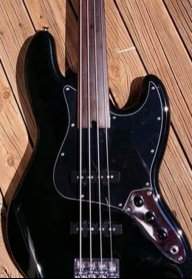
The purpleheart board on my current #1 fretless is epoxy infused in a proprietary way (not glossy or thick and you can still clearly see the grain pattern), at 5 years in it with pressurewound strings it seems to be holding up exceptionally well.
 
  • Like
Reactions: Ritter667
The purpleheart board on my current #1 fretless is epoxy infused in a proprietary way (not glossy or thick and you can still clearly see the grain pattern), at 5 years in it with pressurewound strings it seems to be holding up exceptionally well.
Different pieces of the same species can vary quite a lot as mentioned above.
The rosewood board on my Warmoth fretless neck was, in the words of the luthier who did the leveling for me when it was very worn, "the softest piece of #### rosewood ever...... should have only been used on a fretted neck". He decided to epoxy it for me.... first time he's ever done an epoxy job. It's a very thin coat but is now well over 10 years old with hundreds, if not well into the thousands, of hours of use. It has some string marks which appeared very early on but is showing no signs of real wear. Should last longer than I do.
 
  • Like
Reactions: Passinwind
Different pieces of the same species can vary quite a lot as mentioned above.
The rosewood board on my Warmoth fretless neck was, in the words of the luthier who did the leveling for me when it was very worn, "the softest piece of #### rosewood ever...... should have only been used on a fretted neck". He decided to epoxy it for me.... first time he's ever done an epoxy job. It's a very thin coat but is now well over 10 years old with hundreds, if not well into the thousands, of hours of use. It has some string marks which appeared very early on but is showing no signs of real wear. Should last longer than I do.
Cool! My Travis Bean fretless had a rosewood board with no obvious finish at all that still looked fine after 40 years, and it was my only bass for over half that time. It came with Rotosound rounds back in '77, but I mostly used half rounds or in later days pressurewounds with it.