• TalkBass has been independent since 1998. Add your voice.
    Create a free account to reply to discussions, view embedded media, and browse with fewer display ads.
    Join freeLog in
    Want zero display ads or expanded classifieds tools? Compare plans.

How much music theory do you really need to know?

Sunday matinee, the understudy for Liza Doolittle is going on in place of the marquis actress, and five minutes before curtain the music director announces to the orchestra "Note, all of Liza's numbers will be played down a whole step."

Happened all the time years back at a TV church. Rehearse 2-4 pm, tape 6 pm. Good exercise. Learn everything closed position. Why I always brought a 5 string.

Prima Donna got her way until the Easter and all those contract string and brass players only read whats on the paper. I think the understudy pushed up.
 
  • Like
Reactions: DJ Bebop
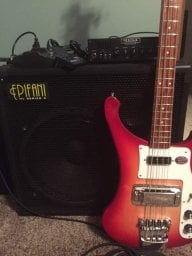
View attachment 4854401

To be able to read music you need to learn to read the notes on the staff and how they correspond to the mechanical things you need to do to produce them like, pluck the string, push the key, or blow the note, first.

And that is taught before any kid or adult knows the notes that form a diminished chord and why, or have to know that an ASCENDING SCALE, is a peculiarity of the minor scale adopted in modern music, that its form is frequently varied by accidental chromatic alterations, to satisfy what are assumed to be the requirements of the ear; and as these alterations most commonly take place in ascending passages, it is usual, in elementary works, to give different forms of the minor scale, for ascending and descending.

You don't need to know cycle of fifths, cycle of fourths, chords, arpeggios, to read dots on paper. But if one keeps at it, they will.

Yes at first you learn the staff and the symbols used on the page to read the music but that is not music theory in itself, it is part of it though.

Matter of fact there are a lot of readers that have been reading music for years and still don't know these things. Of course IMHO

:)

The diminished and augmented scales make such pretty patterns on the fretboard.

Guitarist Howard Roberts spoke of "sonic shapes" and I think he infected Pat Metheney.
 
  • Like
Reactions: DJ Bebop
How can someone "learn the song" when there's no time, no recorded material to listen to, the song was never heard before, the songs belongs to an unfamiliar musical genre, all the available information about the song is written in a piece of paper and the person can't read music?

I'll help. That person won't learn the song.

Reading music is not theory.
 
  • Like
Reactions: DJ Bebop
Communication among people fluent in theory is so much more effective and satisfactory.

Imagine you're describing a tune to someone fluent in theory. You might just say something like:
- "play a major ii-V-I in Bb, then a minor ii-V-i in the relative minor, then a cycle of dominants (2 bars each) starting on the III7 and come back to the top"
and they will instantaneously hear the chord progression you're describing to them an can start playing it right away with you

Trying the same with someone with zero theory background, you will need to tell them: "put this finger here, then that finger there, then blablabla" for hours, or tab it for them...

On the other hand, if they are really good hear players, you might just play the chord progression once for them and they will get it. That's fine too.
 
parts have to be played exactly as they were written... There's no room for illiteracy here.

Yes, you play the song as written.

Standard Notation alone will only get you so far and even when fully annotated it is incapable of capturing, encoding or conveying every nuance. It is not a deterministic language and offers no guarantees as to the nature or quality of the outcome. The success of process of parsing a score into actual music relies on the musicianship of the player - their ability to interpret the score (join the dots), imagine the intent and actually realise those sounds on the instrument in hand. Not only practical skills, but also personal taste, insights, experience and general understanding of music on a visceral level make up the shortfall in the notation.
 
Pretty interesting read all in all. In a sense, everyone is right. I am reminded that what we mean when we say we are bass players varies greatly. I have a suspicion that many here are weekend warriors playing covers in a suburban setting. Not a single thing wrong with that. You get the recording, you memorize the bassline. Most of us start that way. I remember being pretty popular because I could play YYZ note for note. Then there are others of us who come up learning music in school in orchestra class where we have to read. Those kids often couldn’t jam with anyone, but they could read. Also cool. Then there are those who took up Jazz and were given a chart for Oleo and had to play something they compose on the spot. They could read a chart down but they also had to solo which meant they started to study chords, apreggios, scales, leading tones, substitutions. Most could read. And lastly there were those who’s curiosity also led them to want to play with all kinds of people, all kinds of music, learn quickly on the stand, pride themselves on being able to play anything. These, aside from classical musicians, are the professionals I meet and play with. It is common that everyone I meet can do it all, at the drop of a hat, play consistently great under any conditions. Most of those people would never look down on anyone when playing music with them whichever level they fall in the spectrum. They know it matters and it doesn’t. When you play your first notes with anyone, all that matters are the sounds you are making together. In order to play good music you meet each other where you are. The music is what matters.
 
For me, it's all connected: theory, reading, ear training, fingerboard knowledge, rhythm, etc. They aren't disconnected things that I have to learn and then force together. All of these elements naturally meld together when I've put enough time in on them. I can't NOT see a G minor triad if I'm reading a bar of music with the notes G, Bb and D. That information is etched into me. When I see those 3 notes on the chart, I instantly see in my head the G minor triad laid out in different locations on the fingerboard because I've spent time working that stuff out. If I need to transpose that music, no problemo because I've worked it out.

There isn't a one-size-fits-all. I think everyone has to decide for themselves the kind of musician they want to be and figure out the right path. I've always been the type of player who wants to be able to cut any gig that comes my way, so I try to be as ready as possible by continuing to fill in the gaps. I don't think there is a "how much theory do I need to know". I just want to keep pushing forward. Maybe I'll be satisfied when I can hear any tune and immediately be able to play it in 12 keys or can transpose any piece of music to all 12 keys. Probably not...
 
the bass clef, the time signature, the key, the tempo, whole notes, half notes, quarter notes, sixteenth notes, etc., dynamics, bar lines, fermatas, codas, etc.... none of this is music theory?
It depends upon what people want to call music theory. What you describe comprises the various conventions used to write music on paper. Yet when knowing all this, one can read music and play it from sheet music, but one still does not know much about music itself, how it is structured and organized, about harmony and the many diverse styles of music.

Generally one considers that music theory encompasses not only all of the above, but also concepts that refer to the music itself, such as rhythmic structures, harmony, counterpoint, form, orchestration, etc.
 
It depends upon what people want to call music theory. What you describe comprises the various conventions used to write music on paper. Yet when knowing all this, one can read music and play it from sheet music, but one still does not know much about music itself, how it is structured and organized, about harmony and the many diverse styles of music.

Generally one considers that music theory encompasses not only all of the above, but also concepts that refer to the music itself, such as rhythmic structures, harmony, counterpoint, form, orchestration, etc.
Right, but it doesn’t make the stuff Smooth mentioned “not theory.”
 
This is why I read TB. Thanks.
20200901_161935.jpg


This was 2 years ago. Do you see the mistake?
 
  • Like
Reactions: DJ Bebop
Right, but it doesn’t make the stuff Smooth mentioned “not theory.”
Yes, it is part of music theory, but it's not all of music theory. It's the part that helps you read the dots on paper.

The bass clef, the time signature, the key, the tempo, whole notes, half notes, quarter notes, sixteenth notes, dynamics, bar lines, fermatas, codas, are all reading dots on paper tools. It teaches you how not why. That is what the rest of music theory does.

Like language, I can read the word 'is' and speak it and use it in a sentence but, by just reading it or using it doesn't teach me the word is a verb, unless I know the rest of the rules of language.
 
  • Like
Reactions: JimmyM
IMHO the answer to the OP's question: "How much theory do you really need to know?" is the same as to those other questions:
- "how much ear training do I need?"
- "how much music should I listen to?"
- "how much should I practice?"

My own answer to those questions is:
"As much as you can, knowing that won't be enough. Therefore you're never done with learning, ear training, listening, practicing. It's a life long journey."
 
IMHO the answer to the OP's question: "How much theory do you really need to know?" is the same as to those other questions:
- "how much ear training do I need?"
- "how much music should I listen to?"
- "how much should I practice?"

My own answer to those questions is:
"As much as you can, knowing that won't be enough. Therefore you're never done with learning, ear training, listening, practicing. It's a life long journey."
This is the correct answer!

:)
 
Yes, it is part of music theory, but it's not all of music theory. It's the part that helps you read the dots on paper.

The bass clef, the time signature, the key, the tempo, whole notes, half notes, quarter notes, sixteenth notes, dynamics, bar lines, fermatas, codas, are all reading dots on paper tools. It teaches you how not why. That is what the rest of music theory does.

Like language, I can read the word 'is' and speak it and use it in a sentence but, by just reading it or using it doesn't teach me the word is a verb, unless I know the rest of the rules of language.
Ok, I buy into that ;)
 
  • Like
Reactions: DJ Bebop