• TalkBass has been independent since 1998. Add your voice.
    Create a free account to reply to discussions, view embedded media, and browse with fewer display ads.
    Join freeLog in
    Want zero display ads or expanded classifieds tools? Compare plans.

How much time do you spend jamming to a drum looo or Jan track?

Apparently.

Because I honestly can't stand classical music. Some people hate Hip Hop, Country, Polkas whatever, and are perfectly ok with that.

If you love classical, that's a beautiful thing. Enjoy.

OK, not liking a genre is no reason to make snides at folks from that tradition. I love pop, rock and jazz/fusion, I'm not a big trad or bebop fan but I can appreciate it, but my first love, along with my background and formal training is all classical.

Anyway, here's a petty insult back at you, then we're even: Most people who say they hate classical.music don't actually hate it, they're just not ready for it yet.

:thumbsup:
 
OK, not liking a genre is no reason to make snides at folks from that tradition. I love pop, rock and jazz/fusion, I'm not a big trad or bebop fan but I can appreciate it, but my first love, along with my background and formal training is all classical.

Anyway, here's a petty insult back at you, then we're even: Most people who say they hate classical.music don't actually hate it, they're just not ready for it yet.

:thumbsup:
You're so cute when you're angry...
 
You never put a needle into a record groove over and over? Hit the rewind button on a cassettes player? None of that?

Only sheet music, huh...

Oh yeah, there were lots of records and tapes ... mostly to get the words, but I did play/sing along with them sometimes. I've hardly ever had to play stuff "just like the record," so the chord structure, rhythm patterns, and arrangement were what I was looking for.
 
Oh yeah, there were lots of records and tapes ... mostly to get the words, but I did play/sing along with them sometimes. I've hardly ever had to play stuff "just like the record," so the chord structure, rhythm patterns, and arrangement were what I was looking for.

So you still don't see where I'm going with this eh? It's fine... Don't worry about it. But the times haven't changed as much as you seem to think.

But when you were doing it, it was ok, right? Working with it in a way you saw as "correct"...
 
Yes, I can see you're a lot smarter than I am, so I'll just be quiet here and go back to the double-bass side.
I'm quite sure I'm no smarter than you. But I don't try to tell people how they have to approach their musical craft. It's too wide and deep for any one interpretation.

I'm not gonna tell anyone "what you're doing isn't this, or that."
 
  • Like
Reactions: OldNARDGuy
Respectfully disagree. Jam tracks are literally a substitute for that. There are many endeavours that can be practiced in a simulated environment when real-world practice is not available. Of course it is not as good as real-world, but real-world is not an option right now. Pilots use flight simulators, astronauts use simulators, hell even F1 drivers use games to help them learn the tracks better.

Anyway, you do you, and I'll do me :)

The games you speak of are way better at simulating reality than any musical loop. Regardless, I maintain that unless you are going out to play gigs with machines, jamming with loops won't help. I say that because the loops don't interact with you. In a "jam" situation, which I assume has an element of improvisation, the players play off of one another. A loop won't help you with that at all.
 
Composing isn't practicing, but it involves stretching your creative and improvisational skills, which is why I mentioned it. That's something that most of us would do well to include as part of our practice routine in whatever way we can.

That's not practicing. Practicing isn't about being creative. It's about learning things you can't do already. If it sounds creative, you should be working on something else. The tools for improvisation are things you learn and study, but stretching out your improvisation is something you do while being creative, which occurs during real playing situations. Call me Jeff Berlin if you want to. He's right about what to practice.
 
A loop won't help with that.

In your opinion.

I have my own opinion, and that is that I'd rather not sacrifice the good for the sake of the perfect.

I'd much rather go into a real-world session having some experience to playing along to stuff, even if it's only a loop.

I honestly can't fathom how you don't see there is any benefit to that. But hey, that's what makes the world go round, so we'll just have to agree to disagree on this one!
 
In your opinion.

I have my own opinion, and that is that I'd rather not sacrifice the good for the sake of the perfect.

I'd much rather go into a real-world session having some experience to playing along to stuff, even if it's only a loop.

I honestly can't fathom how you don't see there is any benefit to that. But hey, that's what makes the world go round, so we'll just have to agree to disagree on this one!

Fair enough. I play with loops when I'm paid to do so, and I don't have any problem doing it even though I've never practiced with them. So, there's no benefit to me, but if it benefits you, that's cool.
 
Metronome<Drum Loop<Making music with others musicians.

IMO YMMV

Gotta agree with this flow chart. Playing with different drummers is an education all by itself. The three drummers I work with most often are all on wildly different parts of the rhythm spectrum. One lays back, one is very centered, and one pushes the beat REALLY hard. If you insist on sticking to your internalized metronomic rhythm, the band will sound bad. You've got to be flexible and play nice with whomever is on stage/in the practice room with you. An interesting aspect of playing with a drummer that's on top of/borderline ahead of the beat is that you have to respect that he's going to be early in certain places, and that gives you the weaker parts of the beat to kind of incognito reign things back in and get that measure under control . . . . . until the next downbeat. It's a lot of work, actually.

AND IF YOU DISAGREE WITH ME I WILL BE SO PERSONALLY OFFENDED THAT YOU WILL HEAR MY REEEEEEEEEEEEEEEEEEEEEEEEEEEE FROM SPACE
 
  • Like
Reactions: Lownote38
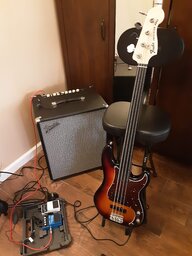
I think some people are stuck on the "either/or" mentality. I play a fretless bass. Alone I do 2 things to practice - I play scales and watch the tuner, or play to some canned MP3's that allow me to hear my intonation, and I use a Beat Buddy to practice timing and pocket playing (and because that is easy to get going and fun to do).

Both are required if you are going to play in a live situation with others. I really don't see how they are exclusive practice routines - they compliment each other.