I worked in the antiques business and when we wanted a plastic replacement part to look like old ivory or bone we would usually scuff it with scotch-brite, wipe it with wood stain, and then feather some colored spray can lacquer over it to give it some tonal variation. If we were going for a perfect match to an existing part, I would use an airbrush for more fine control. This process gives excellent results, but may take some experimentation. If you don't like the result, you can always clean or sand off the top layer and start over.

Enjoy the benefits of a premium membership!
Upgrade Account
-
TalkBass has been independent since 1998. Add your voice.
Create a free account to reply to discussions, view embedded media, and browse with fewer display ads.
Join free Log in
Want zero display ads or expanded classifieds tools? Compare plans.
You are using an out of date browser. It may not display this or other websites correctly.
You should upgrade or use an alternative browser.
You should upgrade or use an alternative browser.
How to age a white pickguard?
- Thread starter Micolao
- Start date
More options
Who Replied?
Next, mix yourself up some of the yellow powder with a little water
What to use for the powder? Turmeric?
I had a pickguard like this:
http://cgi.ebay.com/USA-Fender-Tele...Pickguard_W0QQitemZ170305499236QQcmdZViewItem
on a jazz that I used to have. They're made to be a light mint green color that supposedly mimics the color vintage white pickguards age to. The bass I had it on was black (and looked spankin' brand new) and I thought it didn't look all that great, but other folks dug it. It might look better on your cream bass.
IMO, I think a brown tortoise or a black guard looks better on cream basses. I also think it helps to have a worn looking bass to match your worn looking pickguard.

http://cgi.ebay.com/USA-Fender-Tele...Pickguard_W0QQitemZ170305499236QQcmdZViewItem
on a jazz that I used to have. They're made to be a light mint green color that supposedly mimics the color vintage white pickguards age to. The bass I had it on was black (and looked spankin' brand new) and I thought it didn't look all that great, but other folks dug it. It might look better on your cream bass.
IMO, I think a brown tortoise or a black guard looks better on cream basses. I also think it helps to have a worn looking bass to match your worn looking pickguard.
As an eBay Associate, TalkBass may earn a commission from qualifying purchases.
I worked in the antiques business and when we wanted a plastic replacement part to look like old ivory or bone we would usually scuff it with scotch-brite, wipe it with wood stain, and then feather some colored spray can lacquer over it to give it some tonal variation. If we were going for a perfect match to an existing part, I would use an airbrush for more fine control. This process gives excellent results, but may take some experimentation. If you don't like the result, you can always clean or sand off the top layer and start over.
"Feather"?
bassrique, that is a damn fine looking strat you linked to, and I've never uttered the phrase "fine looking strat".

bongomania
Commercial User
You know that's actually not a bad idea! I mean I'd feel silly buying a carton of smokes, and when the cashier says "what kind" I'd have to say "I dunno, they're not for me, they're for my bass." But rigging up a little smoke-concentrating box would probably work quite well.
But rigging up a little smoke-concentrating box would probably work quite well.
bongomania
Commercial User
"Feather"?
Lightly spray in a delicate quick sweeping motion.
Lightly spray in a delicate quick sweeping motion.
^^ Yes.
Also, I would like to try the cigarettes thing sometime, but I would think it would make the pickguard reek. That's a very hard odor to get rid of.
Seymour Duncan (many years ago) told me to use "Kiwi" brand Black shoe polish - just wipe on and wipe off. I can't remember now if he told me to leave it a while before wiping off (it was over 20 years ago). I assume other brands would work as long as they contain some sort of alchohol base.
I'd STRONGLY recommend trying it on a SMALL part of the underside of the plate first.
I'd STRONGLY recommend trying it on a SMALL part of the underside of the plate first.

There is a device called a magnuflux machine that is used (in conjunction with a huge electromagnet and fluid with iron particles) to find cracks in steel and cast iron automotive parts.
ouch
 there were a couple of these in the place where I used to work...
unfortunately I don't have access there anymore...


Steel wool and RIT dye. Use the steel wool to "rough up" the surface of the pickguard a bit. Then, give the pickguard a bath in some tan dye. The dye works pretty quickly, so check it every 15 minutes or so. If I recall, 15-30 minutes was all it took. Take it out, dry it off and take a look. The use the steel wool again to "clean it up" as desired. The final use of steel wool will actually make the pickguard look less aged, so you can use it intelligently so that certain parts of the pickguard look more aged/dirty/worn that others.
Figuring out with parts should look more aged than others is the hard part. This is the difference between making it look like an old pickguard and a pickguard dipped in dye. Hint: around the knobs and immediately below the strings (where your hand hits if you slap) should probably look a little more aged than directly beneath the strings.
Its just a pickguard. RIT dye is only a couple dollars. Have fun!
Figuring out with parts should look more aged than others is the hard part. This is the difference between making it look like an old pickguard and a pickguard dipped in dye. Hint: around the knobs and immediately below the strings (where your hand hits if you slap) should probably look a little more aged than directly beneath the strings.
Its just a pickguard. RIT dye is only a couple dollars. Have fun!

I did this to a white 03 jazz bass picguard. Didn't sand it. Didn't do anything but soak it in a double batch of strong coffee. Only used half the water for a full pot. Put it on a cookie sheet with the coffee over it for three hours. I put some paper towels over the top to keep the coffee on top. Really didn't think it did anything andwas disappointed. I rinsed it and put it back on the bass. Maybe the subtle color came out over time though, as when I got a Geddy Lee bass with a white picguard, I could see that the picguard I soaked had slightly darkened to a very nice hue when the basses were side by side. It looks nice now with the sunburst, but I still wanted something different. I took it off and changed to a tortoise picguard this morning. Here's a pic of the white one I tinted with the coffee, and the white on the Geddy Lee that it was like. You can see the difference.
Invalid Link Removed
Invalid Link Removed
Not sure if everybody who suggested it is aware, but cigarette smoke really stinks. If you're looking for a stinky pickguard, though, this approach will definitely get you there. Slowly.
Tea or coffee sounds like a good idea, and they will get you there, I guess. Slowly.
RIT dye = fast + easy , which is for me, because wvbass = lazy!
Not sure how well these pictures capture it but here is the pickguard I did:
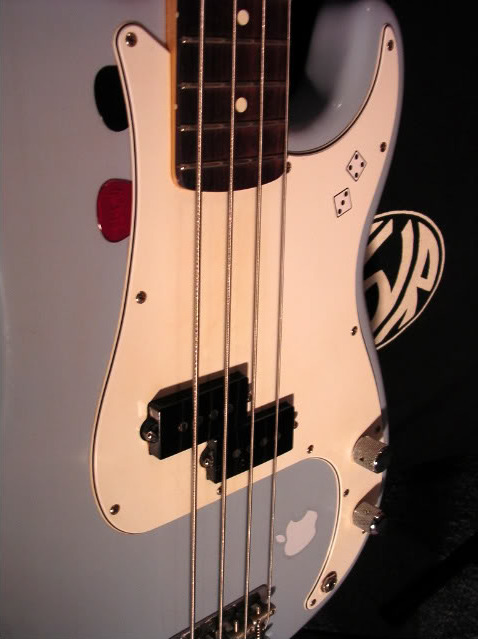
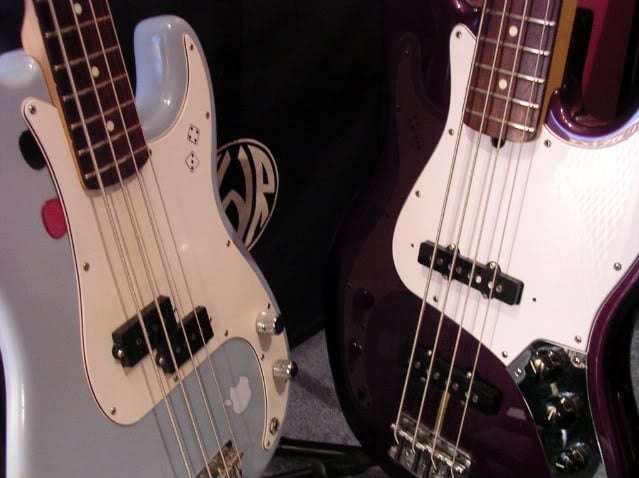
The jazz bass has its original, unmodified pickguard. The precision has been through a RIT treatment. I wanted a subtle change, which I think I got. When I first dyed it, I really overdid it. I used the steel wool to remove some of the discoloration. The steel wool is very important. The dye won't stick at all to the smooth pickguard.
As you can see, it still looks like a white pickguard, but it doesn't look like its going to glow in the dark anymore. It is also easy to change the color very significantly, if you choose. The pictures of the guitar that are linked to in this thread look to be a lot more dramatic a color change than I wanted. I also used tan instead of yellow because I wanted a darker, duller color.
(If you look closely, you can see the grill of my Baby Blue reflected in the j bass pickguard. The steel wooled and dyed guard won't act like a mirror, which also cuts down on its perceived "brightness.")
Tea or coffee sounds like a good idea, and they will get you there, I guess. Slowly.
RIT dye = fast + easy , which is for me, because wvbass = lazy!
Not sure how well these pictures capture it but here is the pickguard I did:
The jazz bass has its original, unmodified pickguard. The precision has been through a RIT treatment. I wanted a subtle change, which I think I got. When I first dyed it, I really overdid it. I used the steel wool to remove some of the discoloration. The steel wool is very important. The dye won't stick at all to the smooth pickguard.
As you can see, it still looks like a white pickguard, but it doesn't look like its going to glow in the dark anymore. It is also easy to change the color very significantly, if you choose. The pictures of the guitar that are linked to in this thread look to be a lot more dramatic a color change than I wanted. I also used tan instead of yellow because I wanted a darker, duller color.
(If you look closely, you can see the grill of my Baby Blue reflected in the j bass pickguard. The steel wooled and dyed guard won't act like a mirror, which also cuts down on its perceived "brightness.")


Forgot to mention that my experiments with high intensity UV light were targeted at aging lacquor paint. The interest was due to a friend (and well know vintage dealer)buying a VERY expensive early Flying V that turned out to be bogus (he got the money back). Came with a legit case and real PAF's. The aged finish was perfect and we were trying to figure out how the forger did it. Didn't spend much time with aging plastic but believe it would work fine.
Not convinced that a topical treatement (smoke, coffe, stain, dye, etc.) will hold up to much abrasion over the course of playing.
The more I think about this, the more it makes sense to have someone make a perfect gaurd from your sample from some properly colored plastic.
Not convinced that a topical treatement (smoke, coffe, stain, dye, etc.) will hold up to much abrasion over the course of playing.
The more I think about this, the more it makes sense to have someone make a perfect gaurd from your sample from some properly colored plastic.
Not convinced that a topical treatement (smoke, coffe, stain, dye, etc.) will hold up to much abrasion over the course of playing.
You're tight about this of course. My dyed pickguard is whiter than it used to be. The dye doesn't come off quickly, but since the plastic isnt porous, it will whiten as it ages. I guess that is exactly the opposite of the desired effect, huh?
The more I think about this, the more it makes sense to have someone make a perfect gaurd from your sample from some properly colored plastic.
as I already said, his is exactly what is going to happen,
so, why can't I try to make this experience ?
as I already said, his is exactly what is going to happen,
so, why can't I try to make this experience ?
Jim isn't telling you not to try it. He's merely pointing out some possible shortcomings. If somebody's going to jump on you for doing something to your bass, it won't be him.


