• TalkBass has been independent since 1998. Add your voice.
    Create a free account to reply to discussions, view embedded media, and browse with fewer display ads.
    Join freeLog in
    Want zero display ads or expanded classifieds tools? Compare plans.

How to get a good FOH sound?

I stand by my post. The most important part of a PA is the speakers. If you figure there is say a 100% mark-up on the $200.00 Kustom PA speaker then that means there is only about $100.00 in Parts and labor. Some of you posters are advising spending money on band-aids which is just throwing money away IMO. If you don't know how to use a compressor properly then it may cause more problems than it solves.

It would be more constructive if you made your evaluations based on actual listening tests rather than arbitrary speculations about prices and materials costs. Nobody is saying these are great speakers (I would never choose to work with them if I had the choice) but one can't rule out their ability to get the job done until one has worked with them in context.
 
After further afterthought...

Can you guys spring to have a tenured pro engineer your sound?

There are way too many variables to guess at your issues.. Chances are it starts with everyone trying to "cut through the mix"

There are seven xillion right ways to setup a PA.. and about 20x more to do it wrong.

Tim
 
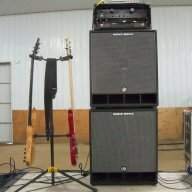
OK here's some of the gear

Peavey Board

Kustom Speakers

Subs are some old school horn loaded Peavey 18" subs. We're not sure of the model because the cabs were recovered & the data plate removed.

Two Crown XLS602 amps - 1 each for mains/subs
a Crown XLS202 for 2 monitor sends

EQ/Crossover for mains/subs

Monitor EQ

As I posted earlier, we have our gig tommorow night, and we play on meeting at 4PM to set up. We will have several hours to try things out.

Something I read earlier...Should we set up our stage sound first, with subs, then bring the mains into the mix for renforcement? Forgot to mention the guitar players are both ampless, going direct with MFX boards. Our monitors mix is the vital to them. Having said that, I'm wondering how vital the stage mix is since there aren't any amps projecting into the crowd?

I really appreciate the advise thus far.
 
I prefer miking my bass, seems like I can get a better sound by taking the signal right off one of my speakers and the adjusting the tone on that channel for bass. I use the same concept for the bass drum. The old concept that the more expensive the cabinets the better they sound is sort of an old wive's tale. A good PA head can make inexpensive speakers sound great, if the person doing the sound knows what they're doing. Take a little extra time sound checking, and you should be able to get a good souind with your system.
 
What you're doing isn't easy for anyone but an experienced Engineer.

The points JimmyM made about slotting from a spectrum placement design are spot on. They also require a guy with educated ears behind the controls to achieve.

Perhaps I'm out on the gang plank here, but I think a band has to find mix happiness at just matching the drummer levels with backline. Then, if the joint is too big for that level, use PA to get that sound big enough for the venue.

I also think most bands try to be too loud.
 
Someone spoke too early when saying your gear was the culprit --- geeze the stuff you're using is better than what most of us were 10 years back.

Opinions

1-Get a non PA sound you can can live with
2-Everyone turn down
3-Everyone avoid the mids like the plague (nobody should be "cutting through/over" vocals)
4-Get a tenured pro to help you dial in live sound etc.

Buying gear at this point is a totally foolish comment... sounds like it's hands on training.
 
The old concept that the more expensive the cabinets the better they sound is sort of an old wive's tale.
a better source and a competent soundguy can make bad stuff sound good, but this is simlpy false. the transducers (mics and speakers) are vital to the overall quality, and make a huge difference, maybe the biggest difference.

cross over the subs at 100Hz, adjust their volume to just add in what's missing in the mains, turn the lows down on everything except the kick and the bass, turn all the instruments the hell down and turn the vocals the hell up, and you should be OK.
 
I prefer miking my bass, seems like I can get a better sound by taking the signal right off one of my speakers and the adjusting the tone on that channel for bass. I use the same concept for the bass drum. The old concept that the more expensive the cabinets the better they sound is sort of an old wive's tale. A good PA head can make inexpensive speakers sound great, if the person doing the sound knows what they're doing. Take a little extra time sound checking, and you should be able to get a good souind with your system.

Why don't you go over here [Invalid or Expired Link Removed] or here http://www.prosoundweb.com/forums and post your theory about a old wives tale just to find out how wrong you are.:rollno:
 
a better source and a competent soundguy can make bad stuff sound good, but this is simlpy false. the transducers (mics and speakers) are vital to the overall quality, and make a huge difference, maybe the biggest difference.

cross over the subs at 100Hz, adjust their volume to just add in what's missing in the mains, turn the lows down on everything except the kick and the bass, turn all the instruments the hell down and turn the vocals the hell up, and you should be OK.

Yeah, better speakers can sound 100 times better, but they are usually out of the range of a small gig band. A good sound guy can even coax a decent sound using a box of old 58s and Peavey SP-1's for a small live show.

Definitely start trying to cross-over at 100. If you don't have a crossover, the board may have a "sub out." If not, another trick would be to take an extra out form the board (or run mono and use left or right) and EQ it to mimic a crossover.

Your outboard EQ is almost as important to a clean sound as your board so be careful with what you use. I've always advocated removing unwanted frequencies and avoiding boosting anything because that potentially adds noise.

The suggestions about slotting the instruments and starting with the stage-only mix are dead on.

And I agree totally that you shouldn't just go out a get a compressor. They take a bit of study and practice to use them properly.

Learn all you can about gain structure starting from the mic preamps on each channel of the board and keep your signals clean and optimized for headroom. Mackie and Allen & Heath have literature on line and in manuals that is easy to follow.

Read about mic technique, patterns, and proximity effect and try to show your bandmates how "powerful" a mic sounds when you use it correctly. This will allow you to have the mic gain lower and not pick up everything else in the vocal mics. It will also give you more headroom before feedback in the monitors.

Aim the monitors at the back of the vocalists ears (from the front, of course, not straight up into the mic.

Keeping the band at a reasonable level on stage is uber important.

Keep your eyes open for an old cheap Peavey Gatekeeper or some other multi-channel noise gate. You can use it to start tightening up the drums and eliminate bleed. I can't speaker on the Behringers because I never tried their gates. You should be able to find something to start with at around $65-$80 in a single rack space with 4 or 5 gates. Entry level dbx gear sucks, so save for the good stuff or hire a sound company when you get to that point :).

Just my 4 cents... Have fun!

Mark

 
Something I read earlier...Should we set up our stage sound first, with subs, then bring the mains into the mix for renforcement? Forgot to mention the guitar players are both ampless, going direct with MFX boards. Our monitors mix is the vital to them. Having said that, I'm wondering how vital the stage mix is since there aren't any amps projecting into the crowd?
most soundmen i know do the exact opposite...get the mains sound happening, then add subs. if you start with the subs, all you'll hear is low end and won't be able to get a fix on the other instruments.

and the stage mix is ALWAYS vital, especially with guys going ampless. if you're not comfy onstage, you'll never do your best.
 
I'm pretty sure it's set at 100hz, and the high end roll off at around 10k

It's mostly the drummers gear, and he has done most of the set up. He has the EQ set for his basement, where we practice. He thinks once it's set up, it should be good and we shouldn't have to adjust the 31band EQ. I was thinking how dead my bass & his kick sound, I was going to try turning up the low end...40-100 on the EQ, and engage the low end channel cut on the board for the all the other channels besides the bass & Kick, hopefully that will isolate some of the cummulative bass effect we have going on. Also try rolling back the bass pots on most of the channels.

Like I said, I have a bunch of Ideas to work with tonight.
 
I'm pretty sure it's set at 100hz, and the high end roll off at around 10k

It's mostly the drummers gear, and he has done most of the set up. He has the EQ set for his basement, where we practice. He thinks once it's set up, it should be good and we shouldn't have to adjust the 31band EQ. I was thinking how dead my bass & his kick sound, I was going to try turning up the low end...40-100 on the EQ, and engage the low end channel cut on the board for the all the other channels besides the bass & Kick, hopefully that will isolate some of the cummulative bass effect we have going on. Also try rolling back the bass pots on most of the channels.

Like I said, I have a bunch of Ideas to work with tonight.

Sounds like a good plan.
 
I'm pretty sure it's set at 100hz, and the high end roll off at around 10k

Where do you have the low cut set, though?

I'm wondering about how this EQ/Crossover actually functions. When the sub out is used and crossover set, are the main L and R outputs crossover as well? I would hope and assume so, but if that's not the case then you'll get a muddy response because the tops and subs will be producing the same frequencies. I downloaded the manual but it does not explicitly state that the main outputs are also crossed over.

IF the crossover does indeed act on both the main and subwoofer outs, I would then start by setting the low cut to around 40 or 45hz. I would NOT boost the low end (40hz) on the graphic because it's likely that your horn-loaded subs are not capable of even reproducing those frequencies and you'll just be putting excess stress on the woofers. Those Peavey subs (like many hornloaded subs) probably have a significant peak in frequency response in the upper lows (70 to 90hz or higher) and fall off quickly below 50 or 60hz. A small boost in the 50hz region may help even out the very low end, but make sure the low cut is engaged at 40+hz. I'm making some broad assumptions about the gear, but give this a try as see what happens.

If the room is already lively at those low frequencies you may need to cut some low end on the graphic. Either way, small adjustments are usually better. There is no way to "EQ the room", you can only put less information out at frequencies that excite the room. And the response is location and frequency dependent, so it can be a fool's errand to try to even out the response of the room.
I was going to...engage the low end channel cut on the board for the all the other channels besides the bass & Kick, hopefully that will isolate some of the cummulative bass effect we have going on. Also try rolling back the bass pots on most of the channels.
Engage the 80hz high pass "button" on all channels except for bass and kick. You will then probably not need to turn down the low EQ on those channels, unless the guitar, keys or floor toms are putting too much information below 100hz. Then just use a small to moderate cut, don't turn the knob all the way down because the shelving filter will pull a lot of low mid and mid frequencies with it.
Like I said, I have a bunch of Ideas to work with tonight.
Play around with them all, but only do one or two things at once. Too many adjustments can easily make things worse.

Get the systems response as even as possible in rehearsal using the Xover, Low Cut and mixer channel high pass filters; make minor adjustments on the EQ as needed at the gig...then just get on with it. :)
 
Don't know if this has been said, but start with all sources (including stage amp, monitors, mixer, speakers) with flat bass, lo-mid, mid, hi-mid and treble - all flat.

By process of elimination, you can probably figure out what's giving you the honky bass sound. I've done this several times while I was doing PA work. Everyone wants to crank up, but sometimes it's easier if everyone turns DOWN - and what some posters say is true about cutting dbs from low freqencies, so the bass guitar or the kick drum won't clash.
 
Hey, don't forget that every room has different sonic characteristics and frequency resonations. That's what your 31 band EQ is used for. Just because it sounds good in his basement, doesn't mean that it's going to sound good at a gig.

Speaking of which....how did that gig go?