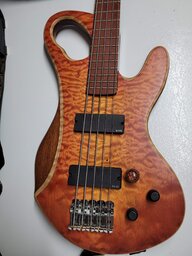
I have been learning the bass for almost three years. I do not play with a band or have ever had the opportunity due to my 12 hour workday. It's just me, my learning books/DVDs, and my iPod.
I enjoy playing with my iPod because it affords the band experience that I am lacking.
I am getting discouraged because 8th notes are about as fast and skillful that I can get. I practice at least an hour or more every day, (It kills my sleep schedule but I feel the need to practice). I practice on average 4 hours per day on weekends.
Is this all I am ever going to be? A mediocre player? Anyone else out there like me or am I alone?
Three things really
1/ are you acually practicing or just reinforcing what you know?
Now many people think they are practicing to improve, but you can practice amd ingrain habits and info that make it harder to improve.
You can practice bad and making it easy to be bad as easy as it is to practice good to make it easy to be good.
In order to practice good you have to take new ideas you do not understand and work on them till you do.
The same applies to skills in a way, but skills have a personal expectation as the focus.....not the actual skill application.
Look at this example,
A Brieve is a whole note you strike and sustain it for an 8 count brfore releasing it. So how long that note lasts depends on the tempo, the slower the tempo the longer the sustain, the faster the tempo the shorter the sustain, because it is about the length of time that it takes the 8 to come by.......not the tempo.
So with 8ths the slower the tempo the slower the eights and of course visa versa. So 8 brieves equivilent could be 8ths being played really really slow....depending on the tempo.
So if that can happen, then one reality of practice is that note value depends on understanding counting in relation to tempo.
So when i practiced i practiced everything really slow and sub divided that tempo into time sigs.....i did not play different tempos or speeds if you will, i just played an even slow tempo and sub-divided them into the time sigs........then all i do in increase the tempo to the desired one because that is the only other criteria to apply, but that needs an application of a song or music.
Plus one more thing on this point, most of what you play will be 4/4 based, so every new song you learn that is 4/4 based is not practice because you can play 4/4 already, all you are doing is sub dividing what you already know.
OK it may have some syncopation or off beats, but it is still 4/4 and you already know 4/4.
Try practicing 3/4 and get comfortable with that, because when you add 3/4 and 4/4 time sigs you move into a new area of compound or complicated times sigs. Again this is about learning to relate a count, it is not tempo, tempo can vary from 45 BPM to 200 BPM but the count is the same regardless of tempo.
2/ do you practice major and minor scales?
If you practice the two stop. You do not need to practice them, just recognise and hear them.
Play a major scale of your choice over two octaves and look at what you have actually done. Look at the 6th degree of the scale, you played the relitive minor scale within the major scale.......so you in fact played two scales.....not one.
Take this idea a stage further and start with the lowest scale note available to you and play to the highest note and you will find you only have 12 positions to play 12 scales that will cover all major and natural minor scales, as well as triads, arpeggios, and chord extensions to the 13th, as well as chord tone substitutes etc....all from playing 12 times.
The 12 times or 12 positions has a lot of imformation to learn so take each position work on it a wring it dry of info. In this way you have broken down a lot of info into small, but related chunks to learn. The more you learn the more you see and hear how they interact and build up a library of skills and knowledge to draw from.....you give yourself good foundations to build on.
3/ do you warm up and practice in small sessions?
A lot of player just play for hours and think it is practice, but the reality is it is just tiring out already tired hands. Think about it, you work all day then come home and practice so you are already tired when ypu start, not only physically, but mentally as well.
So why practice at night, go to bed early, get up early and practice before work, then you have better rested and refreshed mind and body to work with. Break practice down to warm up, read up on what you will practice, practice it, rest. Then practice and rest for small sessions till you have got it, then move on.
A lot of player hang around to long on certain practice ideas. Because many ideas are related and are based on application the student does not know when enough is enough, but a good teacher would.
Many music ideas are anout understanding, from that understanding develops skills to play and perform the idea.
So improvment is led by the mind not by skills or techniques, so let me explain that.
Play any scale...not slap it, nowfinger pick it, now tap it, now add any effect, use 3 finger picking, 4 finger picking, fret it one finger per fret, fret it Simandl etc etc......now matter what you do the information of the scale is the same in all, nothing changes with any new or different technique....so if you played a G major scale, then it will always be a G major scale, and so will all the information you have learned about that G Major scale will still be the same.....you really have mot learned anything new about G major.
Check out these 3 points and look honestly at how you practice....are you really practicing or just going over what you already know?


 ). I've been playing bass for 33 years - many of those years were spent, like yourself, cooped up alone with a tutorial book and a bass, playing scales, chords, etc etc, and making seemingly no progress. I *did* learn a bit that way, but most of it was wasted time going over the same old ground. My growth spurts happened when I played with others - as some have suggested, find a teacher from time to time to pop you out of your comfort zones; definitely find some like-minded friends to just jam with informally - there is NOTHING like playing with other people; finally, for me the biggest growth spurts have happened when I've actually played gigs: nerve-wracking at first, but once you get over that, you can amaze - and thoroughly enjoy - yourself! Don't get discouraged!