As far as I'm concerned, the one with double-sharps in it is always the wrong choice.I know which score I'd rather write out,

Enjoy the benefits of a premium membership!
Upgrade Account
-
TalkBass has been independent since 1998. Add your voice.
Create a free account to reply to discussions, view embedded media, and browse with fewer display ads.
Join free Log in
Want zero display ads or expanded classifieds tools? Compare plans.
You are using an out of date browser. It may not display this or other websites correctly.
You should upgrade or use an alternative browser.
You should upgrade or use an alternative browser.
How we should speak to guitarists.....
- Thread starter WI Short Scaler
- Start date
More options
Who Replied?
You speak to guitar players?
I thought you were supposed to use words of one syllable or fewer. Hold on, that's for talking to drummers, my mistake.
I wouldn't try any of this crap with my guitar player. He reads well enough to play classical pieces and was a studio player in Nashville many years ago. He still can be a bit of a prima donna.
Ah, he's a frustrated a cellist.
D
Deleted member 165050
Guest
You a guitarist?
I can play 6-string guitar, can't everyone? The only instrument I play in bands is bass (mostly fretless) and I learned bass first.
Ps I also play cello, only grade 5 though.
Isn't it amazing how a humorous post has devolved into people airing their prejudices without so much as a smile?
F# is what I was taught to call it but if you were taught something different then so be it. It's not like I feel a burning desire to bang on and on about how wrong you are, you're different, so freakin' what? If you start talking about Gb I'll know that it's F# in my head, and vice versa. It's not the end of the bleedin' world people, and it's not wrong, it's just different names for the same thing depending on your musical upbringing.
May I also take this opportunity to wish you a Merry Christmas and ask that you lighten the frack up.
This has been a public service announcement from someone who plays guitar, bass, a bit of keyboard, a few chords on the mandolin, blues-harp, and can shake a mean tambourine in any key.
F# is what I was taught to call it but if you were taught something different then so be it. It's not like I feel a burning desire to bang on and on about how wrong you are, you're different, so freakin' what? If you start talking about Gb I'll know that it's F# in my head, and vice versa. It's not the end of the bleedin' world people, and it's not wrong, it's just different names for the same thing depending on your musical upbringing.
May I also take this opportunity to wish you a Merry Christmas and ask that you lighten the frack up.
This has been a public service announcement from someone who plays guitar, bass, a bit of keyboard, a few chords on the mandolin, blues-harp, and can shake a mean tambourine in any key.
I just keep a handy rack with twelve tambourines, one for every key...This has been a public service announcement from someone who plays guitar, bass, a bit of keyboard, a few chords on the mandolin, blues-harp, and can shake a mean tambourine in any key.
Yeah, F# and Gb are the same key, potatoe, potaatoe. What drives me bonkers is when the key signature is a flat key like say Db and the guitar player or worse yet the chart says the second chord is a F#. NO!! That is wrong. That is when it not a F#, it’s an Gb!!! I take the original humorous post in that context.
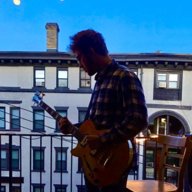

Replace your guitar player with a real pianist. Your negative issues will be reduced and pleasures increased. Your musicality can be bumped up a several levels. Now, this may be an impractical solution for some, but for me it is the perfect win-win environment.

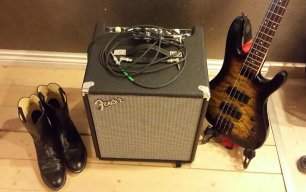
I'm tired of playing around with his fortissimo passages. My Ampeg may only be solid state but it's still an Ampeg and it's 450 watts. The amp has 2 10" speakers and then I have a 15" Celestion 400 watt Green Label Bass extension speaker in a cabinet. I tested it out at 8 on the preamp and 8 on the Ampeg. It is freaking monstrous.
"Yeah man I've got this like Dorian thing going on y'know".... yep, we've all been there many a timeGuitarists seem to pick up an understanding of music theory (and practice) from other guitarists, which exists at anywhere from 60 to 180 degrees from standard music theory.

I think whether you're more likely to see one than than the other really depends on what instrument you play and what style of music.
Totally agree. I play rock, "americana/amerijuana" and dabble in reggae, blues, and jazz - all from a rock standpoint, what for me is almost all guitar-based writing (other than some jazz standards).
When I write, it's on the treble clef, if any (as opposed to just naming the notes and fret position, or doin' a little tab).
I must say, I have never seen anything in the key of Db (absent a chromatic part), only C#, same with Gb versus F#.
Now, I think today I'm-a write sompin' in Cb.

Don't you mean "what in the E#"? Remember, we don't use flats where a sharp will do.Sharps?
Flats?
What the Gbb… is going on?
I play rounds and trust my ears!
may the bass be with you
Wise(b)ass
Oddly enough, last weekend I played 3 concerts and all 3 had a piece in Db and two of them had a piece in Gb. All choral music and church stuff I admit. Just thought that was a funny connection.Totally agree. I play rock, "americana/amerijuana" and dabble in reggae, blues, and jazz - all from a rock standpoint, what for me is almost all guitar-based writing (other than some jazz standards).
When I write, it's on the treble clef, if any (as opposed to just naming the notes and fret position, or doin' a little tab).
I must say, I have never seen anything in the key of Db (absent a chromatic part), only C#, same with Gb versus F#.
Now, I think today I'm-a write sompin' in Cb.
Last edited:

'To'...maybe, it gets difficult when attempting the 'with'.( Sorry, I had to...)
Well said, and a good lesson for developing communication skills.
Oddly enough, last weekend I played 3 concerts and all 3 had a piece in Db and two of them had a piece in GB. All choral music and church stuff I admit. Just thought that was a funny connection.
We’ve been getting a lot of songs in Bb since our PWL’s wife started running the orchestral instrument section...lol.
I was being facetious, and referring to the great majority of people who play guitar and how we learn - and include myself in there despite getting some formal instruction. The young players coming through now who have a deep knowledge of theory blow me away."Yeah man I've got this like Dorian thing going on y'know".... yep, we've all been there many a time
I apologise to anyone who feels my comments were off topic, and thank the contributors who helped me see what I was missing in the F#/Gb question.
Maybe the third chord is a B, because it’s a new key.Yeah, F# and Gb are the same key, potatoe, potaatoe. What drives me bonkers is when the key signature is a flat key like say Db and the guitar player or worse yet the chart says the second chord is a F#. NO!! That is wrong. That is when it not a F#, it’s an Gb!!! I take the original humorous post in that context.
Oh no, here comes a new discussion.
All I get from this thread is that guitarists can easily torment bass players by pretending they don't understand music theory.


