• TalkBass has been independent since 1998. Add your voice.
    Create a free account to reply to discussions, view embedded media, and browse with fewer display ads.
    Join freeLog in
    Want zero display ads or expanded classifieds tools? Compare plans.

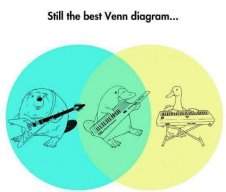
How we should speak to guitarists.....

If you keep ignoring everyone who disagrees with you, you’ll never see accurate music theory posts again.

I'll just tell my classical musical teachers they were wrong then, be right back. May as well chuck all those classical grade certificates in the trash while I'm at it...

I only ignore confrontational people and trolls.
 
Because ficelles asserts that the key between F and G is a sharps key, when, in fact, it can be notated in F# or Gb—both are valid and legitimate keys.

If you'd read through the thread, I said the key between F and G is generally referred to as F#, which it is. I didn't say always. Sorry if that escaped you.
 
Perhaps this could help the discussion about flats and sharps, hope you find these interesting:
1) sharps and flats “appear” to generate the scales of each one of the 12 tones, following the circle of 5ths (on both directions) from C major
2) Starting from C, going “up” you get G major which has 1 sharp, F#. Following that logic, the shaps continue F#, C#, G#, D#, A#, E#, B#, generating the scales of G, D, A, E, B, F# and C#. Same with flats, going on the opposite direction, by 4ths to complete the circle
3) this is nothing more than a very ingenious convention, to provide some order to what otherwise would be a very tough to grasp concept
4) F# and Gb are not the same sound actually. The distance between F and G is measured in 9 “commas”, F# is F+4 commas, while Gb is G-5commas. This applies only to fretless instruments and it is a concept almost abandoned all together
5) Please don’t fight about this; remember we are viruses in a dying planet trapped in a universe extinguishing while it keeps expanding. I thought about sharing this item to put things into perspective.

I hope this helps,
 
Last edited:
I'm not following you. There are six changed notes either way:

F# G# A# B C# D# E# F#

Gb Ab Bb Cb Db Eb F Gb

And either way there is one changed note which is enharmonic to a natural. E# or Cb, respectively.

What am I missing?
Nothin', I was just sayin' how I say it.

Altho' I confess, it's also how everyone I ever knowed that could say anything about it says it.

But mebbe that's a Chicago thing.

Y'know, like, rat-a-tat-tat.
 
But in my experience, what is mine and evidently not yours(?), it's almost always called F#, and it certainly causes less confusion amongst the punters I know to call it so ...
In my experience I've seen the key of Gb more often than F# in sheet music, but the key of F# more than Gb in chord charts.

I think whether you're more likely to see one than than the other really depends on what instrument you play and what style of music.
 
"Dude, that's where I stand. Please move your awesome Line6 Spider over. BTW, the metal tones you're getting out of that thing rule!"
Ha, what's up with everybody using line 6 lately? They're trash. They drop speakers, and fry tubes like it's what they were made for? I dont get it. It's like everybody's just simply forgot that their grandfather's Marshall's, Peavey's, and Mesa's are still going as strong as the day they bought them. They most likely sound even better now then they did then too. Pfhh, guitarist right?
 
Last edited:
Ha, what's up with everybody using line 6 lately? They're trash. They drop speakers, and fry tubes like it's what they were made for? I dont get it. It's like everybody's just simply forgot that they're grandfather's Marshall's, Peavey's, and Mesa's are still going as strong as the day they bought them. They most likely sound even better now then they did then too. Pfhh, guitarist right?

I know Spider amps get their share of hate, but people love the Helix stuff and I still see a lot of pros using DL4s.
 
  • Like
Reactions: Mr_Moo
Perhaps this could help the discussion about flats and sharps, hope you find these interesting:
1) sharps and flats “appear” to generate the scales of each one of the 12 tones, following the circle of 5ths (on both directions) from C major
2) Starting from C, going “up” you get G major which has 1 sharp, F#. Following that logic, the shaps continue F#, C#, G#, D#, A#, E#, B#, generating the scales of G, D, A, E, B, F# and C#. Same with flats, going on the opposite direction, by 4ths to complete the circle
3) this is nothing more than a very ingenious convention, to provide some order to what otherwise would be a very tough to grasp concept
4) F# and Gb are not the same sound actually. The distance between F and G is measured in 9 “commas”, F# is F+4 commas, while Gb is G-5commas. This applies only to fretless instruments and it is a concept almost abandoned all together
5) Please don’t fight about this; remember we are viruses in a dying planet trapped in a universe extinguishing while it keeps expanding. I thought about sharing this item to put things into perspective.

I hope this helps,

In my experience I've seen the key of Gb more often than F# in sheet music, but the key of F# more than Gb in chord charts.

I think whether you're more likely to see one than than the other really depends on what instrument you play and what style of music.

I only know what I was taught as a grommet, and I daresay it was simplified for our benefit.

As an orchestra grommet, we were told that the main reason why scores were in, say Bb rather than A#, was to avoid key signatures with double sharps. The slight theoretical differences between Bb and A# were glossed over. It was presented as a convention to make our lives easier.
Obviously F#/Gb and C#/Db can go either way, but didn't occur at the levels I was at.

Jazz guitar teacher was only interested in that to the extent he made use of written music. Rock and folk guitar teachers didn't see it as relevant.

And in the end perhaps it just comes down to convention and convenience.
 
  • Like
Reactions: hintz and Slevage
Beginner and intermediate guitar music is in sharp keys, to take advantage of the open strings; beginner and intermediate school band music is written in flat keys, to take advantage of the open native key of brass instruments.

If they don’t progress to an expert level, guitarists get very little exposure to flat keys (unless they join the school band); and, if school band students don’t progress to an expert level, they get very little exposure to sharp keys (unless they play in the string orchestra).

At the expert level, all keys are fair game.
Yes, you're right. The only guitarists I know who can handle flat keys with ease regularly play with big bands or small jazz ensembles.

As to the whole F#/Gb thing that blew up, I was already thinking of the Gb chord in the context of a major key. For example, Gb as the subdominant chord of Db. You would not call that an F#. The argument about the keys of F# and Gb being enharmonic equivalents was fair though, I didn't think of it that way.

I remember a band rehearsal though where one of the guitarist threw a little fit over my insistence that we not notate a song in D# but in Eb instead... It boggles the mind, especially if the mindset "it's all the same anyway" is so prevalent.
 
  • Like
Reactions: hintz and Mr_Moo
I remember a band rehearsal though where one of the guitarist threw a little fit over my insistence that we not notate a song in D# but in Eb instead... It boggles the mind, especially if the mindset "it's all the same anyway" is so prevalent.
I'm guessing you were notating as a chord chart rather than on a staff? Because D# would require the key signature to be sharps on F C G D A E B F C. Whereas Eb has flats on B E A. I know which score I'd rather write out, even if reading them is essentially the same on a guitar.
 

Latest posts