• TalkBass has been independent since 1998. Add your voice.
    Create a free account to reply to discussions, view embedded media, and browse with fewer display ads.
    Join freeLog in
    Want zero display ads or expanded classifieds tools? Compare plans.

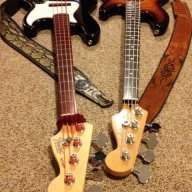
I think we should stop arguing about maple vs rosewood (see inside)

Geoff St. Germaine said:
How would an aluminum fretboard reduce the weight of an instrument?

a thin slice of lightweight aluminum vs a slab of wood? How would it not? I work with this stuff all day long. aluminum is light.
Or even forget aluminum. What about styrofoam? The strong stuff used to insulate. Since it doesn't matter what the frets are mounted in, styrofoam should work great!
 
Agreed. Not as dramatic.

I used the fretless to help illustrate the broader point. After the string, the fingerboard is first in line on a fretless, second in line on a fretted. Still significant, IMO.

Showdown said:
That is because the string is vibrating against the wood. That is what gives fretless basses their unique sound. Fingerboard wood doesn't have the same dramatic effect on fretted basses.
 
steve4765630 said:
I forgot one more rant. I hate it when guys say they like the FEEL of one wood over another. YOU NEVER TOUCH THE FINGERBOARD WITH FRETS AND RARELY EVEN ON A FRETLESS! Over half of my basses are fretless and I could care less what kind of wood is on the fingerboard as long as it holds up to the strings. Unless your fingers have kankles and fat is pouring over the depressed string, you will never ever touch the actual wood while you are playing, so don't give me that. Sorry, I'll stop.

But the frets DO touch the wood, and depedning on the density of the wood, this will determine "feel" or even to an extent "sound". If you take fretted instruments, no matter what the fingerboard wood, its probably going to sound similar to the point of having almost no difference in tone. BUT, if the frets are removed, the string contacts directly onto the wood, in which you are going to get more tone from the wood then the frets. Also, if you dump epoxy on, you're more then likely going to get a brighter tone, since you are playing on the epoxy rather then the actual wood.
 
AerospaceGuy said:
a thin slice of lightweight aluminum vs a slab of wood? How would it not? I work with this stuff all day long. aluminum is light.
Or even forget aluminum. What about styrofoam? The strong stuff used to insulate. Since it doesn't matter what the frets are mounted in, styrofoam should work great!

So the neck will be made thinner? In order to save weight, the aluminum (specific gravity ~2.7) fretboard would have to be less than 1.6 mm thick when replacing a maple (specific gravity ~0.75) fretboard that was 6 mm thick. If a typical neck is 20 mm thick, then the new one would be less than 15.6 mm to save any amount of weight. I know a lot of people that get cramps from necks that are too thin.
 
Geoff St. Germaine said:
So the neck will be made thinner? I know a lot of people that get cramps from necks that are too thin.

No you can make the neck any diameter you want. but my point wasn't that aluminum fingerboards would lighten the load on a lot of basses (which it will) my point was, aluminum fingerboards sound like crap.

OT: In your post above if that were the case you could form the neck from graphite. Make the neck bigger and lose even MORE weight. Graphite vs wood. but like I said before that wasn't my point.
 
AerospaceGuy said:
No you can make the neck any diameter you want. but my point wasn't that aluminum fingerboards would lighten the load on a lot of basses (which it will) my point was, aluminum fingerboards sound like crap.

OT: In your post above if that were the case you could form the neck from graphite. Make the neck bigger and lose even MORE weight. Graphite vs wood. but like I said before that wasn't my point.

You can make the neck any thickness you like, I agree, but most people aren't going to like the feel of a radically thinner neck, IME. The only basses I've known that used aluminum were Kramers and they are renowned for their neck diving because they made them the same profile as their other necks resulting in a very heavy neck.

I see that you said that aluminum is a poor choice for tone (arguably), but you also said that it would save weight. On a standard sized wood neck, an aluminum fretboard will not save any weight since it is more dense than the wood, which you obviously know.
 
Hey Fretless Freak: My pads do touch the fingerboard, especially on the D and G strings, and when I am bending or"warbling" a note. I've got pretty long fingers for a 5' 8" guy, but not fat fingers. Fingers not currently in use on a note will also touch areas of the neck as I play and mute. I notice a "feel" difference between necks. I'm currently playing a fretted 64 Jazz and a fretless 2001 MIM Jazz, both with Rosewood. The two Rosewood necks even feel different. I've played bass for 32 years. I don't like the way maple fingerboards feel.

Breathe in slowly, breathe out, you'll be fine. :)

SD:cool:
 
Geoff St. Germaine said:
You can make the neck any thickness you like, I agree, but most people aren't going to like the feel of a radically thinner neck, IME. The only basses I've known that used aluminum were Kramers and they are renowned for their neck diving because they made them the same profile as their other necks resulting in a very heavy neck.

I see that you said that aluminum is a poor choice for tone (arguably), but you also said that it would save weight. On a standard sized wood neck, an aluminum fretboard will not save any weight since it is more dense than the wood, which you obviously know.


yea the neck isn't aluminum. Imagine a full graphite neck. with a VERY thing sheet of aluminum over the fingerboard.
 
Seems that we're getting OT. I was under the impression that this thread was related to the SOUND of maple vs rosewood, not weight or feel.

Also, since maple seems to require finishing for appearance and/or other reasons, any such treatment to the fingerboard would seem to have relevance to this discussion.

And no, I'm not a MODERATOR, but I did stay at a Holiday Inn Express last night! :p
 
BigMikeW said:
LOL Why are your fingernails that long? :hiding:

Because I scratch my ass with my left hand, wiseguy.

Because some people have short nail beds, and their fingertips extend well beyond their nails. I do not.

I have long nail beds, that extend to the ends of my fingertips, and if I let my nails grow even a millimeter long (white part, beyond nail bed) to where they are actually comfortable, and provide some rigidity to my fingertip, they tend to dig into rosewood fingerboards.

Was this trip into the minute details of my anatomy really necessary? ...Or would my expression of a preference have been enough for most?

:spit:
 
AerospaceGuy said:
Okay by the feel of the wood I don't mean by touching it. I mean by how the wood reacts to the strings touching it. Harder, softer etc. Have you ever heard "I like the way the tires feel on the road"? Do you actually thing people are driving around running over their own hands to see what it feels like? it's an expression... and you my friend, are an idiot.

What?? My strings never touch the fingerboard (fretted bass). If they did, there would be dents/scrapes/whatever in the fingerboard. You all are crazy. :hiding: I mean sheesh, what are you fretting the string right between the two frets (or even closer to the fret behind) to be able to bend it all the way down to the fingerboard?? And I have some seriously tiny frets on my MTD, and any sideways vibrato is only putting pressure on the fret. If not, man you have a whack technique or are trying to bend the note by pushing the string into the fingerboard. I'l start calling you the hulk.
 
KayCee said:
No doubt that the tonal differences between rosewood and maple are subtle, and less significant than many other factors.

However, for anyone to say that the fingerboard has NO effect on an instrument's tone isn't considering that it is still a VITAL link in the tone chain from the strings to your ears.

Anyone that's ever heard a fretless bass with rosewood board, then "jaco-ed" with epoxy, knows that the fingerboard wood and finish CAN make a radical difference in sound.


But now you're talking about the string vibrating directly against a surface. Hence the muwha or however you folks splee it. On a fretted instrument, there is no string to fretboard contact.
 
FretlessFreak said:
But the frets DO touch the wood, and depedning on the density of the wood, this will determine "feel" or even to an extent "sound". If you take fretted instruments, no matter what the fingerboard wood, its probably going to sound similar to the point of having almost no difference in tone. BUT, if the frets are removed, the string contacts directly onto the wood, in which you are going to get more tone from the wood then the frets. Also, if you dump epoxy on, you're more then likely going to get a brighter tone, since you are playing on the epoxy rather then the actual wood.


You're telling me that you can push the string down on a fret and tell what kind of wood the fret is set in? You are able to push hard enough that you can feel the wood pushing back on your finger through the fret. You know equal and opposite reaction, and all. You all are seriously cracking me up at this point. :D
 
As an earlier poster said: It would be almost impossible to actually test the same bass with different fingerboards and keep all other elements the same. So this argument is not getting resolved anytime in the next few decades.

A few days ago I had the chance to pluck on five or six J's and Super J's as well as my G&L, all unpluged. Here's what I heard:

My G&L: Maple on Ash - Nice high-mid snap. Balanced sound.

My new 60's Jazz: Rosewood on Alder - MUCH brighter than my G&L when they both sport new XLs. Actually the Jazz's are a bit more broken in.

Mike Lull 4 string J: Maple on Ash? DARK. I mean Thumb Bass with old steels dark. Nice mellow sound, but definitely not the stereotypical "maple" snap.

Sadowsky Metro 4 string- Maple on Alder (I've been corrected, this must have been Ash) - Sweetly balanced. Blindfolded I would have said Rosewood.

Modulus VJ4 - Graphite - Sizzling highs and gut kick bottom (unplugged!) Certainly FELT different than the wood necks (whether my finger pads touched the fingerboard or not!)

You get the point. No pattern based on fingerboard alone.

Can we all agree that the sound YOU get out of WHATEVER bass I put in you hands comes mainly from (and roughly in this order):

1) Your playing technique (Imagine that!)
2) What pickups are on the bass AND which setting you are using
3) What strings you use.
4) Your amp system or recording signal chain.
5) The beautiful or gnarly resonant qualities of the main body and neck woods on your instrument. This is where the subtleties of you tone are found. This is why we buy nice basses, but if you are any good you can play the hell out of a $300 bass with decent pickups through your rig.
6) Finally, the fingerboard. Which cannot be separated from the other materials mentioned in number 4 above and is therefore disqualified from the individual events!:crying:


I will grant you this: The fingerboard definitely affects how you feel ABOUT your bass! (awwwww, so sweet) Seriously, it has more to to with your response to the "vibe" of the instrument and its looks than the actual sound. It matters...but only to the player...and you can't hear it on a record.
 
Sean Baumann said:
What if it this is all just related to mass. Can we all agree that a bass with more mass will be brighter? I guess that would be the selling point for those hefty bridges such as BAII, etc. Which fingerboard would have more mass? A maple or rosewood?

</post-fest>
Rosewood has more mass than maple. That leads to an obvious conclusion... ;)