
Enjoy the benefits of a premium membership!
Upgrade Account
-
TalkBass has been independent since 1998. Add your voice.
Create a free account to reply to discussions, view embedded media, and browse with fewer display ads.
Join free Log in
Want zero display ads or expanded classifieds tools? Compare plans.
You are using an out of date browser. It may not display this or other websites correctly.
You should upgrade or use an alternative browser.
You should upgrade or use an alternative browser.
I think we should stop arguing about maple vs rosewood (see inside)
- Thread starter draginon
- Start date
More options
Who Replied?
FretlessFreak said:I'm going Switzerland now.

I've just come back from Switzerland. It's cool if you're into the whole neutrality thing...

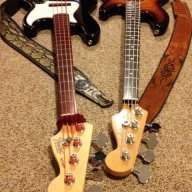
Hey Fretless Freak: No problem, it's just talk. It was a long time ago that I had the maple neck, and it felt hard, cold, and I didn't like the clear finish on it. It was a 74 or75 Jazz (new), with the white-ish block inlays. My 2001 MIM Rosewood fretless has a very smooth, almost metallic feel, but I like it, though I don't think I would care for that feel on a fretted neck. (I know, I'm nuts, right?) My 64 Rosewood Jazz has an earthy, organic, soft feel.
I can't explain why I get these "feelings" from the fingerboards, but while practicing last night I noticed that that my fingers make a lot of contact with the wood as I play. It's the direct contact I'm talking about, a physical feeling of the neck material itself. Hope this helps a little, but it's completely personal to me, your mileage may vary, as they say...oh, and I have no opinion on any tonal difference, don't have enough experience with maple to comment on that.
SD
I can't explain why I get these "feelings" from the fingerboards, but while practicing last night I noticed that that my fingers make a lot of contact with the wood as I play. It's the direct contact I'm talking about, a physical feeling of the neck material itself. Hope this helps a little, but it's completely personal to me, your mileage may vary, as they say...oh, and I have no opinion on any tonal difference, don't have enough experience with maple to comment on that.
SD

Just found this thread. Just had time to skim it. Here is the result of my 34 years experience building guitars and basses:
I am convinced that the fingerboard has a bigger tonal influence on the instrument than the body wood. In other words, the difference between a maple and rosewood fingerboard is greater than the difference between an alder and an ash body.
Of the woods I use, maple is the brightest and tightest. That is why it is the preferred wood among slap players. Rosewood is the sweetest and warmest. South American and Madagascar rosewoods are tighter than East Indian rosewoods. Ebony is in the middle regarding brightness, but it has the most "punch" (the most solid center to the note).
This is true regardless of the fret size, type of finish, or anything else. This is not "IMHO". This is "just the facts m'am".
Roger
I am convinced that the fingerboard has a bigger tonal influence on the instrument than the body wood. In other words, the difference between a maple and rosewood fingerboard is greater than the difference between an alder and an ash body.
Of the woods I use, maple is the brightest and tightest. That is why it is the preferred wood among slap players. Rosewood is the sweetest and warmest. South American and Madagascar rosewoods are tighter than East Indian rosewoods. Ebony is in the middle regarding brightness, but it has the most "punch" (the most solid center to the note).
This is true regardless of the fret size, type of finish, or anything else. This is not "IMHO". This is "just the facts m'am".
Roger

Sadowsky said:Just found this thread. Just had time to skim it. Here is the result of my 34 years experience building guitars and basses:
I am convinced that the fingerboard has a bigger tonal influence on the instrument than the body wood. In other words, the difference between a maple and rosewood fingerboard is greater than the difference between an alder and an ash body.
Of the woods I use, maple is the brightest and tightest. That is why it is the preferred wood among slap players. Rosewood is the sweetest and warmest. South American and Madagascar rosewoods are tighter than East Indian rosewoods. Ebony is in the middle regarding brightness, but it has the most "punch" (the most solid center to the note).
This is true regardless of the fret size, type of finish, or anything else. This is not "IMHO". This is "just the facts m'am".
Roger
Roger,
Thank you for responding to this thread. Always good to have someone who actually builds these damn things for a living respond. I dare say most of us "players" on TB don't really know what the hell we are talking about when it comes to woods and sound with regard to electric instruments. Only a true master luthier such as yourself could possibly have anything intelligent and informed to say about this particular, hotly debated, topic. You are a genius and your instruments have achieved legendary status. My hat is off to you, sir.
Now, about my endorsement deal...

I agree, thanks Roger for the input.
I must say, though, that I find the input of many of the TalkBass community to be very informed and intelligent. There are bassists posting here that have been playing just as long as Roger has been making instruments, and their opinions are valid, too!
I must say, though, that I find the input of many of the TalkBass community to be very informed and intelligent. There are bassists posting here that have been playing just as long as Roger has been making instruments, and their opinions are valid, too!
Fawkes007 said:Roger,
Thank you for responding to this thread. Always good to have someone who actually builds these damn things for a living respond. I dare say most of us "players" on TB don't really know what the hell we are talking about when it comes to woods and sound with regard to electric instruments. Only a true master luthier such as yourself could possibly have anything intelligent and informed to say about this particular, hotly debated, topic. You are a genius and your instruments have achieved legendary status. My hat is off to you, sir.
Now, about my endorsement deal...
KayCee said:I agree, thanks Roger for the input.
I must say, though, that I find the input of many of the TalkBass community to be very informed and intelligent. There are bassists posting here that have been playing just as long as Roger has been making instruments, and their opinions are valid, too!
Dude...I was buttering Roger up for that endorsement deal...don't kill it for me...
Fawkes007 said:Dude...I was buttering Roger up for that endorsement deal...don't kill it for me...
LOL!
Roger's comment might explain part of why I'm drawn to rosewood, since I prefer what I think of as smooth, buttery and "round" tones. I liked the ebony fingerboard on my Ampeg AUB-1 also.
SD
SD

 I've never been able to "definitely" tell the difference between maple, rosewood, or ebony fretboards as far as tone is concerned. As many have already stated, I've seen bright and dark versions of them all.
 Many rosewood or ebony fretboarded basses have maple as the main part of the neck. So, which has the most influence, the thinner freboard, or the thicker main body of the neck? That is, if either can be "blamed" for the tone.
I still think that most people are easily influenced by what that expect to be influenced by. In some instances, the influence lasts all of their lives. In other instances, it changes when "facts" are shown not to be "facts". I know I have concerning various "truths" throughout my life.
The only basses that I've owned that I actually hated the tone from were maple necked with ash bodies. Both of these were P-Basses that I've sold. Just couldn't get what I wanted out of them. But, they were sure "pretty". Can I make a sweeping, generalized statement from this? Don't think so. Some may, though!
I actually prefer the look of maple, birdseye maple to be specific. But, I don't believe it influences the tone as much as some claim. Just my experience and opinion.
Tone is more of a package deal: body, neck, fretboard, bridge, pickups, strings, nut, fingers, position of impact with the strings, type of impact with the strings. All of these will contribute. And then of course, there is the "remote" chance that the amplifier and the speakers just might have a little influence over the sound.
Watch out for the "maple" or "rosewood" speaker cones; they'll get you everytime

Seriously, you just can't make sweeping, generalized statement as some do and be correct. I don't care if you are a great luthier or builder. I just simply flies in the face of logic.
But, this subject, like many other, will continue. And the beat goes on, and on, and on, and on!
Very interesting thread, though. A lot of well thought out replies. Really enjoyed this one.

Sadowsky said:I am convinced that the fingerboard has a bigger tonal influence on the instrument than the body wood. In other words, the difference between a maple and rosewood fingerboard is greater than the difference between an alder and an ash body.
This is true regardless of the fret size, type of finish, or anything else. This is not "IMHO". This is "just the facts m'am".
Roger
Wow! Well, Mr. Sadowsky is definitely the coolest luthier I've met, and he makes the SWEETEST basses, but my 17 years of playing tell me different things than his 34 years of bass building. That said, I am NOT going to argue with a man who has had his hand on a thousand times more instruments than me. Roger wins!
Thank you, sir, for sharing your vast knowledge with us.
You are the man!
I've got a maple and a rosewood so I'm covered.
...psst....my rosewood is brighter...don't tell Roger.

Interesting to even have Roger Sadowsky come by and leave his thoughts. I am waiting for Ken Smith to come and leave his opinions also... It was nice to see both of them at the 2006 NAMM show. Very interesting.
I still can't get over the mTD tone of my friend's bass. The tone absolutely sings especially in the higher registers but very well in the mid registers and nice and tight in the low registers. Can anyone give any info on pau ferro?
I still can't get over the mTD tone of my friend's bass. The tone absolutely sings especially in the higher registers but very well in the mid registers and nice and tight in the low registers. Can anyone give any info on pau ferro?
draginon said:Can anyone give any info on pau ferro?
Pau Ferro is a Bolivian Rosewood. It also goes by the names Morado and Caviuna.
Roger
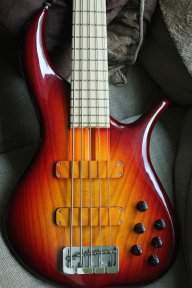
My comment is toward the "pickups and strings are the big thing" camp. Woods don't make a difference or not much...
If that were the case it seems like I could throw Rick p'ups into a Jbass, P bass or anything else I wanted and it would sound like a rick. Yes? All Fender J basses with the same components will sound exactly the same regardless of the woods used in the rest of the instrument. And if I change the p'ups to some other kind, it will sound just like that other brand? Yes, and Wish basses could be the equal of Sadowski or Alembic with the right pickups and strings. (though not as pretty IMO)
Originally Posted by Sadowsky
"I am convinced that the fingerboard has a bigger tonal influence on the instrument than the body wood. In other words, the difference between a maple and rosewood fingerboard is greater than the difference between an alder and an ash body.
This is true regardless of the fret size, type of finish, or anything else. This is not "IMHO". This is "just the facts m'am".
Roger"
I think that the only "constant" you can have in this subjective discussion (not arguement) is a builder himself. Thanks for these comments Mr.S. Though I've heard the bright rosewood and dark sounding maple anomalies too, I have to go with what a master builder of instruments (that most here would agree are at least acceptable? Sadowskys are ok, agreed?) has to say. I know that at least one other fine builder of basses has a formula which holds that the fingerboard material is a crucial part of the whole sound.
I have my ebony fretboard bass and my maple one is on order right now!
I hope the two instruments sound different from eachother!
If that were the case it seems like I could throw Rick p'ups into a Jbass, P bass or anything else I wanted and it would sound like a rick. Yes? All Fender J basses with the same components will sound exactly the same regardless of the woods used in the rest of the instrument. And if I change the p'ups to some other kind, it will sound just like that other brand? Yes, and Wish basses could be the equal of Sadowski or Alembic with the right pickups and strings. (though not as pretty IMO)
Originally Posted by Sadowsky
"I am convinced that the fingerboard has a bigger tonal influence on the instrument than the body wood. In other words, the difference between a maple and rosewood fingerboard is greater than the difference between an alder and an ash body.
This is true regardless of the fret size, type of finish, or anything else. This is not "IMHO". This is "just the facts m'am".
Roger"
I think that the only "constant" you can have in this subjective discussion (not arguement) is a builder himself. Thanks for these comments Mr.S. Though I've heard the bright rosewood and dark sounding maple anomalies too, I have to go with what a master builder of instruments (that most here would agree are at least acceptable? Sadowskys are ok, agreed?) has to say. I know that at least one other fine builder of basses has a formula which holds that the fingerboard material is a crucial part of the whole sound.
I have my ebony fretboard bass and my maple one is on order right now!
I hope the two instruments sound different from eachother!
Sadowsky said:Just found this thread. Just had time to skim it. Here is the result of my 34 years experience building guitars and basses:
I am convinced that the fingerboard has a bigger tonal influence on the instrument than the body wood. In other words, the difference between a maple and rosewood fingerboard is greater than the difference between an alder and an ash body.
Of the woods I use, maple is the brightest and tightest. That is why it is the preferred wood among slap players. Rosewood is the sweetest and warmest. South American and Madagascar rosewoods are tighter than East Indian rosewoods. Ebony is in the middle regarding brightness, but it has the most "punch" (the most solid center to the note).
This is true regardless of the fret size, type of finish, or anything else. This is not "IMHO". This is "just the facts m'am".
Roger
From the king of bass guitar building himself.. Roger Sadowsky!
rotero said:Wow! Well, Mr. Sadowsky is definitely the coolest luthier I've met, and he makes the SWEETEST basses, but my 17 years of playing tell me different things than his 34 years of bass building. That said, I am NOT going to argue with a man who has had his hand on a thousand times more instruments than me. Roger wins!
Thank you, sir, for sharing your vast knowledge with us.
You are the man!
I've got a maple and a rosewood so I'm covered.
...psst....my rosewood is brighter...don't tell Roger.
You have to remember though, the fingerboard may not be what is making your bass brighter, there are a lot of other components even if it is the same make, model, in even color.. no two basses are alike.
Comments by someone of the acknowledged stature of Roger Sadowsky are always worth paying serious attention to.
That said, I'd bet money that you could find builders of equal stature who'd disagree about the primacy of the FB wood.
That said, I'd bet money that you could find builders of equal stature who'd disagree about the primacy of the FB wood.
Richard Lindsey said:Comments by someone of the acknowledged stature of Roger Sadowsky are always worth paying serious attention to.
That said, I'd bet money that you could find builders of equal stature who'd disagree about the primacy of the FB wood.
Agreed. Still, I'll bet you'd find very few that would TOTALLY dismiss the role of fingerboard materials in shaping tone.
Latest posts
-

-
 Need recommendation on Preamp Pedal with DI, EQ, Compressor and Overdrive
- Latest: chiphaleonbass
-

-

-
