• TalkBass has been independent since 1998. Add your voice.
    Create a free account to reply to discussions, view embedded media, and browse with fewer display ads.
    Join freeLog in
    Want zero display ads or expanded classifieds tools? Compare plans.

Ian Anderson as a bass player

IMMusicRulz

Commercial User
Aug 3, 2020
2,935
10,708
Atlanta, GA
Disclosures
I am a semi-professional musician
Ian Anderson is pretty much capable of playing guitar, harmonica, tambourine, and flute. He has also played dulcimer, mandolin, bouzouki and mandola.

But it was while researching Jethro Tull discography that I noticed Ian played bass on their 1979 album, Stormwatch. This was mostly because John Glascock (who was the bassist for Jethro at the time) had been asked to leave for health issues, and allegedly had been undergoing drug and alcohol abuse at the time. Sadly, John Glascock died of open heart surgery in 1979 at the beginning of the tour to promote Stormwatch. He was only 29.

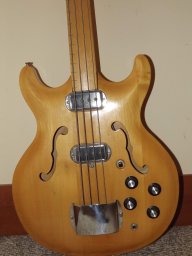
My guess is that Ian Anderson played the good Music Man Stingray Bass that John Glascock used to play on Songs From The Wood and Heavy Horses. John Glascock also played a Yamaha acoustic bass guitar during this time. John Glascock’s brother, Brian Glascock, was the drummer for the Motels.
6A583BD9-AD2B-464E-A6ED-7AA0F810A890.jpeg

I own Too Old To Rock & Roll: Too Young To Die and a promotional record called The Big Ball that features Nothing Is Easy from Stand Up.

But please respond if you find this interesting.
 
I’m happy to see a thread mentioning the late, great John Glasscock. I’ve been a Jethro Tull fan (Thanks to covertly listening to my older brother’s records on their stereo) since I was probably 8 or 9 years old.

I also had the pleasure of seeing Jethro Tull twice in my mid teens. John played a black Fender P-Bass (with a white pickguard) during their “Heavy Horses” tour. In fact, I put a white pickguard on one of my current P-Basses, because I loved the look of the P-Bass he was playing.
 
Last edited:
After the interviewer said about Glascock, "It was said that he'd damaged his health with drink and drugs - and that you'd threatened to kick him out of the band in an effort to straighten him out. What's the truth in that?", Anderson replied:

"John was always a bit of a party guy from the get-go. He wasn't a wildman. He was an easygoing, nice guy, a benign drunk. And I've known people who were not that way. John was never fired from the band.

"He was just told by me: 'You've got to stop and get yourself fixed, and come back when you're well.' When we stepped away from day-to-day contact with him it could have gone either way.

"I hope he knew his job was waiting for him if he could make it back. But he didn't, and that was a great sadness that we had."

How did that affect you emotionally?
"It made me angry with him. It made me angry with myself. I could have done more to confront John and steer him back.

"We all could have tried harder to make him understand that this really wasn't a great way of living his life, and his job depended on sorting himself out.

"But one will never know if his demise was due to the failure of the heart surgery he had, or to what degree it might have been aggravated by his lifestyle."

Jethro Tull Leader Recalls Anger After Band's Bassist Died Aged 28, Talks Group's Keyboardist Coming Out as Transgender Aged 61
 
Ian Anderson is pretty much capable of playing guitar, harmonica, tambourine, and flute. He has also played dulcimer, mandolin, bouzouki and mandola.

But it was while researching Jethro Tull discography that I noticed Ian played bass on their 1979 album, Stormwatch. This was mostly because John Glascock (who was the bassist for Jethro at the time) had been asked to leave for health issues, and allegedly had been undergoing drug and alcohol abuse at the time. Sadly, John Glascock died of open heart surgery in 1979 at the beginning of the tour to promote Stormwatch. He was only 29.

My guess is that Ian Anderson played the good Music Man Stingray Bass that John Glascock used to play on Songs From The Wood and Heavy Horses. John Glascock also played a Yamaha acoustic bass guitar during this time. John Glascock’s brother, Brian Glascock, was the drummer for the Motels.
View attachment 4451177
I own Too Old To Rock & Roll: Too Young To Die and a promotional record called The Big Ball that features Nothing Is Easy from Stand Up.

But please respond if you find this interesting.
The Big Ball! I thought I was the only person on earth who had that (1970)! I think I still do buried with the rest of my LPs.

Loved that album.
 
John Glascock and Barrymore Barlow were the dream team for sure!
Unless of course you might prefer the team of Glenn Cornick and Clive Bunker.
Interesting that Martin Barre now really dislikes Anderson.
Glenn was pulled aside by the manager as the band was boarding the plane to return from the American tour and told that Ian didn’t want to work with him anymore. He had to catch another flight the next day.
 
Unless of course you might prefer the team of Glenn Cornick and Clive Bunker.
Interesting that Martin Barre now really dislikes Anderson.
Glenn was pulled aside by the manager as the band was boarding the plane to return from the American tour and told that Ian didn’t want to work with him anymore. He had to catch another flight the next day.

I never knew Anderson could be such a tyrant to his bandmates.