

Enjoy the benefits of a premium membership!
Upgrade Account
-
TalkBass has been independent since 1998. Add your voice.
Create a free account to reply to discussions, view embedded media, and browse with fewer display ads.
Join free Log in
Want zero display ads or expanded classifieds tools? Compare plans.
You are using an out of date browser. It may not display this or other websites correctly.
You should upgrade or use an alternative browser.
You should upgrade or use an alternative browser.
More options
Who Replied?
Were you able to keep the piezo's working with the Audere preamp?hat I did not care for was the passive mag. circuits nor the the tone of the licensed pickups. So I removed the passive circuitry and installed an excellent Audere Classic preamp. I got the setup for four holes - Stacked volume/balance, Stacked High-mid/low-mid control, and separate bass and treble. I wired the output of the preamp to where the wire from the passive volumes used to go and that all worked like a champ. I also replaced the pickups with a pair of Bartolini MK6CBC soapbars and the bass now sounds tremendous.
I have an older SRF706 manufactured before they switched to Panga Panga. I believe that all the Portamentos from 2017 and before had rosewood fingerboards. In my opinion, rosewood is a better choice for fretless than Panga Panga. I guess the CITES rules make it much more difficult to use rosewood now.It bothers me that Ibanez basically refuses to use anything besides panga panga for most of their basses. No problem for fretted ones but fretless definetly warrants some harder material. They use plenty of ebony on their guitars; even those at the same price as the portamento. Ebonol or richlite would also be great, but they are only used on one model respectively. There is a heck of a lot of fretboard wood on the portamento so that would drive up the cost. I do hope they use that ebonol stuff on more basses. I have yet to see the Steve Digiorgio signature in the wild.
Sure. Just ran the output of the Audere to the same connection on the main PCB where the output from the prior passive volume controls connected. Removed one, replaced it with the other. Easy-peasey.Were you able to keep the piezo's working with the Audere preamp?

To each their own. Rosewood is WAY softer. If you use rounds they are much more likely to chew into the board than any of the more typical woods used for fretless.I have an older SRF706 manufactured before they switched to Panga Panga. I believe that all the Portamentos from 2017 and before had rosewood fingerboards. In my opinion, rosewood is a better choice for fretless than Panga Panga. I guess the CITES rules make it much more difficult to use rosewood now.
Don't know which kind of Rosewood this is but here are the Janka numbers:To each their own. Rosewood is WAY softer. If you use rounds they are much more likely to chew into the board than any of the more typical woods used for fretless.
Brazillian Rosewood 2790
East Indian Rosewood 2440
Panga Panga 1640
According to the Janka chart, Rosewood is harder than Panga Panga
When I first heard they switched to Panga Panga, I thought that was a very poor choice for a fretless fingerboard being that it is on the softer side for hardwood on the Janka Scale. But it is still harder than Hard Maple which is used on a lot of fretless basses.
Hard Maple 1450
I would prefer harder woods for a fretboard like these.
Gaboon Ebony 3080
African Blackwood 3670
Snakewood 3800
Quebracho 4570
I met John Clarity through Facebook. John has mastered the art of defretting necks and I paid his very modest fee to learn how he does it. I asked him about panga and he too agreed that it was a poor choice for a fretless board. Makes you wonder what goes through the minds of the people who made that decision.Don't know which kind of Rosewood this is but here are the Janka numbers:
Brazillian Rosewood 2790
East Indian Rosewood 2440
Panga Panga 1640
According to the Janka chart, Rosewood is harder than Panga Panga
When I first heard they switched to Panga Panga, I thought that was a very poor choice for a fretless fingerboard being that it is on the softer side for hardwood on the Janka Scale. But it is still harder than Hard Maple which is used on a lot of fretless basses.
Hard Maple 1450
I would prefer harder woods for a fretboard like these.
Gaboon Ebony 3080
African Blackwood 3670
Snakewood 3800
Quebracho 4570
I have ordered new strings (LaBella Super Steps) to replace the factory-supplied flats. When I remove the flats, I will see what I can do to use John's method to smooth out the board.
Meantime, since I am new to the party, is anyone in charge of giving out Membership Numbers? If so, I would certainly like one.
I paid for the Clarity method, but haven't worked though it. I have a custom Warmoth neck for a build that I haven't had time time to do.I met John Clarity through Facebook. John has mastered the art of defretting necks and I paid his very modest fee to learn how he does it. I asked him about panga and he too agreed that it was a poor choice for a fretless board. Makes you wonder what goes through the minds of the people who made that decision.
I have ordered new strings (LaBella Super Steps) to replace the factory-supplied flats. When I remove the flats, I will see what I can do to use John's method to smooth out the board.
Meantime, since I am new to the party, is anyone in charge of giving out Membership Numbers? If so, I would certainly like one.
I should do it on my Portamento too.

How did the method work out for you?
@tellheryousawme is the keeper of numbers here, but hasn't posted to the thread in a while.
It worked great! I had been defretting basses for over a decade before encountering John. At first I thought it was a scam, but it clearly wasn't. I specialize in defrettting and upgrading Sterling Ray4s and 5s and occasionally Ray34s and 35s. At the price I resell them, I cannot afford to spend as much time and effort on the necks as he does, but it definitely improved my results. Absolutely worth what I paid him. He's also a really nice guy. I've asked him quite a few questions after I completed his instruction and he always answers me and usually quickly.I paid for the Clarity method, but haven't worked though it. I have a custom Warmoth neck for a build that I haven't had time time to do.
I should do it on my Portamento too.
How did the method work out for you?
@tellheryousawme is the keeper of numbers here, but hasn't posted to the thread in a while.

I've got a Steve DiGiorgio SIgnature and it's GLORIOUS.It bothers me that Ibanez basically refuses to use anything besides panga panga for most of their basses. No problem for fretted ones but fretless definetly warrants some harder material. They use plenty of ebony on their guitars; even those at the same price as the portamento. Ebonol or richlite would also be great, but they are only used on one model respectively. There is a heck of a lot of fretboard wood on the portamento so that would drive up the cost. I do hope they use that ebonol stuff on more basses. I have yet to see the Steve Digiorgio signature in the wild.
Attachments


Ibanez also put a stainless steel fingerboard on a BTB for Linus Klausenitzer. But it's a one-off and not something available to the public as far as I can tell.
Ibanez also put a stainless steel fingerboard on a BTB for Linus Klausenitzer. But it's a one-off and not something available to the public as far as I can tell.
Sweet. Wonder what it would cost to get a fretboard conversion for one of my basses? I did a little research on wood vs. Aluminum for a fretboard a while back in post https://www.talkbass.com/threads/the-fretless-club-part-iv.910686/page-178#post-23705192
Here is the excerpt...
Looked up the "hardness" on Aluminum. Hard to compare to wood because there is no "Janka" scale on Aluminum, but someone has done the comparison on the Brinell Hardness chart. Australian Buloke is the one of the hardest woods around and has a Janka of score of 3,760 lb, its BHN score is 11.48. Pure aluminum is 15 BHN and hardened AW-6060 aluminum is 75 BHN, Even mild aluminum would make a far harder fretless neck than most woods. I have a bass with a Panga Panga neck which is only 1,640 Janka. For reference, a favorite for fretless necks is Gaboon Ebony at 3,080.
I wonder if you had a AW-6060 Aluminum neck with round wounds could you get a good Mmmwah, or would it just zing like it was on frets?
Copper is 35 BHN and would make an awesome looking fretless neck and probably 4 times harder than Ebony.
Looked up the Brinell hardness for Stainless.
Brinell hardness of stainless steel – type 304 is approximately 201 MPa.
Brinell hardness of ferritic stainless steel – Grade 430 is approximately 180 MPa.
Brinell hardness of martensitic stainless steel – Grade 440C is approximately 270 MPa.
Brinell hardness of duplex stainless steels – SAF 2205 is approximately 217 MPa.
Lots harder than aluminum. So, AW-6060 aluminum is 6 times harder than Buloke and Stainless would be 2.4-3.6 harder than AW-6060
Unless you can do your own machining, I would guess that a one-off metal fingerboard would cost way more than the bass itself.
Other than the issue of being more porous and potentially uneven, what makes you want to replace the neck? Seems like some judicious sanding with the proper radiused sanding block should smooth things out. If you were still unhappy, you could always coat it with CA or epoxy.
Other than the issue of being more porous and potentially uneven, what makes you want to replace the neck? Seems like some judicious sanding with the proper radiused sanding block should smooth things out. If you were still unhappy, you could always coat it with CA or epoxy.
I just thought it would be cool.Unless you can do your own machining, I would guess that a one-off metal fingerboard would cost way more than the bass itself.
Other than the issue of being more porous and potentially uneven, what makes you want to replace the neck? Seems like some judicious sanding with the proper radiused sanding block should smooth things out. If you were still unhappy, you could always coat it with CA or epoxy.
Yeah, I bet it would be cool. I messaged John Clarity regarding panga. He agreed that it's not a good wood for fingerboards, so it makes you wonder what Ibanez was thinking. For a bass of that caliber, it wouldn't add all that much to the price if they had chosen ebanol or even ebony itself.I just thought it would be cool.
As soon as my new strings arrive, I am going to take all the flats off and then see what I can do to make the board a bit more playable. I have to admit, it's not that bad now, so hopefully it won't take me too long to smooth it out. The strings should be here The strings will arrive the day after tomorrow. Stay tuned...
Yeah, I bet it would be cool. I messaged John Clarity regarding panga. He agreed that it's not a good wood for fingerboards, so it makes you wonder what Ibanez was thinking. For a bass of that caliber, it wouldn't add all that much to the price if they had chosen ebanol or even ebony itself.
Agreed. Even Ibanez's new SRD900 basses seem to be a bit of a successor to the SRF700 (though I prefer the SRF), yet they still decided to go with panga panga again. SRD900F | SR | ELECTRIC BASSES | PRODUCTS | Ibanez guitars
Maybe the buyer's brother-in-law owns a lumber yard....Agreed. Even Ibanez's new SRD900 basses seem to be a bit of a successor to the SRF700 (though I prefer the SRF), yet they still decided to go with panga panga again. SRD900F | SR | ELECTRIC BASSES | PRODUCTS | Ibanez guitars
Well, the LaBella Super Steps arrived yesterday, which gave the excuse to remove the original flats (anyone know who made those?) and see if I could get the fingerboard in better shape. Mine wasn't bad to begin with, but I have sandpaper and I know how to use it! lol.
Anyway, I started with 600 grit and worked up to 1000. After 1000, I wiped the neck off with a damp rag, then a dry rage, and worked it up to 10K grit. After that, I used Tried n True (beeswax and linseed oil combo) and let it sit overnight. The picture doesn't do it justice. The fingerboard actually gleams a little bit and is smooth as proverbial glass, not uneven anywhere.
Not satisfied, and with more sandpaper in hand, I turned the bass over and ran my hand over the back of the neck. With the bass in playing position, the neck stripe nearest the bottom (nearest the C string) was rough in several places. Have sandpaper, will sand. The back of the neck is now WAY smoother than it was.
I had given the neck overnight for the treatment to dry, and finished it off with a light burnish with 0000 steel wool. Now both sides of the neck are way smoother than they were, which makes for an easier bass to play (on a bass that was pretty darned easy to play to begin with).
Now it's time to install the new set of strings....
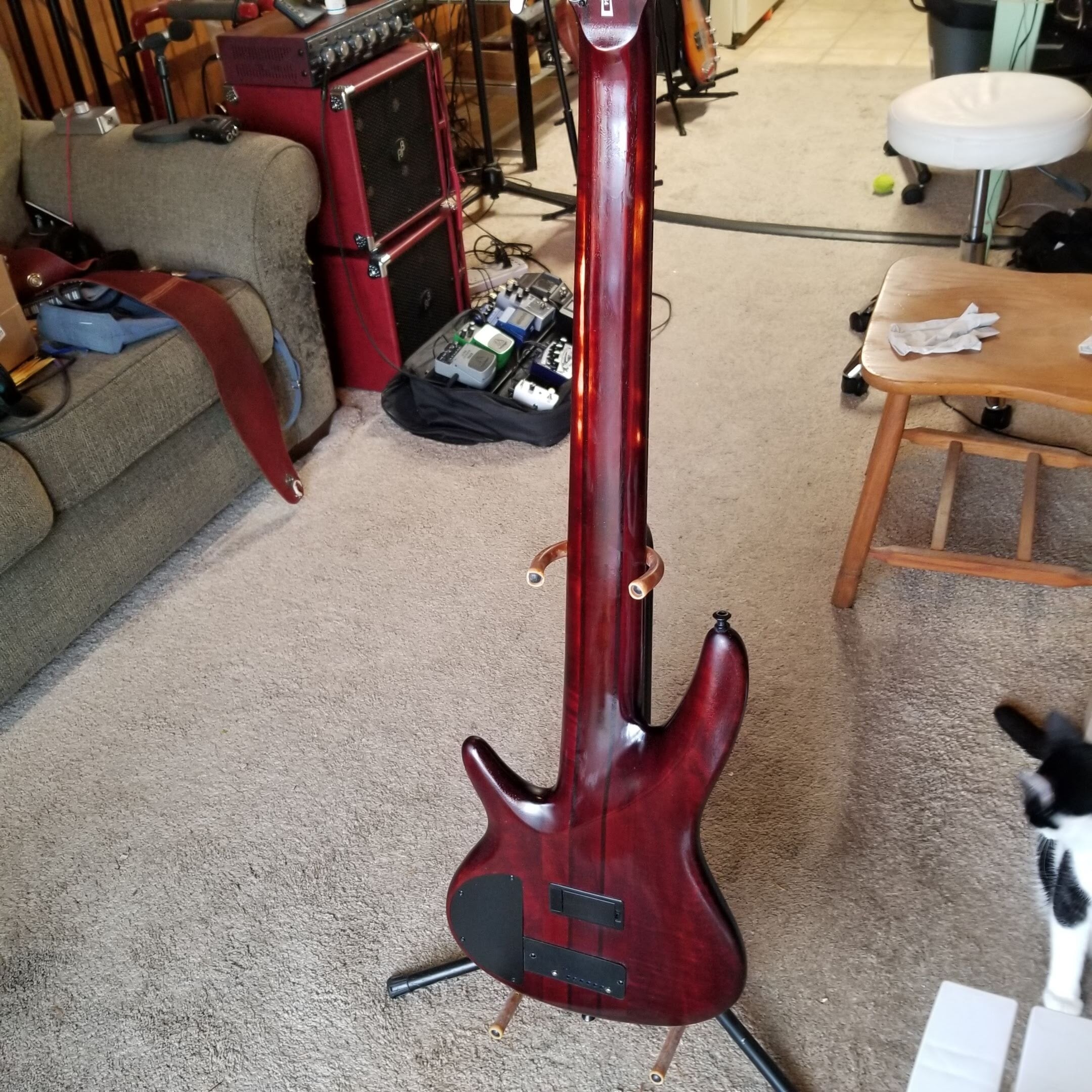
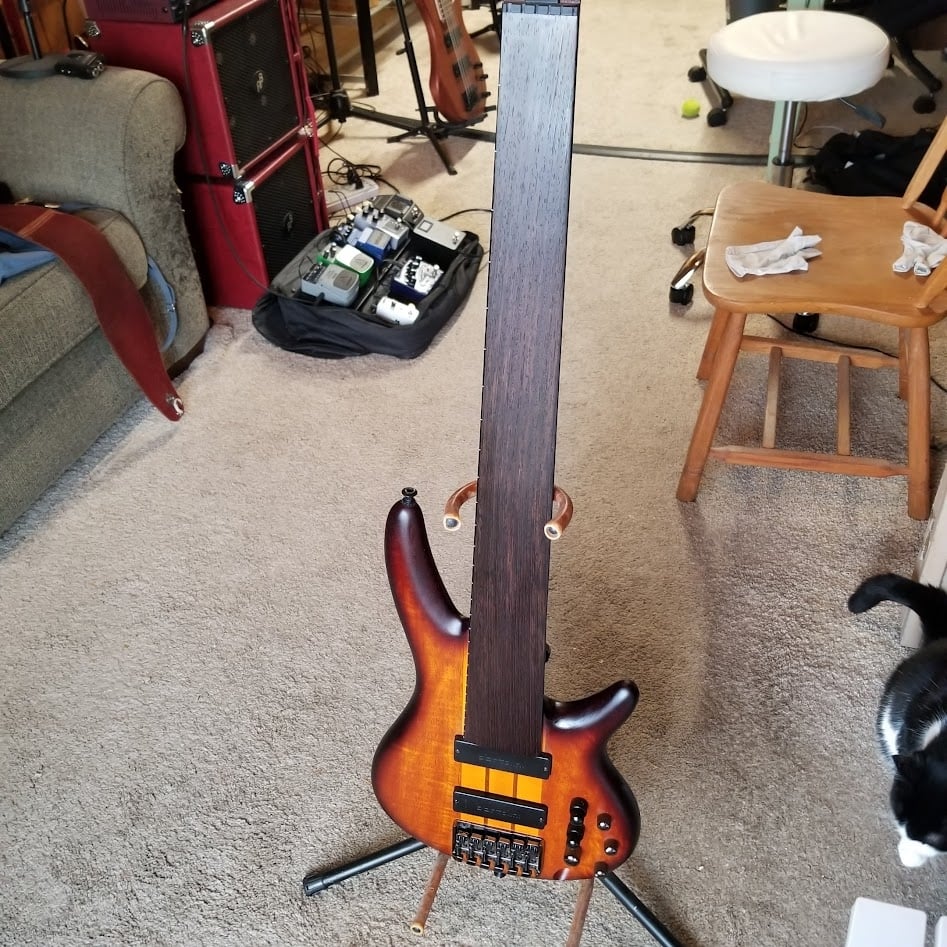
Anyway, I started with 600 grit and worked up to 1000. After 1000, I wiped the neck off with a damp rag, then a dry rage, and worked it up to 10K grit. After that, I used Tried n True (beeswax and linseed oil combo) and let it sit overnight. The picture doesn't do it justice. The fingerboard actually gleams a little bit and is smooth as proverbial glass, not uneven anywhere.
Not satisfied, and with more sandpaper in hand, I turned the bass over and ran my hand over the back of the neck. With the bass in playing position, the neck stripe nearest the bottom (nearest the C string) was rough in several places. Have sandpaper, will sand. The back of the neck is now WAY smoother than it was.
I had given the neck overnight for the treatment to dry, and finished it off with a light burnish with 0000 steel wool. Now both sides of the neck are way smoother than they were, which makes for an easier bass to play (on a bass that was pretty darned easy to play to begin with).
Now it's time to install the new set of strings....
Curious to find out how you like results. I've never had any issues with my fingerboard or neck. The only thing I'd change on mine is some of the electronics, but I pretty much love it it the way it is.Well, the LaBella Super Steps arrived yesterday, which gave the excuse to remove the original flats (anyone know who made those?) and see if I could get the fingerboard in better shape. Mine wasn't bad to begin with, but I have sandpaper and I know how to use it! lol.
Anyway, I started with 600 grit and worked up to 1000. After 1000, I wiped the neck off with a damp rag, then a dry rage, and worked it up to 10K grit. After that, I used Tried n True (beeswax and linseed oil combo) and let it sit overnight. The picture doesn't do it justice. The fingerboard actually gleams a little bit and is smooth as proverbial glass, not uneven anywhere.
Not satisfied, and with more sandpaper in hand, I turned the bass over and ran my hand over the back of the neck. With the bass in playing position, the neck stripe nearest the bottom (nearest the C string) was rough in several places. Have sandpaper, will sand. The back of the neck is now WAY smoother than it was.
I had given the neck overnight for the treatment to dry, and finished it off with a light burnish with 0000 steel wool. Now both sides of the neck are way smoother than they were, which makes for an easier bass to play (on a bass that was pretty darned easy to play to begin with).
Now it's time to install the new set of strings....
View attachment 7078122View attachment 7078123
The results, in terms of improving how it looks and how it plays, are great, but like I said, it was already pretty good in those areas before I did anything to it. I absolutely agree that some of the electronics - that is, the pickups and passive circuitry, had to go. The preamp and pickups made a HUGE difference in sound quality. This is one great bass.


