
Hello everyone, long time lurker, first time poster.
Just wanted other bassists know who might be considering a 6-string bass but didn't want to deal with an extra long scale and/or extra large/wide neck and string spacing common on most standard 6-string basses, that I have successfully converted a new Ibanez SRC6 short scale bass from its factory E to E (guitar-like) tuning to a standard bass B to C tuning using standard, medium gauge bass strings from Fodera (Stainless Steel strings with a medium gauge and a tapered B string were used: .34, .45, .65, .85, .105, .130).
The bass only required a couple of minor modifications to allow the use of these larger gauge strings - namely minor body hole widening and refiling the nut grooves to accommodate the larger gauge strings.
The biggest/scariest hurdle I faced was how I would be able to get the larger B and E strings through the body holes (for those who haven't played one, on an SRC6 the strings go through the back of the body, like a guitar, but the holes are only wide enough for about a .95 gauge string). This was solved by using a precision drill press, a level jig to hold the guitar, a sharp 9/64 (.144) cobalt drill bit and a lot of nerve to widen the 2 existing holes where the new B and E strings would go. After leveling the guitar and lining up the bit with the string holes on the back of the guitar, I carefully drilled/widened the holes all the way through to the bridge (I removed the 2 saddles by the holes I was drilling out so they wouldn't get scratched up). The other 4 holes were already large enough to accommodate the new string gauges being used so didn't require widening.
With that done, now the nut would require filing for the larger gauges. But, since I don't have a collection of precision rat-tail files in various sizes and since nut adjustment is delicate work, I referred this part to a local luthier, who was also nice enough to finish the restring and setup of the neck, bridge and intonation.
The end result is a well-balanced, super-light, short-scale 6-string bass tuned B to C with very tight string spacing (10.6mm) that plays like butter. Playing with a pick is a breeze and even finger playing is easier/faster with the ultra-narrow spacing (although, slap/pop playing is difficult at best, but since I don't play that style much, that's ok). The larger gauge strings also mitigate the floppy string feel and keeps fret slapping to a minimum while finger-playing (although, being a short-scale bass it still does require a bit of a lighter touch to play than a long-scale bass).
So, if anyone out there thought about doing this but didn't have the gumption to tackle it, I say, "Go for it". It was really not that difficult and the end result was surprisingly comfortable-playing bass.
Pictures to follow soon.
Just wanted other bassists know who might be considering a 6-string bass but didn't want to deal with an extra long scale and/or extra large/wide neck and string spacing common on most standard 6-string basses, that I have successfully converted a new Ibanez SRC6 short scale bass from its factory E to E (guitar-like) tuning to a standard bass B to C tuning using standard, medium gauge bass strings from Fodera (Stainless Steel strings with a medium gauge and a tapered B string were used: .34, .45, .65, .85, .105, .130).
The bass only required a couple of minor modifications to allow the use of these larger gauge strings - namely minor body hole widening and refiling the nut grooves to accommodate the larger gauge strings.
The biggest/scariest hurdle I faced was how I would be able to get the larger B and E strings through the body holes (for those who haven't played one, on an SRC6 the strings go through the back of the body, like a guitar, but the holes are only wide enough for about a .95 gauge string). This was solved by using a precision drill press, a level jig to hold the guitar, a sharp 9/64 (.144) cobalt drill bit and a lot of nerve to widen the 2 existing holes where the new B and E strings would go. After leveling the guitar and lining up the bit with the string holes on the back of the guitar, I carefully drilled/widened the holes all the way through to the bridge (I removed the 2 saddles by the holes I was drilling out so they wouldn't get scratched up). The other 4 holes were already large enough to accommodate the new string gauges being used so didn't require widening.
With that done, now the nut would require filing for the larger gauges. But, since I don't have a collection of precision rat-tail files in various sizes and since nut adjustment is delicate work, I referred this part to a local luthier, who was also nice enough to finish the restring and setup of the neck, bridge and intonation.
The end result is a well-balanced, super-light, short-scale 6-string bass tuned B to C with very tight string spacing (10.6mm) that plays like butter. Playing with a pick is a breeze and even finger playing is easier/faster with the ultra-narrow spacing (although, slap/pop playing is difficult at best, but since I don't play that style much, that's ok). The larger gauge strings also mitigate the floppy string feel and keeps fret slapping to a minimum while finger-playing (although, being a short-scale bass it still does require a bit of a lighter touch to play than a long-scale bass).
So, if anyone out there thought about doing this but didn't have the gumption to tackle it, I say, "Go for it". It was really not that difficult and the end result was surprisingly comfortable-playing bass.
Pictures to follow soon.




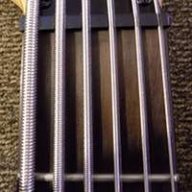



 the nut at the left side of the low B string is so thin, worries it seems prone to crack.