• TalkBass has been independent since 1998. Add your voice.
    Create a free account to reply to discussions, view embedded media, and browse with fewer display ads.
    Join freeLog in
    Want zero display ads or expanded classifieds tools? Compare plans.

"Igor's Chromatic Exercise" Error?

I'm going through "Standing In The Shadows of Motown" and was analyzing "Igor's Chromatic Exercise". In the first example, C, the notes in the second measure, after the triplet, are:

iii-V-IV-vi-dimV-vi-V-I-vi-I-bvii-...

where as in the first measure it goes:

iii-V-IV-V-dimV-V-V-I-vi-I-bvii-...

I then looked at the other five examples where it shows the exercise in the next key in the circle of fifths, and it shows that in both measures it looks like:

iii-V-IV-V-dimV-V-V-I-vi-I-bvii-...

So is this simply an error in the second measure of the first example?

Thanks,

Matt
 
Has anyone else noticed this? With the popularity of this book, I was expecting it to be a known error, but I googled it and found nothing.

It makes more sense to use the second example with fifths as opposed to sixths, but since the possible error occurs in the first example, in the key of C, I wonder if that's correct and the examples in the other keys are actually wrong.
 
Does it really matter? It's an excercise and you found what is perceived to be an error. Inconsistancy maybe a better term. I'd say use it for what it is and incorporate into your playing. Either way, both sounds have their merit. :bassist:
 
I always played those 2 A's as G's, consistent with the form of all the other keys. In fact I never noticed the error/inconsistency.

igor.jpg
 
Bumping this up. I've really been digging working through this exercise, staying within the first five frets and mixing open strings and fretted combinations. Really fun, and very refreshing IMHO. Somehow the rhythm has a natural breathe built in that helps keep me relaxed when playing it.
 
Last edited:
  • Like
Reactions: bassfuser
Exactly. Pedaling on the 6th gives him an opportunity to utilize that open A; Anthony Jackson describes his affinity for using open strings in unexpected places (his analysis of Jamerson's performance of "How Long Has That Evening Train Been Gone" from SITSOM p.95 references his use of the open A in the key of Db; Jackson refers to it as a "lazy" open string), and here he seems to be taking the same sort of tack. BTW, Joe Hubbard concurs:

How to Practice James Jamerson's Bass Exercise! Joe Hubbard Bass - YouTube
 
Last edited:
  • Like
Reactions: ErikP.Bass
There is a statement before the exercise that it was altered a bit to keep it in the lower registers and to allow open strings. The way the intro reads makes me think that the alterations were not made by Jamerson.

Exactly. Pedaling on the 6th gives him an opportunity to utilize that open A; Anthony Jackson describes his affinity for using open strings in unexpected places (his analysis of Jamerson's performance of "How Long Has That Evening Train Been Gone" from SITSOM p.95 references his use of the open A in the key of Db; Jackson refers to it as a "lazy" open string), and here he seems to be taking the same sort of tack. BTW, Joe Hubbard concurs:

How to Practice James Jamerson's Bass Exercise! Joe Hubbard Bass - YouTube

This is what's up. So many people ignore the open string technique for how these exercises are voiced.

Unfortunately, even Joe in that video doesn't play the open G in the first measure as seems clearly intended.

I'm working on a transcription with tabs right now that extends the exercise through the remaining key centers, but here's how I believe the exercise was intended to be fingered:

Flat
 
Last edited:
@klopfenpop

I started messing around with the exercise after reading your post. I've been getting into my fretless lately and this is great for practicing intonation. I'm playing along with a drone type backing track.

I'm also thinking it's useful to play the exercise just 2 chords at a time. I believe this has more of a real life application than just running through the cycle. (Running through the cycle is great too but for me more of a technique exercise than something I would apply to my playing.) Limiting myself to 2 chords helps me concentrate on the chords and play all or part of the exercise as a bass line. Especially when playing the Blues.

Cheers for bringing the exercise back to my attention. I can get caught up in so many different lessons and aspects of playing that I end up forgetting that some of the best practical exercises are ones from the past. Kind of like, "Yeah, I have that one down, what's next?"
 
@klopfenpop
I'm also thinking it's useful to play the exercise just 2 chords at a time. I believe this has more of a real life application than just running through the cycle. (Running through the cycle is great too but for me more of a technique exercise than something I would apply to my playing.) Limiting myself to 2 chords helps me concentrate on the chords and play all or part of the exercise as a bass line. Especially when playing the Blues.

Oh nice, that's a good thought. I'm still at the stage of using it as a way to get the muscle memory of the shapes under my fingers. I might try going back and forth between two at a time.
 
  • Like
Reactions: bassfuser
I found a better notation program called MusScore and finished all 12 keys. Would love any feedback. I had to make some choices based on trying to hit as many of the triple chromatic approaches in first position as possible in each key. Also using alternating open and fretted strings like the book describes.

Also I'm not sure if I'm being 100% consistent with accidental use toward the end. (might have some sharp 2nds and some flat 3rds, etc.)
 

Attachments

BassBuzz recently put up a video on this exercise and included a .pdf and demonstration of it played through 12 keys.

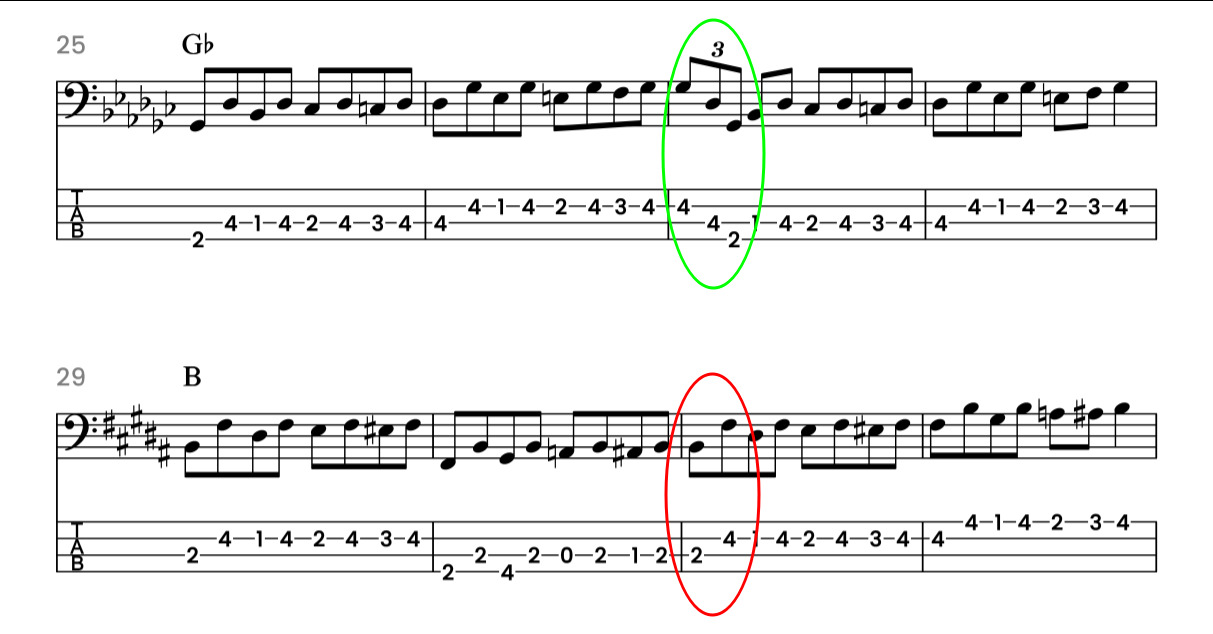
Yes he did and it's a really great exercise. I just dont know why he left out the triplet for the B key.
It is present in every other key. For B it should look just like the one for Gb.

You can add the tipplet and switch bars 30 and 32 to make it easier to play.

 
Last edited:
  • Like
Reactions: ErikP.Bass