• TalkBass has been independent since 1998. Add your voice.
    Create a free account to reply to discussions, view embedded media, and browse with fewer display ads.
    Join freeLog in
    Want zero display ads or expanded classifieds tools? Compare plans.

I'm Afraid of Set Necks

Agree. Especially about the sustain. It is a red herring. I’ve yet to play a bass that didn’t have more sustain than I’d ever need. Even a Höfner 500/1 will hold a note forever if it’s plugged into a decent amp. I spend a lot of time muting. I don’t think I ever once needed to struggle to get more sustain. And if I did, a compressor would fix that problem very quickly.

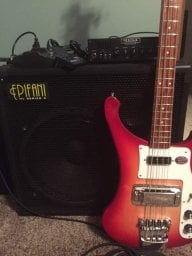
I’ve got all three neck types, although I’m currently down to one neck-through myself. An early 80s Matsumoku hippie sandwich build (Memphis “brand”) that’s light in weight, sounds amazing and is pretty easy on the eyes. Hopefully it’ll continue to hold up. I really like this bass despite its neckdive. Fortunately it’s light enough that a suede backed strap keeps it put.

View attachment 3053214

+1 on all of the above, except I have several set necks, several neck thru's - and a goodly handful of bolt-ons...
 
Thousands of Gibson’s have come off the production line for years without issue! Now if they could design the other end of the neck to keep the headstocks from breaking!

The vast majority, yes, but not all of them. I know two people who've had Gibson guitar neck joints literally fail and fall off in the middle of a gig. One in the 70's and another about 5 years ago. Not coincidentally their instruments turned out to have been made at very low points in Gibson quality control, when they were literally throwing half-finished instruments out the door to meet production quotas at the end of the month.

As has been said many times, the best part of bolt-on necks is that they're cheaper to build in bulk and easier to repair if there's a problem.
 
my husband glued two pieces of wood - i think spruce - together with titebond. a week later, we tried to force the two pieces of wood apart. when the two pieces of wood finally separated with a lot of force, the titebond had held - one of the pieces of wood's facing part peeled away instead.

(edited for typo)

When working with wood glue in the garage growing up, my dad would always say that the wood glue was stronger than the wood it was holding together, frequently thats true!
 
  • Like
Reactions: pcake
As has been mentioned, that set neck joint, if done correctly, is pretty damn strong, and probably far less likely to shift or give than the typical bolt neck.

I really don't have a preference, and I've never built one, but I like to believe that the tolerances during the build process for a good set neck instrument are tighter on average than the tolerances for some (many?) commonly played bolt necks. During the build, part of the incentive has to be the knowledge that once the neck is glued into the joint, it's game over. Removing and re-setting a set neck instrument is an ordeal that only the best luthiers and techs can perform.

When I see the wide variation in tolerances in the neck/pocket relationships of bolt necks, as displayed here countless times on TB in graphic detail, with basses across a wide spectrum of price points, I am astonished at how much variation there is. Obviously, when it's not permanently installed and you can easily unbolt the neck and do a little something something in the pocket, the tolerances don't have to be as exact. I think the better builders of bolt neck instruments get it about as close as a set neck, but many bolt neck basses used in heavy rotation studio and stage obviously do not have the most exact or consistent tolerances.

At any rate, I made it a point long ago to not handle my guitars and basses by the neck too much, unless I'm in the act of playing it. I've seen bolt necks shift just from one rough misplaced jerk on the neck. So now I'm in the habit of handling guitars and basses by the body wood, and I'm a bit averse to hangers as well. Set or bolt, it is a joint, and funny things happen at joints when you least expect it. Once that neck is set the way I like it, I want it to stay that way for a long time.
 
  • Like
Reactions: FingerDub
"I was not aware of this. I thought they were all neck through basses. If I may ask, what model?"

"Epic. No longer a standard model, it was their lowest priced bass but still exceptional quality. Should not have sold mine."

[Invalid or Expired Link Removed]

OK. I remember now. Alembic's web site is blocked here but I think Mr. Newsted used those.
 
As far as I understand them, set necks are a dovetail joint attaching the body and neck together along with some sort of adhesive. I have read that this is supposedly just as strong as a bolt on but I'm not so sure. Even with glue I feel like the wood could move or bend or compress even just a little bit and compromise the joint. I'm definitely more comfortable with bolt on at this point.

I guess I'm asking for my mind to be set at ease. There is a bass I really think I want except for its set neck.

Bolt on necks are the worst connection method of the three types, in terms of strength ans stability.
 
Hendrix smashed his strats as well as burned them,Townshend smashed whatever he played and his instrument wasn't chosen for smashability (I know it's not a real word)....my take is the modern bass was essentially invented by Leo Fender,so there was no "right way" to make a bass until he came along. He intended the instruments to be bolt on. There is a reason bolt on or neck through basses sell more than set neck models. In my experience with set neck basses (Gibson) the necks warp a bit easier,but that's just my experience. It doesn't really matter how much craftsmanship and old world knowledge it takes to make (it's all cnc now anyway). There is a reason more are done in bolt on (aside from easy production,but again its cnc so its far less work even if it's set). Thats like saying a battleship from 200 yrs ago is just as effective as one built in the last 20 yrs because it takes more "old world craftsmanship" to build and is proven to float. Also bolts dont deteriorate over the years like glue can.Thats my rant.

Bolt on necks are the easiet and cheapest to produce. That is the only reason they out number the other two types.
 
  • Like
Reactions: Luigir
May have been said before, but the only reason I won't get a set neck or neck-through again, is because the truss rod on my Carvin lb75 snapped. I tried to remove the fretboard, but it cracked, so there's no easy way of salvaging it. If it were a bolt-on, repair would have been so much easier.

Only exception would be a bass like the Fodera's with the rod that pulls right out.
 
There is no reason to worry about the basic integrity of a set neck. Glued joints in wood are stronger than the surrounding wood; since wood is a porous material, the glue soaks in a bit and so forms somewhat of a wood/glue composite.

Depending on the type of glue used, it may be possible to "undo" the glue joint using heat, making neck replacement possible in some set-neck designs. That's a somewhat expensive operation so it's not as common as replacing a bolt-on neck, but it's also not uncommon to see neck replacement in higher value guitars like Gibson Les Pauls, etc.[/QUOT
I get that, but if you were to grab a bass by his neck and moving around a little bit or swing it or grab it are you telling me that would not lose its Integrity the same way as a bolt on?

If so, why are so few basses made this way?
OP I'm starting think its all in our heads,
I say our heads cuz I think I'm the only one so far that actually agrees with you ! as more replies/ answers make alott of sence (to me anyways) I'm almost convinced setnecks are a safe bet ! Like the guy who's had a ripper for over 30 years and has never had issues with his set neck not to mention all the Gibson's comments !
but I would still prefer Bolton or neckthu as a personal preference.
 
When I was younger I was making a model airplane. It was a commercial jet (Western Airlines to be precise) and the kit was made out of plastic. I made the mistake of using wood glue instead of model cement because I had run out. The result was the wings would fall off no matter how long I let them cure.

The effect on me is that I grew up with a deep mistrust of both Elmer’s glue and airplane wings. It’s taken a ridiculous amount of flight time for me to get over the latter.

Maybe the OP has a similar glue story in the past haunting him into a similar irrational fear?
 
How many people have really had to replace a neck due to some sort of flaw or damage? Yah, I know, they all hang out here, but in the real world, very few. Obviously not enough to retire set-neck and neck-through instrument design. Not enough to make bolt-on the only reasonable choice.
 
  • Like
Reactions: Craig4003
As far as I understand them, set necks are a dovetail joint attaching the body and neck together along with some sort of adhesive. I have read that this is supposedly just as strong as a bolt on but I'm not so sure. Even with glue I feel like the wood could move or bend or compress even just a little bit and compromise the joint. I'm definitely more comfortable with bolt on at this point.

I guess I'm asking for my mind to be set at ease. There is a bass I really think I want except for its set neck.

Well, then, set your mind at ease. Unless the bass you want is very cheap/poorly made - and I'm guessing that's not the case - then you have nothing to worry about. Like others have said, set neck instruments have been around for a long time, and the neck joint itself is very, very seldom a problem. It is possible for the joint to become loose, but that's a symptom of very poor quality or, much more likely, extreme age/the glue used back then. With a quality bass, you'll probably be dead and gone long before the bass' neck joint becomes a problem...
The only real problem with set neck instruments is that it's difficult (and expensive) to get the neck off if you have to. And, there are sometimes problems that can't be fixed unless you do so. But, again, those problems are ones that come with being (most always) a very old instrument...
Bottom line? If it's a bass you want, then buy it; play it; and enjoy it. If you want to worry about something, then worry about what strings will sound best on it... or whether it's the best bass for Metal....:whistle:
 
When I was younger I was making a model airplane. It was a commercial jet (Western Airlines to be precise) and the kit was made out of plastic. I made the mistake of using wood glue instead of model cement because I had run out. The result was the wings would fall off no matter how long I let them cure.

The effect on me is that I grew up with a deep mistrust of both Elmer’s glue and airplane wings. It’s taken a ridiculous amount of flight time for me to get over the latter.

Maybe the OP has a similar glue story in the past haunting him into a similar irrational fear?
Model glue is less of an adhesive, and more of a solvent "welding" of the plastic.
 
  • Like
Reactions: Korladis and pcake