• TalkBass has been independent since 1998. Add your voice.
    Create a free account to reply to discussions, view embedded media, and browse with fewer display ads.
    Join freeLog in
    Want zero display ads or expanded classifieds tools? Compare plans.

I'm Afraid of Set Necks

BOO!
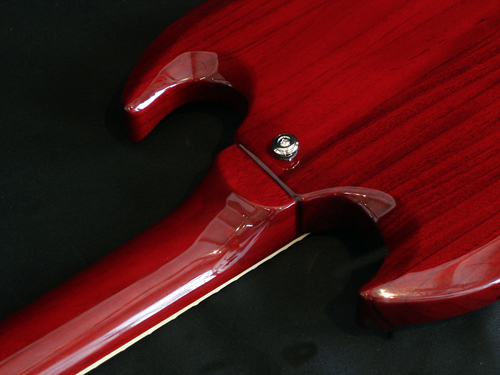
set_neck.jpg

:D
__________________________________________________

Bolt-ons were a Leo Fender idea (pretty sure) from 1948.
The proto-Rickenbacker Electro-Spanish Model B, one of the earliest (1935) solidbody electric guitars played thumb-behind-neck, had a bolted-on, detachable neck:
zyvixr8uvsu9xg5jltdx.jpg

Rickenbacker ELECTRO SPANISH MODEL B 1935 Black
 
Les Paul guitars have set necks. Very often, Les Pauls are tested to their physical limits - through dropping or the like. Les Pauls do not break at the neck to body joint. They do break at the headstock to neck joint - if you want to worry about something, you're worrying about the wrong thing.
 
  • Like
Reactions: CereBassum
As far as I understand them, set necks are a dovetail joint attaching the body and neck together along with some sort of adhesive. I have read that this is supposedly just as strong as a bolt on but I'm not so sure. Even with glue I feel like the wood could move or bend or compress even just a little bit and compromise the joint. I'm definitely more comfortable with bolt on at this point.

I guess I'm asking for my mind to be set at ease. There is a bass I really think I want except for its set neck.
I'm more afraid of turtlenecks...
115485292.jpg
 
For smashing up guitars on stage, Pete Townshend favored hollow-bodied set-neck Rickenbackers. You don't want the neck joint to fail, because then the body would just fly off rather than get smashed, and you want a hollow body because it smashes more easily. That's probably why nobody smashed Les Pauls on stage, and why Jimi Hendrix set Stratocasters on fire rather than smashing them.

Just get a neck through bass. Guy Pratt believes they are VERY strong. Set necks are similar strength.

 
  • Like
Reactions: Low84
Leo Fender designed the bolt-on neck simply from a construction and repair POV:
If your neck breaks, just replace it! Easy assembly. No muss, no fuss.
Before him, quite literally every musical instrument was made via wood and glue.
Pianos, violins, violas, harps, lyres, whatever. EVERYTHING was made with wood and glue.

If you're gonna avoid set-necks, there are other reasons to do so than structural integrity.
 
  • Like
Reactions: Korladis
Glued joints in wood are stronger than the surrounding wood; since wood is a porous material, the glue soaks in a bit and so forms somewhat of a wood/glue composite.
And as mentioned, quality glue joints are much stronger than the surrounding wood.
I've heard many luthiers and woodworkers comment that a well done wood joint can be significantly stronger than the wood around it.
A good neck joint is stronger than the wood around it.
When working with wood glue in the garage growing up, my dad would always say that the wood glue was stronger than the wood it was holding together, frequently thats true!
If well glued, glue is stronger that wood itself.
Its more difficult to destroy pieces of wood glued toghether than the actual block of that wood.
a glued joint is literally stronger than the woods that are joined together.
We bass players do embrace repetition, do we not?
 
Violin and viol family instruments also have what could be called "set" neck construction, and it hasn't been improved on in 400+ years of lutherie.

We are at 500+ if you are only counting the European violin family. Set necks elsewhere go back thousands.

Since bolt ons are so prevalent and offer some sonic distinctions you’re safe leaving the set necks to the adventurous. :)
 
have you ever tried to break apart a couple chunks of woods that were glued together a couple years ago ...??

the vast majority of the time , it will not break where it's glued ..!! the glued bonded wood becomes stronger than the wood around it ... YMMV ...

have you ever sheared a bolt ..?? i have ... many times ..

just saying
 
  • Like
Reactions: Korladis
We bass players do embrace repetition, do we not?

have you ever tried to break apart a couple chunks of woods that were glued together a couple years ago ...??

the vast majority of the time , it will not break where it's glued ..!! the glued bonded wood becomes stronger than the wood around it ... YMMV ...

have you ever sheared a bolt ..?? i have ... many times ..

just saying
 
I get that, but if you were to grab a bass by his neck and moving around a little bit or swing it or grab it

Are you a bass player or a juggler? Maybe you're on the wrong site...

grab a bass by his neck

Who told you a bass is male? I have 4 basses - two are male, two are female. I wanted them to be happily paired off - I look after my children. :D
 
  • Like
Reactions: Korladis
As far as I understand them, set necks are a dovetail joint attaching the body and neck together along with some sort of adhesive. I have read that this is supposedly just as strong as a bolt on but I'm not so sure. Even with glue I feel like the wood could move or bend or compress even just a little bit and compromise the joint. I'm definitely more comfortable with bolt on at this point.

I guess I'm asking for my mind to be set at ease. There is a bass I really think I want except for its set neck.

I'd check it out. Being a set neck or neck through is not a negative. They are generally a more expensive / higher quality instrument than a bolt on neck, with some exceptions.
 
  • Like
Reactions: Korladis

Latest posts