• TalkBass has been independent since 1998. Add your voice.
    Create a free account to reply to discussions, view embedded media, and browse with fewer display ads.
    Join freeLog in
    Want zero display ads or expanded classifieds tools? Compare plans.

I'm ready to throw in the towel (5 string).

They only give you a few more notes but being able to play over two octaves without having to shift is the biggest incentive to learn to play a five string.. IMO
Very true. And those additional positions can make transposing easier, too. Two of the groups I play in shift most of our songs up or down several half steps depending on who's singing them on a given night and having those additional positions makes it much easier for me to play that many songs in multiple keys.

Yeah, I'm sure some will tell me that I'm cheating and that I'm not properly developing a necessary skill. Maybe to some extent, but it works for me. Transposing songs more easily is one of the reasons I decided to start out learning on five-strings, even though the overwhelming majority of what I listen to and play was written before five strings existed. Glad I made that decision. :D

But, just to repeat what I said earlier, there's no shame in playing fours exclusively. The percentage of players who play fives here on TB is probably a fraction of members and the percentage outside of TB members is probably a lot lower than that. You're in good company if you play only fours! ;)
 
  • Like
Reactions: Bassngtr
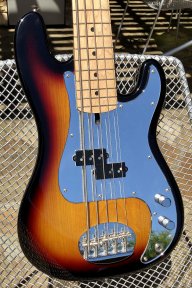
To the OP - it may just be a matter of finding the right 5 string for you. I went through several iterations before finding what worked for me. I ended needed a big 5 string (35 inch scale, wide string spacing at the bridge and nut, etc.), so I ultimately found a Lakland Skyline 55-64 that fit me correctly. It may help to learn which 4 string works best for you and try to find the 5 string that is most like that. My main preference in 4 strings was the old school P bass (with 1.75" at the nut) - my Lakland is the closest 5 string with similar dimensions, pickup, etc. Also, you have to put in a certain amount of time when first moving to additional strings (4-5, 5-6, even 4-8 with octaves).
 
My friend Kyle bought the Tobias (the inexpensive MusicYo version of a Tobias) that is in the photo of me to the left. It is a narrow - spaced 5, which is why I no longer have it. For his application, he loves it, plus - the tone does have booty.

When he bought it, he made the transition form four strings to five. I told Kyle, "once you get used to playing 5 strings, it's hard to play a 4".

After a few years passed, he said "When you first told me that, I didn't believe you. Now, I understand"

Bottom line (clever, I know) play what feels right to you. And remember, if your listeners are counting strings, they aren't listening.....
 
Last edited:
I've been back and forth on 4's and 5's since the early 90's. Most the bands I've been in have dictated which ones I end up using. I'm just going to say that 4's still out sell 5's by a large number and that you can get pretty much everything done with a 4 banger. However, it's nice to have the option to use a 5 if need be. My main bass will always be a 4 string though and its the one I feel most comfy on.
 
I will second the notion about floating thumb. Learning to use a floating thumb technique pretty much eliminates the difficulty of more strings. Muting increases automatically, and your fretting and plucking hand are always in the same relative position. Add 1, 2, heck even 3 strings and it doesnt matter because you never experience a different amount of space between the strings, which is what I feel causes the issue at hand. Learn floating thumb before you ship off your 5 string. Worst case scenario, you learned a new technique and have more money in your pocket.
 
I have more trouble trying to use a 4 string these days. Especially when my band changes keys of songs from the original.
It's just so simple on a 5 string to transpose on the fly. Just slide up or down a fret or two and play the song.
This does require using the B string for the root note which I think is the key.
After a while you can control your attack on the B string so that it sounds the same as the E string would have.
 
If you can you lose yourself between bone and bridge, the number of strings is happenstance, the fingerboard's a dance floor, and digits love to dance.
 
Last edited:
There have been thousands of hit records that were done with 4 strings, so it isn't a requirement. If a 4 string feels right and lets you play without straining, it is right for you. How many gigs have you played with 4-strings?

James Jamerson, Donald Dunn and a ton of other legendary bassists only used 4 strings. If the 5 isn't right for you, play the 4 as well as you can and use it to make great music.
 
I’ve played 4 for over 30 years, tried a 5 and it did my head in, I didn’t waste any time with it, I knew it didn’t suit me, just been listening to Bobby Vega, can’t see him playing a 5 string and in my opinion he’s one of the most musical sounding players I’ve heard, all the players I like are 4 players, why waste time on something when you can be happy on 4
 
This really comes down to why someone plays bass. There are a number of scenarios:

1. for a living. In that case, probably need to learn 5 and 6, be able to read, and hustle your ass off.
2. for fun, but "serious" - in multiple bands, study, experiment, etc. In that case, likely want to play 5 and/or 6.
3. for fun, but do gig from time to time. In that case, depends on the gig. Some gigs will "require" a 5, but not that many.
4. for fun, don't gig, but play to keep mentally active. In that case, an extended range bass can be a good "stretch", as could studying with a teacher.
5. for fun, don't gig, play for pure enjoyment and not looking for a "challenge".

None of these are better than the other. But if one is honest about what category they are in, gear choices become a bit simpler.
 
Last edited:
  • Like
Reactions: Passinwind
I played 4's exclusively for 20 years, then 5's exclusively for the next 15. One day I realized the b string was the most expensive thumb rest ever, so I went back to 4 and am a whole lot happier. Like you, I am a lot more at home on a 4. Playing is easier, buying strings is easier (and cheaper), it's just a lot more fun. No shame in dumping the 5, just have a good time.
 
Peoples and persons of Talkbass, I hate to say it, but I'm ready to forget about a 5 string as
my 'always' bass.

When I got my first fiver just shy of two years ago I never saw it as a potential "always" thing. I did have a substantial honeymoon period though, particularly since it was my first fretted bass in 35+ years. Spent quite a bit of time shedding, am now pretty comfortable and also ready to mostly but not exclusively move back to things I love more. Took about ten minutes with my new fretless four to identify one of those things.
Yel_wink.gif
 
  • Like
Reactions: saabfender
Mentioned earlier but it’s my main thought: string spacing.

I own two 4-strings and one 5-string (one of the first BTBs). I bought the BTB 5 thinking that similar string spacing (to my 4s) would help me learn the 5. That was correct, but until I joined a band that asked for a 5, I barely used my 5. For almost 18 months now I’ve used the 5 exclusively in this newest band, while using my 4s for other gigs and church. The “exclusiveness” was the key to me getting used to (and proficient on) the 5.

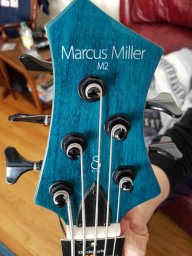
I’m getting ready to pull the trigger on a backup 5 (Sire M2 – 18mm spacing) and while shopping in person I tried a few 5ers that had narrow(-er) string spacing than my BTB (19mm I think). WOW even for the songs/lines I play in the new band on the 5, I was totally lost – the string spacing was SO different. None of my “moves” were working, and I just couldn’t figure out which string I was playing.

The initial use of a 5 vs. a 4 is tough IMO due to the fundamental nature of the string positioning. I compare it to trying to drive a new car with a steering wheel in the middle of the dash instead of the left driver’s position, or playing drums with the snare outside my left or right leg instead of between my legs…it’s truly a fundamentally different positioning, which takes a good amount of experience to get used to.

Like some have said I now find it tricky playing the 5 then going back to the 4. I still prefer playing my 4s, but it’s sure nice (esp. in church) to have a low Eb and D. :) And changing keys (which all my bands do a LOT) is much easier on the 5.
 
  • Like
Reactions: saabfender