
Look at my posting history. This is not a troll thread. The reason I haven’t posted it is because a) I’ve been really busy this week and have 2 young kids who keep demanding attention and b) I don’t know how to get it from my drop box to here. I’ve got 10 minutes just now. I’ll see if I can work it out.I have a feeling it sounds fine it's just that the OP ears aren't developed enough, especially if the major 7th is in the top voice of the chord. And for some reason he's avoiding letting us hear the track, so that's just added confirmation for me.
I'm actually kind of suspicious that this is just a troll thread

Enjoy the benefits of a premium membership!
Upgrade Account
-
TalkBass has been independent since 1998. Add your voice.
Create a free account to reply to discussions, view embedded media, and browse with fewer display ads.
Join free Log in
Want zero display ads or expanded classifieds tools? Compare plans.
You are using an out of date browser. It may not display this or other websites correctly.
You should upgrade or use an alternative browser.
You should upgrade or use an alternative browser.
Improvising over maj7 chords
- Thread starter Yonni
- Start date
More options
Who Replied?
There are numerous youtube videos about that "problem".
"First, you don’t know how to properly HEAR Maj7 chords… let alone how to play over them. Second, stop assuming the root note of the chord is the strongest and most stable note to improvise from. You should NOT be jumping straight to C ionian over a CMaj7 chord and assuming that the C note is your tonic note."
Thank you! I’m not crazy and I am hearing something discordant! He lost me at about 11 minutes in when he started talking about adding “tension 4” but at least I have a jumping off point to explore now.
I’ve only been playing 5 years and covid screwed up my development (no lessons or exams). Improvisation is a new skill to me. I was due to do this exam 18 months ago but the world went to hell so I just carried on learning songs and following Scott’s Bass Lessons instead. The exam I’m doing isn’t very high level (UK grade 4) but the aim is to build confidence. The format is 3 performance pieces and an improvisation over a previously unseen piece. They play it through once and give you the chart then you have to improvise the bassline live.
I’ve got just over a week to go and have a final lesson on Tuesday. Teacher has been abroad so I haven’t been able to speak to him the last month. Thanks for all the replies. I’ll let you know how I get on.
Improvisation is a new skill to me.
I understand.
You have a two-bar drum pattern - Standard 8th groove.
In the second bar, the kick changes its pattern.
Pay attention to that accent on the second 8th note of Beat 3, emphasize it with the bass note.
the aim is to build confidence. The format is 3 performance pieces and an improvisation over a previously unseen piece.
Let's check some bass-line rhythmic patterns for that drum beat.
N.B. Create a repetitive rhythmic bass pattern with some embellishments, where and when it's needed.
As a beginner bass player, I would start with a simple first bass-line pattern.
Pattern 1.
Due to the track's tempo, the "active Melody", and "IT'S an exam, not a real song" requirements, I would play only E (root) notes with the E major chord. I would not(!) use the 5th on the second 8th of Beat 2.
About that Amaj7.
Yes, the guitar plays that chord with G# as the lowest note, and it adds some aural "confusion", but in the bass it's A (while the Melody is E).
Now.
Here we have an interesting "dichotomy."
The chord (harmonic rhythm) changes exactly on Beat 3, but the Drum rhythmic pattern emphasizes the second 8th of Beat 3.
What to do?
In real life, I would prefer to play B, only on the second 8th of Beat 3, but...
It's an EXAM; therefore, it could be some requirements like,
"It does not matter what the kick plays. If the harmony changes, the bass must change it too".
And just because of it, I've decided to "please" both "bosses" - the exam and the Kick pattern.
I would play both 8th notes on beat 3 (with the accent on the second one), plus the last 8th note in order to land on the next chord root on Beat 1.
Last edited:
so, this thread is basically 5 pages of nothing since the A sounds fine and is arguably the best note for that chord in that context.
my recommendation would be ear trainingso, this thread is basically 5 pages of nothing since the A sounds fine and is arguably the best note for that chord in that context.

so, this thread is basically 5 pages of nothing since the A sounds fine and is arguably the best note for that chord in that context.
my recommendation would be ear training
Dude, he needs help, asks good questions, wants to build confidence.
The only garbage here is your attitude.
@Yonni just listen to @Whousedtoplay. Keep it up.
the aim is to build confidence.
Here is how I would build my confidence.
Bass pattern number 16 (LOL).
Due to that specific melody, I would syncopate the second 8th on Beat 2 and would not play with the kick on Beat 3.
And it would be D#, because it helps to "to push/move the melodic harmony" while the
guitar (melody) plays a double stop of G# and B.
And my omission (a bass-free gap) of Beat 3 would allow me to play the last 8th in the bar - B.
In Bar 2, I would play the long A on Beat 1,
plus that accent (only) of B (second 8th on Beat 3)
and C# as the last 8th in that bar.
That C# note would nicely resolve into F#.
N.B. My rationale (as a beginner bass player) for playing those "second 8th's" on Beat 4 is this.
I don't need to synchronize it with the Drum Snare.
It gives me (IMHO) a simple but "attractive" bass line.
im saying that if he posted the track on page one we could have said, no, the A note is correct, go work on some ear training. and that's not a bad attitude, that's what he needs. that way we could have focused in on his specific problem without all the meanderingDude, he needs help, asks good questions, wants to build confidence.
The only garbage here is your attitude.
@Yonni just listen to @Whousedtoplay. Keep it up.
Last edited:
(The digits with the bass notes indicate octaves.)
While keeping up with the same (more or less) bass rhythmic pattern, let's move into the F#min7 "territory without adding too many (amateur) notes.
For my beginner bass player taste, I like minor sevenths with minor chords.
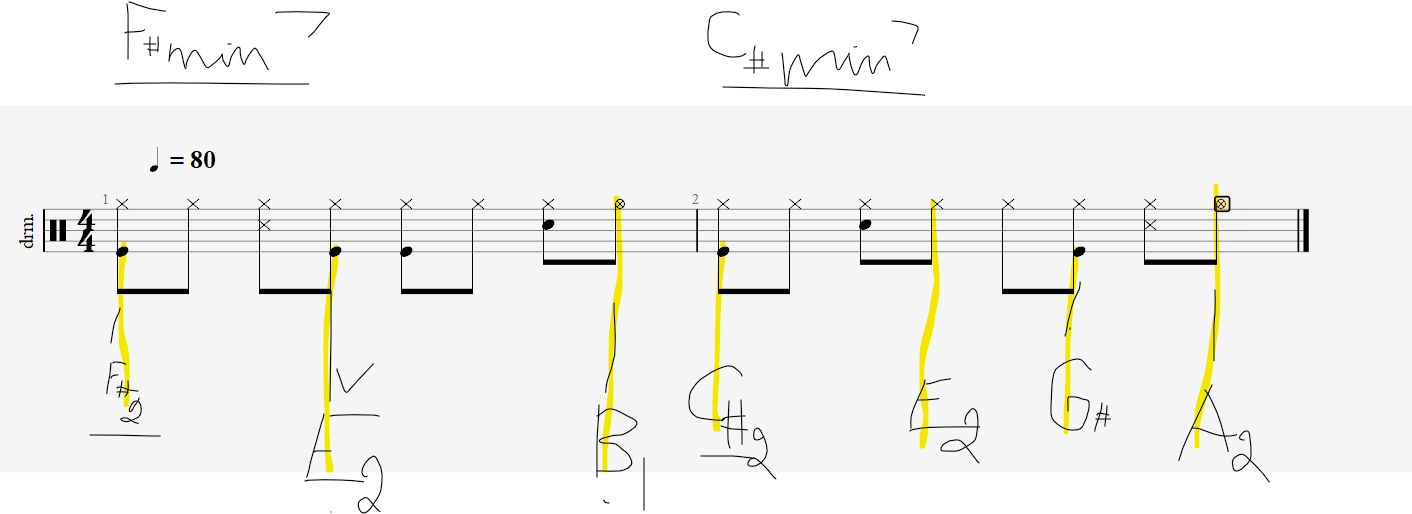
While keeping up with the same (more or less) bass rhythmic pattern, let's move into the F#min7 "territory without adding too many (amateur) notes.
For my beginner bass player taste, I like minor sevenths with minor chords.
Next, we have that "strange" harmonic rhythm section of B7/E7.
Nothing special, just adding/playing the root on Beat 3 - Harmony changes, and we slightly variate the rhythmic pattern.
Also, playing F#(2) before A sounds "more attractive to my ears than G# or B.
In the second bar, we have abundance of the Amaj7 chord to "please" my ears; therefore, I "must" include the 9th (2nd) - B with that chord.
Once again, comply with the bass-line rhythmic template.
As an amateur bass player, I can add lots of other notes, but...
I would become a "soloist", not a good bass player.
Also, with age, I'm always trying to find that "finesse" of "Saying MORE with less".
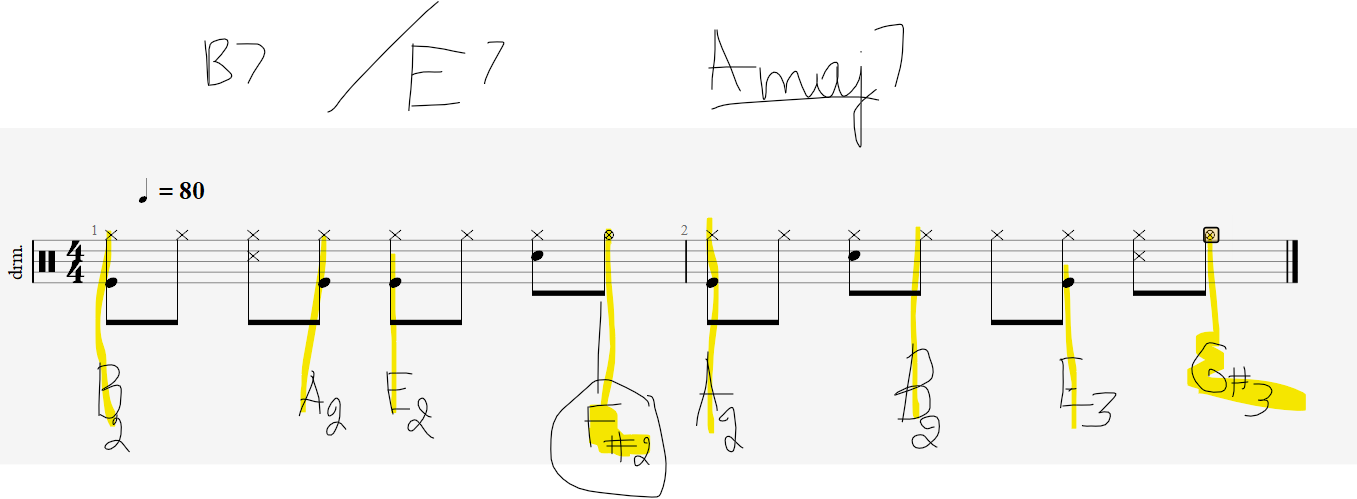
Nothing special, just adding/playing the root on Beat 3 - Harmony changes, and we slightly variate the rhythmic pattern.
Also, playing F#(2) before A sounds "more attractive to my ears than G# or B.
In the second bar, we have abundance of the Amaj7 chord to "please" my ears; therefore, I "must" include the 9th (2nd) - B with that chord.
Once again, comply with the bass-line rhythmic template.
As an amateur bass player, I can add lots of other notes, but...
I would become a "soloist", not a good bass player.
Also, with age, I'm always trying to find that "finesse" of "Saying MORE with less".
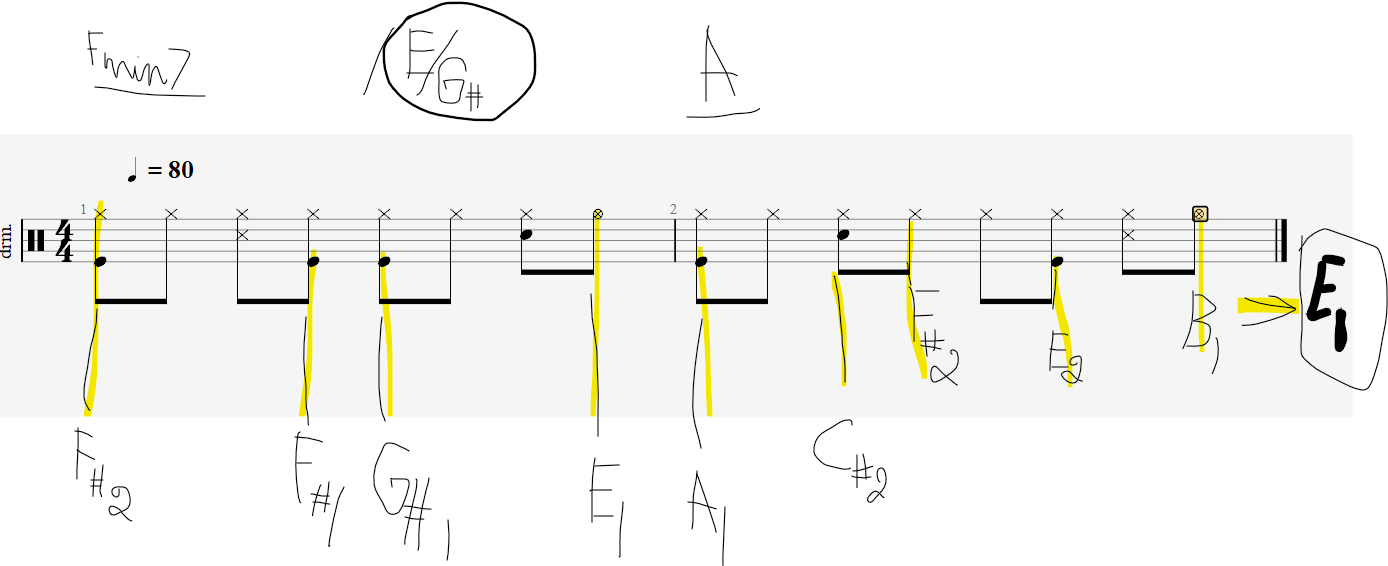
And now, the last part of my amateur/beginner bass player's concoction.
N.B. I slightly rearranged that E chord by adding a Slash bass note.
Please, don't do it for the exam. It could be interpreted as arrogant!
To sum up.
A pop/rock/soul/etc... bass lines are PATTERN-BASED.
Yes, one could add more embellishments, but the rhythmic "template" must be preserved. Developed, but preserved.
N.B. I slightly rearranged that E chord by adding a Slash bass note.
Please, don't do it for the exam. It could be interpreted as arrogant!
To sum up.
A pop/rock/soul/etc... bass lines are PATTERN-BASED.
Yes, one could add more embellishments, but the rhythmic "template" must be preserved. Developed, but preserved.
if he posted the track on page one
Sometimes, when the track is not yours, is not that easy to post it - copyrights.
we could have focused in on his specific problem without all the meandering
Here is what Yonni wrote:
"I’m trying to improvise a bass line
Improvisation is a new skill to me."
That aural "issue" of Amaj7 was, more or less, just a side effect.
CREATING - improvising - a bass line from scratch for Pop, Rock, RnB, Soul, Funk, etc... always involves establishing a rhythmic template from the "correct" notes, but...
It's a very long discussion, not for this thread...
just as a refresher, here is the OP:Sometimes, when the track is not yours, is not that easy to post it - copyrights.
Here is what Yonni wrote:
"I’m trying to improvise a bass line
Improvisation is a new skill to me."
That aural "issue" of Amaj7 was, more or less, just a side effect.
CREATING - improvising - a bass line from scratch for Pop, Rock, RnB, Soul, Funk, etc... always involves establishing a rhythmic template from the "correct" notes, but...
It's a very long discussion, not for this thread...
This has been getting me all week. I’m trying to improvise a bass line over a chart with some maj 7 chords in it but if I play the root on the “one” for those chords it doesn’t sound good. For example:
E | Amaj7 B | F#m7 | C#m
Its fine on the rest of the progression but when I get to that Amaj7 it sounds off. Same happens with Emaj7 Ebmaj7 or Abmaj7 etc. any tips? What am I doing wrong here? Am I missing a key bit of theory?
the answer is, the root sounds fine. need to work on ear. just so that i'm not that guy who says go work on this but then doesnt say how, a good place to start is to work on everything on this site:
Ear Training
but start with intervals and then move to chords. then i personally would go to intervals in context and melodic dictation.
concurrently working on hearing every chord on the following sheet :
even if you cant play piano, its good to figure it out on your own because you will be learning theory at the same time as developing your ear. if the above sheet seems hard, dont worry. dont avoid it. when someone plays a random chord on the sheet, you need to be able to name it. the sooner you start with it the longer you will have to work on it. it will come with time and repetition. (those who know, know where that sheet is from)
I have nothing against Ear Training.just as a refresher, here is the OP:
This has been getting me all week. I’m trying to improvise a bass line over a chart with some maj 7 chords in it but if I play the root on the “one” for those chords it doesn’t sound good. For example:
E | Amaj7 B | F#m7 | C#m
Its fine on the rest of the progression but when I get to that Amaj7 it sounds off. Same happens with Emaj7 Ebmaj7 or Abmaj7 etc. any tips? What am I doing wrong here? Am I missing a key bit of theory?
the answer is, the root sounds fine. need to work on ear. just so that i'm not that guy who says go work on this but then doesnt say how, a good place to start is to work on everything on this site:
Ear Training
but start with intervals and then move to chords. then i personally would go to intervals in context and melodic dictation.
concurrently working on hearing every chord on the following sheet :
View attachment 4486929
even if you cant play piano, its good to figure it out on your own because you will be learning theory at the same time as developing your ear. if the above sheet seems hard, dont worry. dont avoid it. when someone plays a random chord on the sheet, you need to be able to name it. the sooner you start with it the longer you will have to work on it. it will come with time and repetition. (those who know, know where that sheet is from)
I totally encourage ear training.

Glad we are in agreement. Please look at the notes I listed. The G# makes it A major 7
Yeah, there's probably just some confusion about naming here: an "A7" or "A dominant 7" is A, C#, E, G. The "AM7" or "A7" or "A major 7" is A, C#, E, G#.
It's the A7 that resolves down to a D: those notes are all part of a D major scale (note D major has a G natural), and the G natural resolves nicely down a half-step to the third of the D major chord.
The A major 7 doesn't work the same way.
The progression could be either in E or in C#m.
In E it would be: I | IV V | ii | vi
In C#m: it would be: bIII | bVI bVII | iv | i
It is worth pointing out that after I IV V, it is essentially a "cycle of 4th" going backwards (V ii vi); this kind of progression may sound odd if one does not do the voice-leading properly.
It is not clear what rhythmic style you are looking for. Assuming a walking bass line, you might play:
E D# E G# | A C# D# E | F# G# A B | C# etc... (mostly going up) or
E D# E G# | A C# D# E | F# F E D# | C# etc..., if you want to go back down on the C#.
Both lines sound perfectly fine to my ears. There is a root on beat 1 of each chord (except the B chord, where the 3rd, D#, is played instead of the root), and it is mostly chord tones (in the last bar, there are passing notes on beats 2 and 4).
Note that on Amaj7, the maj7 (G#) is not played at all here: you are the bass player; you are not supposed to play allways all the chord tones in your line; in the present case the maj7 (which is anyhow optional, from the point of view of harmony) is left for the guitar or keyboard player.
The reason the lines work is that there is the root on beat 1, and a chord tone on beat 3 (beats 1 and 3 are the strong beats to express the harmony), and that each root is reached by step (half tone of whole tone), which provides a smooth voice leading into each chord and conveys forward motion (in spite of the intrinsically "backward" nature of the chord progression).
In E it would be: I | IV V | ii | vi
In C#m: it would be: bIII | bVI bVII | iv | i
It is worth pointing out that after I IV V, it is essentially a "cycle of 4th" going backwards (V ii vi); this kind of progression may sound odd if one does not do the voice-leading properly.
It is not clear what rhythmic style you are looking for. Assuming a walking bass line, you might play:
E D# E G# | A C# D# E | F# G# A B | C# etc... (mostly going up) or
E D# E G# | A C# D# E | F# F E D# | C# etc..., if you want to go back down on the C#.
Both lines sound perfectly fine to my ears. There is a root on beat 1 of each chord (except the B chord, where the 3rd, D#, is played instead of the root), and it is mostly chord tones (in the last bar, there are passing notes on beats 2 and 4).
Note that on Amaj7, the maj7 (G#) is not played at all here: you are the bass player; you are not supposed to play allways all the chord tones in your line; in the present case the maj7 (which is anyhow optional, from the point of view of harmony) is left for the guitar or keyboard player.
The reason the lines work is that there is the root on beat 1, and a chord tone on beat 3 (beats 1 and 3 are the strong beats to express the harmony), and that each root is reached by step (half tone of whole tone), which provides a smooth voice leading into each chord and conveys forward motion (in spite of the intrinsically "backward" nature of the chord progression).
Last edited:
*UPDATE*
Although the exam was a different piece of music it did still contain a maj7 chord. The whole thing is a bit of a blur but I know I played root, 5th. Anyway, I passed with 75%. A merit. Thank you for the responses but keep the interesting conversation going. It shows me that I still have a lot to learn!
Although the exam was a different piece of music it did still contain a maj7 chord. The whole thing is a bit of a blur but I know I played root, 5th. Anyway, I passed with 75%. A merit. Thank you for the responses but keep the interesting conversation going. It shows me that I still have a lot to learn!

...
...
The exam I’m doing isn’t very high level (UK grade 4) but the aim is to build confidence. The format is 3 performance pieces and an improvisation over a previously unseen piece.
...
Is that one of the Trinity exams?


