• TalkBass has been independent since 1998. Add your voice.
    Create a free account to reply to discussions, view embedded media, and browse with fewer display ads.
    Join freeLog in
    Want zero display ads or expanded classifieds tools? Compare plans.

Inherited 1960's Hagstrom Bass

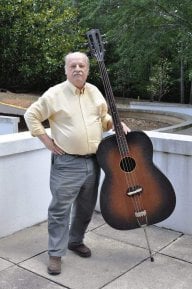
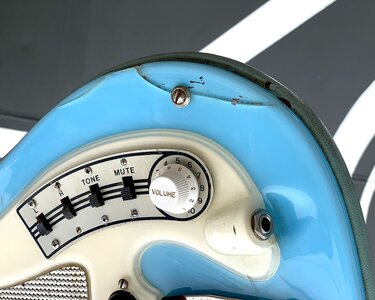
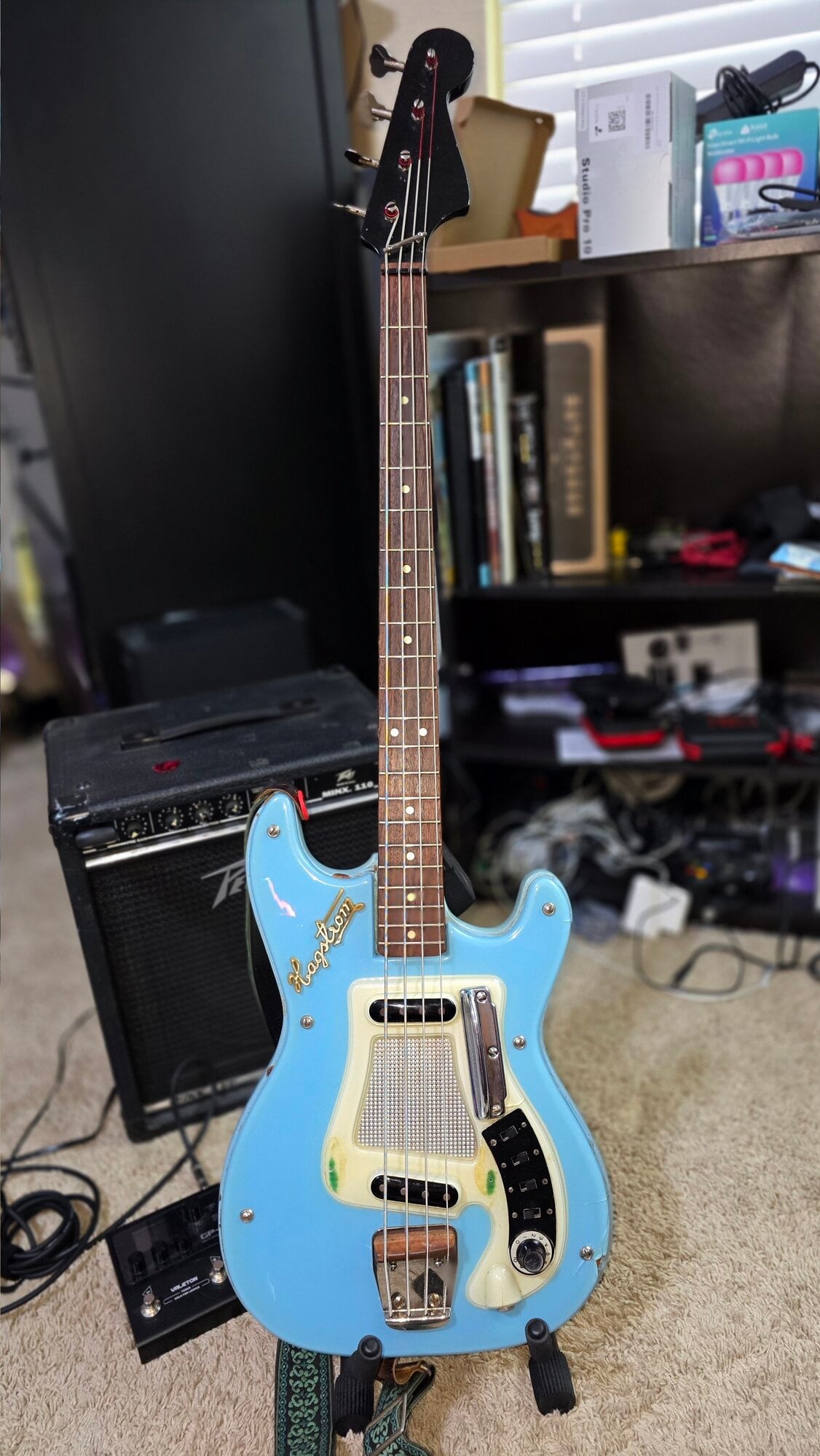
I found a shop local to me to give my 1960's Hagstrom bass (inherited from my grandfather via my mom) some attention and care. I found that my grandfather had performed a few unorthodox repairs on it: for example, a nail file was used under the bridge as a crude spacer. I had those reverted with proper repairs. My grandfather had put this big pick guard on it. I had it reworked to be removeable so it can be reattached and resemble how it looked when he played it. Finally, I had new GHS Bass Boomers strings put on it as I couldn't feel the original taperounds that were on it.

That work made it a much more comfortable and interesting guitar to play. I'm having fun with it. Very happy with the work too. Gentleman in the shop treated it carefully like the family heirloom it is. Only what should be fixed was repaired. It has a punchy, staccato sound to it, at least compared to my Squire bass.

Now I'm interested in learning more about it. Information I've found on the web is conflicting or unclear, so I don't really know what I have other than a Hagstrom bass. On the back is a number 604139. My understanding is the first three numbers are the batch numbers with the last three being the specific number of guitar in that batch.

I'd like a deeper understanding of the characteristics of Hagstrom basses of this era, along with characteristics/specifics of the one I have. My grandfather played in a church band that toured in the Midwest during the 60's-70's and cut a couple of gospel records in Illinois (I have one of them still in the plastic wrapper). While in the shop, anytime the bass was seen by visitors it gathered attention. Several inquiries about my interest in selling it came my way, both from other customers and friends of their employees. Luckily it was made clear that 'the owner is not interested in selling a family heirloom'. The interest in it made me smile, though I'm more interested in actually playing it.

Can anyone help fill in my ignorance about this bass? :-) Much thanks in advance.

* edited for typos
20250615_180739.jpg

20240723_174719-r.jpg
 
Last edited:
8 shades of cool! Hagstrom was one of the first to employ multi-lam...and I mean "multi"...necks well before the Kubicki Ex Factor.

Riis

They also used an aluminum I-beam reinforcing rod that works amazingly well to stabilize the neck. My mid-'60's Hagstrom guitar, bought used in 1985, has never required a single truss rod tweak. Hastroms always had the reputation of having the fastest-playing necks on the market.
 
They also used an aluminum I-beam reinforcing rod that works amazingly well to stabilize the neck. My mid-'60's Hagstrom guitar, bought used in 1985, has never required a single truss rod tweak. Hastroms always had the reputation of having the fastest-playing necks on the market.

Per mid '70's: I recall the ad copy which touted "it's a rail, not a rod" or something similar.

Riis
 
I found a shop local to me to give my 1960's Hagstrom bass (inherited from my grandfather via my mom) some attention and care. I found that my grandfather had performed a few unorthodox repairs on it: for example, a nail file was used under the bridge as a crude spacer. I had those reverted with proper repairs. My grandfather had put this big pick guard on it. I had it reworked to be removeable so it can be reattached and resemble how it looked when he played it. Finally, I had new GHS Bass Boomers strings put on it as I couldn't feel the original taperounds that were on it.

That work made it a much more comfortable and interesting guitar to play. I'm having fun with it. Very happy with the work too. Gentleman in the shop treated it carefully like the family heirloom it is. Only what should be fixed was repaired. It has a punchy, staccato sound to it, at least compared to my Squire bass.

Now I'm interested in learning more about it. Information I've found on the web is conflicting or unclear, so I don't really know what I have other than a Hagstrom bass. On the back is a number 604139. My understanding is the first three numbers are the batch numbers with the last three being the specific number of guitar in that batch.

I'd like a deeper understanding of the characteristics of Hagstrom basses of this era, along with characteristics/specifics of the one I have. My grandfather played in a church band that toured in the Midwest during the 60's-70's and cut a couple of gospel records in Illinois (I have one of them still in the plastic wrapper). While in the shop, anytime the bass was seen by visitors it gathered attention. Several inquiries about my interest in selling it came my way, both from other customers and friends of their employees. Luckily it was made clear that 'the owner is not interested in selling a family heirloom'. The interest in it made me smile, though I'm more interested in actually playing it.

Can anyone help fill in my ignorance about this bass? :-) Much thanks in advance.

* edited for typos

View attachment 7252338
View attachment 7252339
I had the model for a while back in the 70's (black). My recollection is it was a very playable and sounded like an electric bass. Very light since it's hollow.

The tug bar if there was one, was made of wood and much smaller..
 
That is just the coolest!

@JIO might have thoughts.
It's from the late '60s. When I first started playing bass in '66 these (basses and guitars) were on the wall at my local music store in Omaha Nebraska. I was attracted to them and may have even briefly played one but they were more than I could afford. I remember one being red - they also came in that blue & white. Strange chrome (whatever-it-is) acting as a thumb rest .... I'd 86 it if it were mine. What is the green? I recall the pg being molded plastic or fiberglass.
 
  • Like
Reactions: cymbop
I found a shop local to me to give my 1960's Hagstrom bass (inherited from my grandfather via my mom) some attention and care. I found that my grandfather had performed a few unorthodox repairs on it: for example, a nail file was used under the bridge as a crude spacer. I had those reverted with proper repairs. My grandfather had put this big pick guard on it. I had it reworked to be removeable so it can be reattached and resemble how it looked when he played it. Finally, I had new GHS Bass Boomers strings put on it as I couldn't feel the original taperounds that were on it.

That work made it a much more comfortable and interesting guitar to play. I'm having fun with it. Very happy with the work too. Gentleman in the shop treated it carefully like the family heirloom it is. Only what should be fixed was repaired. It has a punchy, staccato sound to it, at least compared to my Squire bass.

Now I'm interested in learning more about it. Information I've found on the web is conflicting or unclear, so I don't really know what I have other than a Hagstrom bass. On the back is a number 604139. My understanding is the first three numbers are the batch numbers with the last three being the specific number of guitar in that batch.

I'd like a deeper understanding of the characteristics of Hagstrom basses of this era, along with characteristics/specifics of the one I have. My grandfather played in a church band that toured in the Midwest during the 60's-70's and cut a couple of gospel records in Illinois (I have one of them still in the plastic wrapper). While in the shop, anytime the bass was seen by visitors it gathered attention. Several inquiries about my interest in selling it came my way, both from other customers and friends of their employees. Luckily it was made clear that 'the owner is not interested in selling a family heirloom'. The interest in it made me smile, though I'm more interested in actually playing it.

Can anyone help fill in my ignorance about this bass? :-) Much thanks in advance.

* edited for typos

View attachment 7252338
View attachment 7252339
Beauty! You have improved the bass greatly since first posting it in your "New Members Introductions" a couple months ago. I looks so much better without the ugly aluminum bridge cover. Looks like the cover interacted with the finish underneath, leaving the green discoloration, but that could probably be touched up without destroying the "vintage" nature of the instrument. Other stuff, like the wear on the bak of neck, I would leave alone. A bass of this age would be expected to show some wear, like a badge of courage? Was the luthier able to get all your switches working?
 
  • Love
Reactions: BaSsIcWiZaRd
I had the model for a while back in the 70's (black). My recollection is it was a very playable and sounded like an electric bass. Very light since it's hollow.

The tug bar if there was one, was made of wood and much smaller..
I had a black one as well. They're not really hollow but the front of the bass is plastic or fiberglass, the colored part. And the back of the bass that is wrapped in vinyl is hard foam.

20231018_224843_Original.jpeg