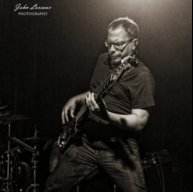
I interviewed Mike Flaherty when he played with Loudmouth. Today he's a member of No One and performs under the name Flare.
No One - Again - YouTube
I was struck by how unbelievably fast he played with his fingers. He was easily the fastest finger player I've ever seen. He used three fingers and his thumb to produce an incredibly steady flow of notes. I watched carefully during his live show but couldn't figure out his technique. He wasn't strumming like a flamenco guitarist; each digit played each note with equal precision and power. There was no difference in sound or attack between his ring finger and his thumb, for example. I'm still awestruck at seeing such mastery up close.
At the same time, I was interested in why someone would take the time and superhuman effort to develop such an unusual and diabolically difficult skill when it would've been much easier to simply use a pick. He could've outplayed any pick-using speed-metal bassist on earth, but I wondered why he bothered. What did he get out of it?
TW: You went from a pick to your fingers on the bass.
MF: I was playing with a pick and I saw a video of Geezer Butler. I make no bones about it: I love Geezer; I love the way he plays. Everything about the man as a player, I just model myself after. So if you want to call me a blatant rip-off, go right ahead. I saw him playing in this video, and his hand was just a blur. I was probably about seventeen and I was just completely floored. The power that the man was getting out of his bass! I was like, "
That's how a bass player should play." All your greats play with their fingers. John Paul Jones, Jack Bruce, Geezer, Steve Harris. I think the idea of playing is to be the best you can be, so that's what I went after. So I just kind of threw the pick aside and instead of going out to parties on Friday nights, I would sit at home with my Sabbath records and practice.
TW: How do you keep the strings from ringing out?
MF: I deaden the E and the A with my right wrist and the D and the G with the area between my fingertips and my palm. It's a very quick motion. It just took a lot of practice. My main thing was to always keep it clean. I use three fingers and my thumb. I would sit at home watching the tube with my bass and just play "one-two-three, one-two-three" for hours and hours at a time, speeding it up gradually. I knew that it was really easy to fall into that galloping sound, so I trained myself to stay completely away from it. I still do get blisters, yeah, but that's just from playing the bass the way it
should be played, just whaling on it.
TW: Tell me about your equipment.
MF: I have a '68 Fender P and a '65 Fender P. I also have a '62 Fender J. My main bass is the '68 P. I like the roundness and the mid-range of P Basses. It really cuts through. I've tried Ibanez, Kramer, Specters, Pedullas, and it just seems like the neck on the P Bass is set up perfectly for my hand. When Leo Fender made that bass, he was thinking of me! I use Ampegs exclusively. I use an Ampeg 810 and an Ampeg ST Pro, the two-head. I like the warmth of tubes, and with the 10-inch speakers, they don't really bottom out too much. You get a good cross between the lows and the highs. It's a really nice balance. I'm trying to stay as old school as I can, so I'm trying not to use effects anymore. Just go right into the head and let the head and my hands get the tones instead of relying on effects.
TW: Watching you in the live show, you played more like a rhythm guitarist than a bassist during the guitar solo.
MF: In four-piece bands, I find it boring when the bass player just rides, especially when the guitar player goes into a solo. If he goes from G to D to A, for example, spice it up! Do a solo yourself, so to speak. You don't want to go overboard, but take it up right up to the edge and bring it back a little bit. Fill up all the extra room that would be there if you just held down the B-G-D-A thing. Listen to Geezer when Tony goes into a solo in "War Pigs." He's all over the place, but it's not too much. It's just old-school bass.
TW: Do you have any musical training?
MF: No. I’m self-taught. I didn't study music because all I wanted to learn was how to play the bass as fast as I could.
TW: How do you keep good time when you're using three fingers and a thumb?
MF: Of course I practiced a lot with a metronome, and I also played with records a lot. But mostly I've got to credit my drummer. Playing with a solid drummer behind you, it's so much easier to keep time. As long as my drummer is in the pocket, then I'm with him. It takes a lot of practice, man. A
lot of practice. Bassists like Geezer and John Paul Jones are a dying breed. It's a shame because it's a lot of fun to play and hear. We're really letting this great style fade. I'm hoping that players wake up and put the time into being the best they could possibly be. You can get better at forty, you can get better at seventy. No one can put a limit on what you can do, and you shouldn't hold back just because it's a bass.


 ) you to put him on there?