

Enjoy the benefits of a premium membership!
Upgrade Account
-
TalkBass has been independent since 1998. Add your voice.
Create a free account to reply to discussions, view embedded media, and browse with fewer display ads.
Join free Log in
Want zero display ads or expanded classifieds tools? Compare plans.
You are using an out of date browser. It may not display this or other websites correctly.
You should upgrade or use an alternative browser.
You should upgrade or use an alternative browser.
Intonation on the modern electric bass
- Thread starter JenderBazzFass
- Start date
More options
Who Replied?

JazznFunk
Supporting Member
This is the one big advantage (and challenge) of fretless instruments.
A fretless still has to be set up and intonated properly.... something a lot of people ignore.
The saddle isn't straight even though it might look like it is. And the saddle block can move on the posts: toward the neck or away, or twist a little clockwise or counterclockwise. From what I've read what it doesn't do well is accommodate high action or certain types of string sets.I’m still trying to figure out how Ned Steinberger was able to use a single saddle bridge design on the NS Radius basses and get it to intonate at least as perfect as equal temperment allows.
View attachment 7379059
I've been able to perfect the intonation of my open notes, still working on the rest.As others have already mentioned, I play fretless.


precision do you think you have effective precision, as precise as normal human ears can be?
the reason we have various temperaments is because you do hear a difference. it's actually quite significant.
the compromise is what it is. lutes, guitars, mandolins, pianos, etc, all live with this compromise just fine. you should adjust the instrument to be as accurate as possible, but accept that this is always just an approximation. even on the most well-set up guitar/bass, a perfect 5th fingered across two strings (5th fret E string A note, 2nd fret D string E, for example) will almost always be considerably out of tune.
the reverse is true. violinists spend a lot of time practicing just to maintain good intonation - but, they can tune every note as needed. also a compromise.
both make perfect sense. it's not worth getting to worked up over. if it was good enough for J.S. Bach's keyboard, it's good enough for our guitars, right?
When I was an engineer working with computer representation of floating point numbers, I learned the difference between precision and accuracy. In a way, the same distinction applies to musical tuning systems. You should be able to intonate any decent guitar precisely to an inaccurate tuning system (equal temperament).
Intonation should be the final step of a setup. If you try to set intonation before the topnut, frets, and bridge saddles are correct, you're just wasting time. Using an accurate electronic tuner helps finesse the intonation adjustment. When all is done, it should be possible to play chords in tune. Whether adding fretted notes to open strings, or playing all strings fretted, the instrument should play in tune. (Note: it may be necessary to take instrument details and the player's technique into account as well. If the instrument has taller frets and/or the player has a strong grip, they may encounter difficulty with "micro-bends" - pulling notes sharp unintentionally. [Not to be confused with what some players want with scalloped fretboards.]) If the instrument does not have separate saddles for each string (i.e. two saddles, or one full-width saddle) then a lot of patience and filing/re-checking may be necessary to get the intonation where you want it to be.I've had numerous guitars and basses over the years, and have tried to be fanatical about intonation. But recently when working on a stubborn bass that would get 95% there but not closer, I think I had a realization.
A fretted electric bass with 12 standard frets is already making a compromise on intonation, because it is subdividing the scale at 12 tones at equal temperament.
The strings are different throughout their length, with small variations in flexibility throughout and they must react differently to the tension of fretting at different points throughout their length, bending and stretching in different ways. Each string is an individual.
Further, the essence of the fundamental being generated is dependent on other factors that affect the string's behavior, like action height, rigidity of the instrument along the scale, the string gauge, the age of the string, interference from the pickups, on and on.
And this is even before you start doubting your measuring instruments. (Is this tuner tracking the B string accurately? Can it track correctly if I'm setting up this bass in Drop A? Is this one particular tuner out of spec?)
Even a Dingwall or whatever - an ideal bass, a fanned-fret multiscale bass with straight frets can't intonate perfectly because even temperament is always an approximation.
So knowing that perfect intonation isn't possible, how do you approach it? At what level of precision are you satisfied? At what level of precision do you think you have effective precision, as precise as normal human ears can be?

Is that how you play? With the absolute lightest pressure possible 100% of the time EVERY SINGLE note?Open strings are in-tune and stable, Bridge saddles are set where the 12th fret harmonic is in-tune and stable as possible, double checked with fretting the string AT the 12th, ON the fret wire with the lightest possible pressure to avoid bending it sharp. I also use a very small gauge allen wrench to press the string down at the 12th fret wire so that the end of my finger isn't influencing it in any way... I also do this on fretless basses. It gets me as close as possible without being more OCD about it than I already am.
Isn’t that the truth??I should add... if you think intonating a bass guitar is frustrating, you haven't tried tuning a piano.

- Apr 18, 2008
- 16,002
- 1
- 31,690
- Disclosures
- I'm highly opinionated and extremely self-assured
Good lord man.
95% is plenty good enough.
Just go play already!
95% is plenty good enough.
Just go play already!

From my experience . . .
1) I looked for all the players to be in tune with each other. Maybe they are, and sometimes they just won't/ can't.
2) Some basses are better than others, the aggregate of fret placement, bridge placement/ adjustment, stability, and the way the player plays: Some guys are always pushing a hair instead of straight down, every note's slightly bent. Play with a big relief/string height, does the same thing.
3) Your ears. The finer you can hear fractions of a step, the worse it is. I once knew a brilliant classical pianist with Perfect Pitch where her condition was almost a curse with the tempered tuning of pianos. On the other hand, I played with a pedal steel player with very good ears who was always in tune and could spot one string a little flat with me and two strings sharp on the guitar player's Strat.
For me, as long as everyone on the bandstand was in the same tuning, the occasional bent note was simply accommodated.
1) I looked for all the players to be in tune with each other. Maybe they are, and sometimes they just won't/ can't.
2) Some basses are better than others, the aggregate of fret placement, bridge placement/ adjustment, stability, and the way the player plays: Some guys are always pushing a hair instead of straight down, every note's slightly bent. Play with a big relief/string height, does the same thing.
3) Your ears. The finer you can hear fractions of a step, the worse it is. I once knew a brilliant classical pianist with Perfect Pitch where her condition was almost a curse with the tempered tuning of pianos. On the other hand, I played with a pedal steel player with very good ears who was always in tune and could spot one string a little flat with me and two strings sharp on the guitar player's Strat.
For me, as long as everyone on the bandstand was in the same tuning, the occasional bent note was simply accommodated.

That why Symphony Orchestras sound great.I remember an interview with Don Was where he said that when he was producing Brian Wilson's (Beach Boys) second solo album, Wilson insisted that musicians tune by ear to a piano rather than use an electronic tuner because the subtle dissonance from everybody being slightly off in different ways made the sound feel larger and richer.
Perfect, exact notes are a good goal to strive for while working on setup, but accepting the errors you can't fix is what helps music be interesting.
I was thinking the same thing. Set the intonation based on how you will be playing the instrument.Is that how you play? With the absolute lightest pressure possible 100% of the time EVERY SINGLE note?

Actually it doesn’t. But it sure makes life easier!A fretless still has to be set up and intonated properly.... something a lot of people ignore.
JazznFunk
Supporting Member
I'm not a machine, but I do try to play with light pressure in general, on the fret wire, not between it. That's also how, in his instructional video, Jaco mentioned to fret notes to get the cleanest sound out of the bass. It also translates to fretless playing where you have to play ON the note/'fret'. There's no reason to be pressing down super hard to fret/sound a note. My method allows the bass is as accurately adjusted in as possible, so that I'm not setting up the bass with the fat part of my fingertip making me intonate slightly sharp or flat depending on how my finger is rolled on the string at a given point. We're always using our ears in the moment, but I want that bass to be set up mechanically and clinically as correctly as possible, and my technique needs to be on point.Is that how you play? With the absolute lightest pressure possible 100% of the time EVERY SINGLE note?
Last edited:
JazznFunk
Supporting Member
Actually it doesn’t. But it sure makes life easier!
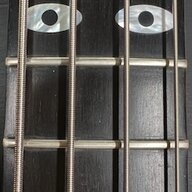
It does, for one key reason: If you're using any sort of visual reference on the neck at any point (side markers or lines) - and every fretless electric bassist does use a visual reference at times (if they say they don't, they're lying) - then the neck must be intonated properly to play in tune as 'clinically' as possible, especially for stuff above the 12th. You might be able to get away without adjusting it perfectly below the 12th, if the bridge is in the right place, but if every string is out of adjustment to some degree in terms of the bridge saddles your positions to play in tune (especially octaves/perfect intervals) will likely be off *above* the 12th. Where I agree with you is that it's easier to make the minor adjustments in the moment that we hear on fretless because we can move our finger to go sharp/flat with ease to compensate to what's happening around us - or TO us. But I'd rather know that my instrument is in the best adjustment possible so that I'm not unnecessarily fighting something that can be mitigated as much as possible.
So *actually*, there are a lot of reasons why a fretless electric bass must be set up/intonated properly. You can be damn sure that any builder of any reputation won't let a fretless leave their shop - lined or unlined- without being properly intonated, and checking that intonation in relation to any side markers or lines for accuracy.
Upright is a different beast since we have way more physical landmarks to feel AND hear where our pitch is and there isn't the same sort of adjustment capability in terms of the bridge like on electric to make that fine adjustment. In either case, our ears have to be the final guide always.
Last edited:

Turnaround
Commercial User
It is not a solution because the fretting points are still in a fixed position. A fretted note has a specific frequency, but the necessary frequency of a note varies. The note E in the key of C is a different frequency from the note E in the key of A. It doesn't matter how you twist the frets you can't have both.


So knowing that perfect intonation isn't possible, how do you approach it? At what level of precision are you satisfied? At what level of precision do you think you have effective precision, as precise as normal human ears can be?
Simple. If it's close enough that the audience won't hear it, it's close enough for me.
When you've done all you can to get it right, you've done all you can. Just play it.

Folks, please review your musical history. This debate is nothing new. It is over three hundred years old. Unless you play in only one key, or are willing to re-tune for each song, or play fretless, all tuning must be adjusted. Please read this article that talks about tuning in antiquity, up to and including the origins of equal temperament, including the 12-"equal"-frets-per-octave that are pretty much the standard for fretted instruments and keyboard instruments:


