Help! I cannot get the freted notes on the bass in tune. Octaves are good, but any fretted notes are very sharp. Is it the set up? Too much pressure on the strings? (Although I use very little pressure) Any suggestions would be appreciated.

Enjoy the benefits of a premium membership!
Upgrade Account
-
TalkBass has been independent since 1998. Add your voice.
Create a free account to reply to discussions, view embedded media, and browse with fewer display ads.
Join free Log in
Want zero display ads or expanded classifieds tools? Compare plans.
You are using an out of date browser. It may not display this or other websites correctly.
You should upgrade or use an alternative browser.
You should upgrade or use an alternative browser.
Intonation problems with flat wounds on Gretsch bass
- Thread starter ccrainey
- Start date
More options
Who Replied?
When you say "octaves", do you mean fretted at the 12th fret? That you say "any fretted notes" makes me think not.Octaves are good, but any fretted notes are very sharp. Is it the set up?
It always will be.
Sharp fretted notes means move the saddle back (further away from the nut).
Sharp fretted notes means move the saddle back (further away from the nut).
This one's a puzzler. Make sure the octave is actually on pitch when fretted, not just the harmonic.
My first idea was too high action, but since you have lowered the action to the point of buzz, we can rule that out.
In the title you say "intonation problems with flatwounds", does that mean that intonation is ok using rounds?
I would be very surprised if Gretsch messed this up, but if the intonation is good for octaves, and way off for other frets, it might be worth checking if there is a fret position error. You can calculate the correct positions fore example with the stewmac fret position calculator. Note that the intonation on guitar/bass is imperfect by design, so a small deviation should be normal.
My first idea was too high action, but since you have lowered the action to the point of buzz, we can rule that out.
In the title you say "intonation problems with flatwounds", does that mean that intonation is ok using rounds?
I would be very surprised if Gretsch messed this up, but if the intonation is good for octaves, and way off for other frets, it might be worth checking if there is a fret position error. You can calculate the correct positions fore example with the stewmac fret position calculator. Note that the intonation on guitar/bass is imperfect by design, so a small deviation should be normal.

What model of bass is this? Can you post a picture of the bridge?Yes. I would except the bridge is glued. I tried lowering the bridge, didn't help and only got fret noise. I can lower the strings individually… but that would be very minimal.

Since you say the bridge is glued, I'm assuming this is a hollowbody Gretsch? Did they glue the floating saddle down? That seems odd to me, especially if they glued it in the wrong place. In any case though, did you press down on the strings on both sides of the saddle to create a proper break angle / witness point over the saddle? Since flats don't have the grooves that rounds have, they're a bit stiffer and can benefit from a little help in this regard, otherwise you'll be re-tuning quite a bit for at least a week. Also, check to make sure the strings pass properly through the nut at the headstock and that there is no unnecessary arch there either.
Finally, is it possible the top part of your bridge saddle got flipped around 180degrees if it came off during the string change? That can cause intonation issues too, if it's carved for proper intonation and meant to be the other way.
And yes, a model number or photo would help us help you as well.
Finally, is it possible the top part of your bridge saddle got flipped around 180degrees if it came off during the string change? That can cause intonation issues too, if it's carved for proper intonation and meant to be the other way.
And yes, a model number or photo would help us help you as well.

A pic would help. But if you truly do have a glued down bridge and saddles that are effectively set in place (like an acoustic guitar), you end up getting what you get with regards to intonation — mostly above the 12th fret is where it may be inaccurate. Nothing you can do about that unfortunately.

Check the position of the nut. I had this issue on another bass I had, and when I measured to see if the nut was in the right place, it was not. It was too close to the first fret, causing the opposite issue: everything up the neck went flat. My luthier put a very thin shim between the end of the fingerboard and the nut, and everything was solved. Your issue may be the opposite: the nut may be too far away from the first fret. Measure from the center of the crown between the 12th and 13th frets. Double this number. measure from the crown of the first fret to the fretboard edge of the nut. This measurement should be exactly double the measurement from the center of the crown from the 12th fret to the 13th fret. This is how my luthier and I figured out how to fix the nut.

BobDeRosa
Commercial User
- May 16, 2012
- 2,445
- 4,403
- Disclosures
- Owner, Tritone Jazz Fantasy Camps
I would seek the opinion of a good local luthier.
How is the nut? Is it cut way too high? That'll often cause fretted notes to be sharp.
First of all restring.
If you have strings from another bass try them.
Usually if the octave is good the rest is at least close so I suspect the strings.
The harmonic will always be in tune if the open string is so I dont know why bother with it.
If nothing helped try to intonate again but get to a point where the fretted notes like A,G...are fine and from there deal with the octave(it shouldn't be a big moove).
If you have strings from another bass try them.
Usually if the octave is good the rest is at least close so I suspect the strings.
The harmonic will always be in tune if the open string is so I dont know why bother with it.
If nothing helped try to intonate again but get to a point where the fretted notes like A,G...are fine and from there deal with the octave(it shouldn't be a big moove).

Is the new string set a heavier gauge than what was previously on? This would change your intonation points
Check witness points yourself, and maybe try a different set of strings if you have old lighter gauge strings laying around, just to see if it makes a difference. If that doesn't give you an answer, then take it to a luthier to check nut height/position and that bridge. Sounds like somebody thought it was a good idea to glue that floating bridge down at some point, but now it can't be adjusted to accommodate different gauges of strings. Luthiers can sometimes do some dark, dangerous magic with the filing of nuts and fixed bridges to improve intonation. It's also possible that a luthier could unglue that bridge without damaging the instrument, which would be great.
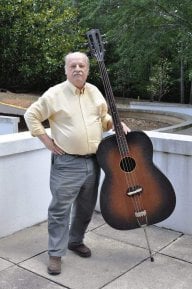
Have you tried a set of rounds to compare? From my knowledge and experience of Gretsch, if yours is a hollow body then that bridge should not be glued.

Orange CA with Filtertrons, I come to TalkBass to get away from my Guitar GAS.


