Sup Cats, I was a guitar player until the past 12 months and due to a surplus of guitar players and shortage of Bass players in my area and age group, I converted. I bought a used but mint G&L ASAT bass and noticed the bridge had been moved forward. I sent it to G&L and ask why would someone do that to a brand new bass ? their reply was they didn't know. They were nice enough to put the bridge back in the correct location ,dress the frets, new strings and shipped her back @ no charge to me. These days Im thumpin for a southern rock band and got me a Korg dtr 2000 for my rack. I Play a G&L JB-2 for giggin love it. I decided to dial in the intonation with my new tuner and found out there is not enough forward travel in the E string to intonate properly. when I get it dialed in open and @ the 12th the adjusting screw is over 1/4 inch short and totally disengaged from the saddle. All the other strings dialed in with no problem. After realizin this I know why the other cat moved the bridge forward on the ASAT Bass he ran out of adjustment before it would intonate' Am I lacking basic knoweledge of the Bass guitar and missin something very key here ? This is my 1st posting here and I'm very glad to have found this site thanks to google. Thanks in advance for any help here is a link to a picture of the bridge in the present position and intonated correctly the adjusting screw is over 1/4 to short. [Invalid or Expired Link Removed]

Enjoy the benefits of a premium membership!
Upgrade Account
-
TalkBass has been independent since 1998. Add your voice.
Create a free account to reply to discussions, view embedded media, and browse with fewer display ads.
Join free Log in
Want zero display ads or expanded classifieds tools? Compare plans.
You are using an out of date browser. It may not display this or other websites correctly.
You should upgrade or use an alternative browser.
You should upgrade or use an alternative browser.
Intonation
- Thread starter BluesHonky
- Start date
More options
Who Replied?
Glad to know that Spidey, just a little late I went to the bolt house and go a longer screw. But look at the picture and the position of the saddle and how forward it is. In all my experience the E is the longest string ?
Glad to know that Spidey, just a little late I went to the bolt house and go a longer screw. But look at the picture and the position of the saddle and how forward it is. In all my experience the E is the longest string ?
Can't see the pic due to filters. Will check later tonight.
Many times the E gets intonated and the saddle is farthest back but not always.
Jim

Something looks funny there...... On all three of my G&L's, the E string saddle is pulled back the farthest. In fact years ago, I had to use a couple of small washers to get enough backwards travel on my SB1. How does the 12th fret E compare to the 12th fret harmonic?
Shes dead on even @ the 19th B on E with the saddle to the Forward position shown. I cant wait to check someone else's bass. It's 1 of those things no one would notice due to the low freq. and rarely playin that high. If Im that hi on the E Im just waitin to get a slide effect to the next position after a pause.Something looks funny there...... On all three of my G&L's, the E string saddle is pulled back the farthest. In fact years ago, I had to use a couple of small washers to get enough backwards travel on my SB1. How does the 12th fret E compare to the 12th fret harmonic?
Checking on my SB1 and L2K.... both are even at the 5th fret harmonic, 12th fret harmonic, 12th fret fretted, and the B at the 19th fret. E string saddles are both pulled back farther than the other saddles. My SB2 on the other hand is serious need of a new nut, so I didn't even bother to pull it out.
How high do you have the action set? It sounds like you have the E string a mile off the fingerboard.
Edit.... as I go back to the picture, it looks like your E string saddle is higher than the others.... but that could be an illusion. Even with a 12"radiused fingerboard, the E string saddle shouldn't be any higher than the A or D. My guess is that you're having to push the string so far down to the fingerboard, that you're really having to shorten the string length (moving saddle forward) to get in tune.
How high do you have the action set? It sounds like you have the E string a mile off the fingerboard.
Edit.... as I go back to the picture, it looks like your E string saddle is higher than the others.... but that could be an illusion. Even with a 12"radiused fingerboard, the E string saddle shouldn't be any higher than the A or D. My guess is that you're having to push the string so far down to the fingerboard, that you're really having to shorten the string length (moving saddle forward) to get in tune.
Im on the ground as far as string height. my technique is drop them down and slowly raise them until the fret buzz subsides. im no more than 3/16 " @ the 12th Im a guitar player that just happens to play some bass U know i got her set up low and with flats.
3/32's here, and some would say that is kind of high (a 64th higher on the SB1, but that is sporting the TI JF's). I think you need to get her in for a good setup. If you have to raise the E up to 3/16's to get rid of fret buzz, then you probably need the truss rod adjusted.
Again, it looks to me like the E is higher in the photo, and in reality, it should be no higher than the A, and probably even a bit lower if you're following the fingerboard radius. The E string saddle from the bottom of the saddle to the face of the bridge is just under 1/8" on my SB1. All the other strings generally follow the fingerboard radius (a touch lower because the thinner strings are less prone to buzz than the thicker ones).
Ljazz
Again, it looks to me like the E is higher in the photo, and in reality, it should be no higher than the A, and probably even a bit lower if you're following the fingerboard radius. The E string saddle from the bottom of the saddle to the face of the bridge is just under 1/8" on my SB1. All the other strings generally follow the fingerboard radius (a touch lower because the thinner strings are less prone to buzz than the thicker ones).
Ljazz
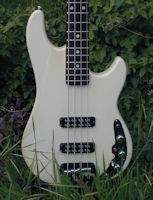
This may sound a bit odd, but here goes:
I'm going to say "fat string" in reference to either a B or E string.
When I've had TI flats on my G&Ls, I used to always have a helluva time getting the fat string to intonate properly and have its saddle position look "normal" compared to the rest.
I told you this may sound odd. Here's more:
Rounds don't do that. The fat string saddle is positioned more-or-less normally.
Then I took a really critical look at how the fat string breaks over the saddle and found that it curved very nicely. Except that I really didn't want it to curve nicely; I wanted it to turn a corner over the saddle. The E & B strings on TI Flats are really thick, which was the cause of my nice curve. So I tuned the strings to pitch and set the intonation as well as I could. Then I pushed down on the string a little less than an inch from the saddle on the neck side, which forced it to break more sharply over the saddle. It also caused the string to go flat. I re-tuned to pitch and reset intonation and the saddle position got very close to normal.
Then I got my first Peterson tuner and the saddle position got pretty much normal.
In the end, I learned that TI Flats need to be dealt with a little differently than normal strings, or even other flats. I also learned that a strobe tuner is a lot more accurate than a regular chromatic tuner, and is particularly valuable when working with harmonic-rich strings and pickups.
Your pic didn't show TI Flats, but they do appear to be flats. Flats are different when it comes to setup.
Of course, YMMV and all that stuff. Use only under doctor's supervision and keep out of reach of children. Do not operate heavy machinery. Do not feed the bears. Hell, don't even poke the bears.
Ken...
I'm going to say "fat string" in reference to either a B or E string.
When I've had TI flats on my G&Ls, I used to always have a helluva time getting the fat string to intonate properly and have its saddle position look "normal" compared to the rest.
I told you this may sound odd. Here's more:
Rounds don't do that. The fat string saddle is positioned more-or-less normally.
Then I took a really critical look at how the fat string breaks over the saddle and found that it curved very nicely. Except that I really didn't want it to curve nicely; I wanted it to turn a corner over the saddle. The E & B strings on TI Flats are really thick, which was the cause of my nice curve. So I tuned the strings to pitch and set the intonation as well as I could. Then I pushed down on the string a little less than an inch from the saddle on the neck side, which forced it to break more sharply over the saddle. It also caused the string to go flat. I re-tuned to pitch and reset intonation and the saddle position got very close to normal.
Then I got my first Peterson tuner and the saddle position got pretty much normal.
In the end, I learned that TI Flats need to be dealt with a little differently than normal strings, or even other flats. I also learned that a strobe tuner is a lot more accurate than a regular chromatic tuner, and is particularly valuable when working with harmonic-rich strings and pickups.
Your pic didn't show TI Flats, but they do appear to be flats. Flats are different when it comes to setup.
Of course, YMMV and all that stuff. Use only under doctor's supervision and keep out of reach of children. Do not operate heavy machinery. Do not feed the bears. Hell, don't even poke the bears.
Ken...
Another note here..... if you follow the setup guide as far as the truss rod adjustment (using feeler gauges) and saddle height, you'll end up with action about half of the 3/16".
I just bumped my E string saddle up on the SB1 to where I'm at 3/16" at the 12th fret, and I can't move the saddle far enough forward to get intonated. Sounds like the exact same problem you're having.
Ljazz
I just bumped my E string saddle up on the SB1 to where I'm at 3/16" at the 12th fret, and I can't move the saddle far enough forward to get intonated. Sounds like the exact same problem you're having.
Ljazz
I got out the feeler gauges I am actually .093 ( 3/32 = .09375 ) or a little less so that is in line with what U said, shows how bad these 53 yr old eyes are ! I also have the strings following the fretboard radius. The neck has a very slight cupped bow maybe .015 . Im not a guit tech but I understand the basics I am a M.E. and own a machine company and have built a few personal customs over the yrs. Works is slow these days and im contemplating buildin an aluminium electric upright with a cymbal stand for the base to support the weight. I really appreciate the input. I'm headin up to the studio shortly to check out the ASAT that the factory did the set up on. Here is a link to an old Son House tune I did. I laid all tracks except the kick and snare are a machine. give it a spin. [Invalid or Expired Link Removed] Appreciate the input.

I second Kens idea about making sure you have a sharp break-angle on the string over the saddle- this will help you dial in action much more precisely as well...a common problem with B strings, and the reason for the existence of "tapered" strings (where the portion that sits on the saddle is a smaller gauge than the rest of the string).
I found that I had to file the B and E string saddle screws shorter to get good intonation. Never an issue on Fender style bridges where the screw goes through the saddle, but it's a pretty easy fix.
If this is a three bolt neck with micro tilt, you may want to put some tilt in there. Or add a shim if you have a 6 bolt neck. This will help you get a steeper break across the saddle.
I added a shim on a P bass after going to a high mass bridge that wouldn't allow me to go low enough with thicker strings. When I switched over to a set of TI flats, I ended up with the saddles pretty high which resulted in a somewhat exaggerated break angle. The bass played amazingly well with this setup.
I added a shim on a P bass after going to a high mass bridge that wouldn't allow me to go low enough with thicker strings. When I switched over to a set of TI flats, I ended up with the saddles pretty high which resulted in a somewhat exaggerated break angle. The bass played amazingly well with this setup.
Thats it Ken, it's a fat string thing I just got back from checkin my ASAT same tail pc same neck and I remember when I got it that it had flats on it and that is why the previous owner over reacted and moved the entire bridge forward about 1/4 " Since I got it back from G&L they relocated the bridge to factory spec and put on rounds I checked it and it is intonated perfectly. If it stays in tune Im gonna leave the JB-2 like it is. I just added a longer adjustment screw and locked it down . Tell me if I'm wrong but where it is located in the pictures is is dead on all the way to 19. Thanks Guy's for all the input. And I also want to say G&L went the extra mile for me when they didn't have to because I bought the ASAT used on ebay. They repaired the bridge,dressed the frets and put on new strings at no charge! But even G&L couldn't tell me why the original owner moved the bridge forward. Great site Glad I found it ! thanks again ! Heres some pictures of my Gig Rig [Invalid or Expired Link Removed] and here is a picture of my JB-2 [Invalid or Expired Link Removed]
Tell me if I'm wrong but where it is located in the pictures is is dead on all the way to 19.
I assume you mean the 19th fret.
It looks good from here.
When I set up my basses, I get all physical aspects of the thing where they need to be; nut slots, neck relief, saddle height. Then I tune to pitch and adjust intonation at the 12th fret. If the frets are positioned properly (you have to take it on faith that they are), overall tune should fall into place within certain tolerances. The lower the action, the generally better the overall intonation because fretting doesn't add undue tension and raise the pitch.
Some players, such as my son, like higher action because they play louder and with a heavier hand. The effect of this is that his intonation isn't generally as accurate because he has more tension on the string when fretted.
Six, one, half dozen, the other. It's all a matter of trade-offs. The important thing is to get where we need to be, wherever that may take us.
Glad you got it working.
Ken...
I think being 1st a guitar player ... I have a pretty soft touch but I love it when I get to throw down with some hard hittin bass... We do a fun tune called Penthouse Pauper and where it says if I were a guitar player Lord I'd have to play the blues... I get to hit it like a big hammer and love ever note !.. The band I play with now tunes 1/2 step flat... It's the 1st time I ever played with a group that does that for the singer... It sure makes it feel slinky G&L ROCKS... I got 5... 3 guits and 2 bass.... THANKS AGAIN FOR ALL THE HELP
Attachments

Today I bent the strings just like Ken said... after that I had to put the original adjusting screw back in place and the intonation went almost perfect in the expected location........ Ken U da man !
Latest posts
-

-

-
Double Bass What is the learning curve like as a new upright bassist?
- Latest: bass player 53
-

-
