• TalkBass has been independent since 1998. Add your voice.
    Create a free account to reply to discussions, view embedded media, and browse with fewer display ads.
    Join freeLog in
    Want zero display ads or expanded classifieds tools? Compare plans.

Intros where it's hard to find the "1"

Spectrum said:
This is a great thread!

That example by the Fixx is a great one. Lot more creative than the average 80s synth pop band IMO.

As for wierd time signatures, how about Dave Brubeck's Blue Rondo a la Turk? It's in 9/8 time, but the pattern is 1-2, 1-2, 1-2, 1-2-3, which kind of confused me the first time I heard it. And then the groovy part in the middle is straight 4/4.

Blue Rondo A La Turk - YouTube

I just saw his quartet (with his son substituting on piano) play this a few nights ago. I definitely had trouble counting that one (well, everything but the stuff in 4).
 
But I still don't think that the intrinsic differences you describe between 7/4 and 7/8 actually exist. The seven can get divided up pretty much anyway at all in either time signature.

Well, that's were I think differently.

Another example: I was taught that while you might think that 4/4 could be divided into 123 123 12, that's not really true. Because at that point it's an 8/8. So there is a difference in "how you call it" caused by how it's subdivided.
 
Well, that's were I think differently.

Another example: I was taught that while you might think that 4/4 could be divided into 123 123 12, that's not really true. Because at that point it's an 8/8. So there is a difference in "how you call it" caused by how it's subdivided.

That's a different comparison than 7/4 to 7/8 - that would be equivalent to comparing 7/4 to 14/8 time.
 
Since we're delving into complex meters - It took me a bit to comprehend this 9/8 (or is it 9/4?) groove by Paul Simon...

"Cool, Cool River"

It's written in 9/8.

Correct.

The bottom number MAINLY matters with regards to the notation of the music.

However, it can also IMPLY (not to a definite) that the tempo of a 7/8 measure is faster/higher than that of a 7/4 measure.

Again, this is not a rule but an implication that it MAY be so.

+1 I would agree that it can according to how easy it is to notate in reference imply a faster/higher tempo.
 
You get the prize! ;)

Hm, he missed the point of my example:

"there is a difference in "how you call it" caused by how it's subdivided."

4/4 vs 8/8 is a perfect example for this.

But to be honest, I'm not going to invest my time in trying to convince you of something you have a strong established opinion about.
I guess in the end it's not important enough to anyone of us.

You play your 7/8 I play my 7/4 -- or vice versa.
 
christoph h. said:
Hm, he missed the point of my example:

"there is a difference in "how you call it" caused by how it's subdivided."

4/4 vs 8/8 is a perfect example for this.

To be fair, I think you missed my point. If you subdivide a 4-count into 8 beats, then you are correct, it might better be called 8/8 than 4/4. But the same logic wouldn't get you 7/8 instead of 7/4, it would get you 14/8.
 
NSU by Cream

The phrasing of Jack's lyric at the beginning of each verse as well as the drums are "on the 2", in a backbeat, but the it all just goes "to the one" for the chorus. It is a weird feel, and part of why this is sort of a hypnotic song, to me. It is really unique, and I cannot think of anything else quite like it.

cream - YouTube

The Australian band, the Lime Spiders covered it and did away with this shifting time thing, singing the opening lyric on the one. But they rock it in their own cool way.
 
Hm, he missed the point of my example:

"there is a difference in "how you call it" caused by how it's subdivided."

4/4 vs 8/8 is a perfect example for this.

But to be honest, I'm not going to invest my time in trying to convince you of something you have a strong established opinion about.
I guess in the end it's not important enough to anyone of us.

You play your 7/8 I play my 7/4 -- or vice versa.

Well, it's not so much an opinion as just a way of thinking about what the bottom number means. :)

7/4 or 7/8 is really a notation difference and nothing more.
 
I haven't followed the discussion about 7/4 and/or 7/8, but anyway I want to add something that I feel relevant about it:

If you write Rush's "Tom Sawyer" middle synth/solo section in 7/4, then the intro/verse sections should be written in 4/2.

If you write the 7-beat sections of Pink Floyd's "Money" in 7/8, then the guitar solo section of the same tune should be written in 4/8.

I agree with Bill about the "notation difference" thing, but anyway I think it's good to notice that the most common beat unit is the quarter note. As an example, I think anybody would go like :eyebrow: if the guitar solo section of "Money" were written in 4/8. 4/4 is the most likely choice and, since the "pulse unit" during the 7-beat section is exactly the same, then it should be written in 7/4. On Tom Sawyer's synth/solo section, the "pulse unit" is half of a "verse section beat". I think everybody agree that it's more "logical" to write the verse section in 4/4 rather than 4/2, so the solo section should be written in 7/8 instead of 7/4.

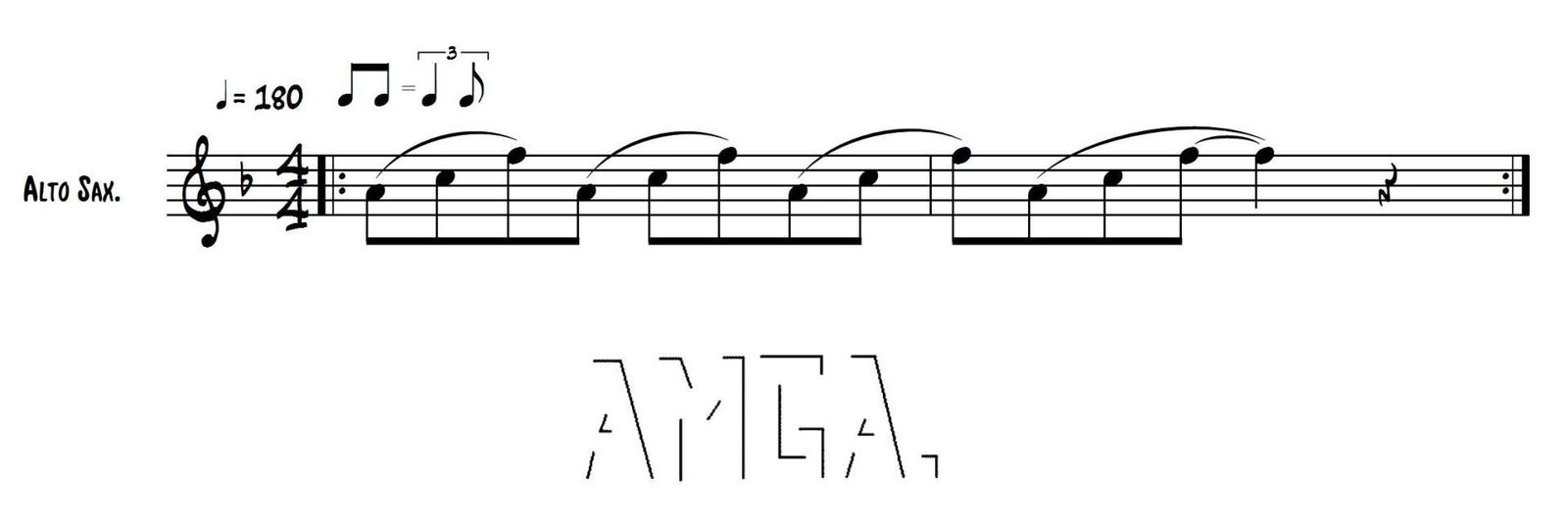
So, it's all relative to the "basic pulse unit" (most likely quarter notes). Hope this helps. BTW, if you want to have fun with time signatures, check this example I transcribed some time ago (don't pay that much attention to the pitches but the rhythms/time signatures):

CatholicA.jpg


(Hear it here)

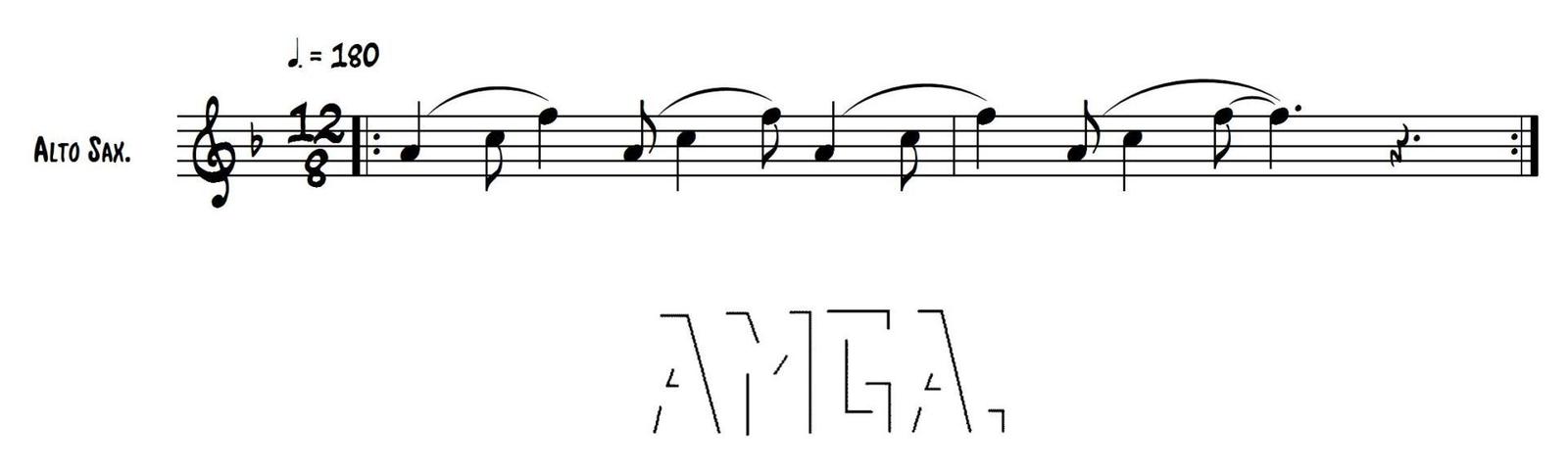
And here's another one, taken from the same song:

CatholicB.jpg


(Hear it here)
 
Alvaro has this right, if you assume constant tempos in both tunes. Alternatively, you could write Tom Sawyer out in 4/4 at the start and then change to 7/4 for the middle section with a metronome mark to double the tempo for that part. You might do this if you felt that it was easier to read the phrasing in 7/4 rather than 7/8. Likewise, you could use a metronome mark to write the first part of Money in 7/8 and then change to 4/4 - but I can't see too much reason for doing this!

The most elegant way to write each one would be 4/4 changing to 7/8 for Tom Sawyer and 7/4 changing to 4/4 for Money, as Alvaro says. However, I can think of some good reasons for writing Money out in 7/4 and then changing to 12/8 for the triplet feel in the guitar solo, using a metronome mark to triple the tempo.

These tunes (and others with mixed time signatures) are examples in which it does make a difference whether you use 7/8 or 7/4 - but the difference is one of elegance in notation rather than an intrinsic difference in feel between the two time signatures. That's what I meant when I said the difference between the two was one of notation only.

For tunes that are in 7 time for the whole piece, it really makes no difference which one you use, although it's true that it might imply something about the tempo or affect the readability, as has been noted.

(Alvaro - that's one of my favourite Zappa numbers! Glad you liked the Deodato tune, by the way).
 
I can think of some good reasons for writing Money out in 7/4 and then changing to 12/8 for the triplet feel in the guitar solo, using a metronome mark to triple the tempo.

I'd just put a "swing eighths" mark at the beginning of the section (in 4/4), but this brings the question: If the immense majority of jazz tunes in 4/4 are played with that feel, why aren't they written in 12/8 instead of 4/4? 4/4 with a swing eighths mark would make more sense to me if the rhythm section played straight eighths behind a "triplet feel" melody, but in most cases, the rhythm section also swings. Shouldn't a piece like Glenn Miller's "In The Mood", for instance, be written in 12/8? Why not? Is it just because the ride cymbal and/or piano don't play the twelve eighth notes of a 12/8 measure, as on a shuffle piece?
 
The choice between 4/4 and 12/8 for me would depend on how many triplets you'd need to write for the phrasing. "In The Mood" needs very few, so I'd stick with 4/4. With "Money", you'd need to use quite a lot of triplets if you wanted to transcribe everything accurately, so I might use 12/8 for that one. Listen to the hi-hats in the quiet section of the guitar solo and some of the fills (and of course the lead in to the solo itself).
 
The choice between 4/4 and 12/8 for me would depend on how many triplets you'd need to write for the phrasing. "In The Mood" needs very few, so I'd stick with 4/4.

Agree, but this...

InTheMoodA.jpg


...could be written like this...

InTheMoodB.jpg


...and still reflect accurately the performance feel without a lot of "unnecessary" notation, doesn't it?
 
7/4 or 7/8 is really a notation difference and nothing more.

Well...

(I've been avoiding jumping into this aspect of the discussion because it feels a little late to the party, but...)

fwiw, having a quarter note denominator generally implies that individual note subdivisions (that subscribe to the "strong-weak-less strong-weak" paradigm...iow, 16th notes) will be relevant, regardless of whether or not they are explicitly articulated.

whereas an eighth note denominator, irrespective of tempo, generally implies that the macro-subdivisions within the measure (e.g., 3+2+2, or 2=3+2 etc.) will be relevant, and moreso than any individual note subdivisions that may be articulated.

Whether one considers that difference to be "a notation difference" is I suppose semantic; I contend that those two time signatures convey different musically viable information that goes beyond simple convenience in writing out a rhythm.
 
Alvaro Martín Gómez A.;11531470 said:
Agree, but this...

InTheMoodA.jpg


...could be written like this...

InTheMoodB.jpg


...and still reflect accurately the performance feel without a lot of "unnecessary" notation, doesn't it?

At the risk of overstating the obvious, every jazz musician and educator I've ever met has insisted that swing eighth notes are not the same as a triplet with the first two partials tied together.

The triplet notation may be the best approximation (and certainly better than the dotted eighth/16th convention that you see on a lot of society music charts), but it's an approximation at best.