OP
go to an automobile parts shop like O'Reilly Autoparts and buy some automotive feeler gauges like Invalid Link Removed. Next buy a 6 inch ruler that measures mm and 32nds (preferably 64ths of an inch) sort of like Invalid Link Removed. Now get a capo. You will also need appropriately sized allen wrenches and phillips head screwdrivers. All this stuff probably will run you like $40 bucks tops.
Time to do the set up –
*all measurements should be done in playing position for accuracy.
1. Make sure the strings are wound going down so that they place pressure on the string at the nut. Make sure they are wound the right way relative to their side of the headstock. Your tech probably did this correctly.
2. Capo first fret, fret the last fret and measure with the automotive feeler gauge at the 9th fret. You want the relief here to be .015. Adjust with allen wrench until it is there. Righty tighty, lefty loosey, go in quarter turns, always detune the strings before twisting then tune back up before measuring. The tighter the truss rod the straighter the neck the smaller the relief. Easy peasy.
3. Next action. Use the ruler to measure the action at the 12th fret. Don't fret anything, just check string height from the fret to the BOTTOM of the string –roughly 8/64 on the E, 8/64 on the A, 7/64 at the D, and 6/64 at the G. Detune the string before adjusting the action, then tune back up to measure.
3.5 Skip this step for now, normally you would adjust the action at the nut, but you want gauged nut slot files, which are expensive and we won't be doing it right now.
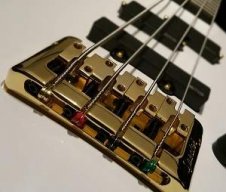
4. Intonation, best to have a really good tuner for this, I like a Sonic Research TurboTuner, strobe's are always better, but non strobe will do. Tune the string at the 12th fret harmonic. Then fret the 12th fret and see if it is in tune. Adjust the string length using phillips head to match. If the note is sharp, tighten, if it is flat, loosen. Once again, detune when making adjustments.
Other than that, you might adjust pickup height for even response and sound but this is a very, very standard action, probably similar to what your tech sent you. It may buzz a little, but not in a way that interferes with the sound coming from the amp. If it is noticeable, then your bass probably has a problem such as uneven fret heights, a whip in the neck, or who knows. Your tech probably basically did this. Let the set up sit for a bit too!
Here's some guides and videos!
Invalid Link Removed
Watch this whole set
and this too
Set up is super easy, just be brave and do it. I probably did some pretty bad things to my basses necks before I knew what I was doing, but they turned out fine as I can assess now.
TLDR
Fret buzz has many causes, and your bass got shipped. I wouldn't assume the tech did anything wrong. But, every person plays different, so just asking for a set up without sending specs is unlikely to be successful. Most people will sound good on the specs I just listed though. I would say that what you got is perfectly reasonable. Paying for a set up prior to shipping is probably not reasonable on YOUR part. Do the set up yourself, it's not hard, you won't break your new bass, I promise, just go really slow with the truss rod. I turned mine a ton on my Squier VM jazz when I first got it to get the neck flat, and it turned out fine.
Also, fret buzz that is inaudible through the amp is really not a problem. If that annoys you, play flatwounds, because jacking your action up to get rid of that buzz will mess up the intonation of your bass.