While I agree that you can play music without knowing a thing about theory (like when I was a child) I think it enhances what you do, and can do, to learn basic theory---and learn how it applies to different styles. After all, when I was a kid I was copying what had already been established. Even stuff I made up on my own had a basis in what had been established in Western music for centuries, only I had no idea.

Enjoy the benefits of a premium membership!
Upgrade Account
-
TalkBass has been independent since 1998. Add your voice.
Create a free account to reply to discussions, view embedded media, and browse with fewer display ads.
Join free Log in
Want zero display ads or expanded classifieds tools? Compare plans.
You are using an out of date browser. It may not display this or other websites correctly.
You should upgrade or use an alternative browser.
You should upgrade or use an alternative browser.
Is music theory important?
- Thread starter Dbt25677
- Start date
More options
Who Replied?
I think it's hilarious that the OP wants to be "the next big spunky rock star".
SPUNKY
In some cultures, that does not mean 'covered in jizz'.
Probably been said already but theory is like a map. There are many ways to get from a to b. but if you are in a stange town and don't ask directions then you could be wandering around for hrs before you get the result you want. Wandering aimlessly can be a pleasure too and give great unexpected things to you but with a map you don't just see a to b, you see a to b and every possible detour route to get from a to b before you even set out on the journey .
Or bluntly put you don't need to play a note before you already know how it's likely to affect the musical story you are telling!
I do most of my practicing in my head now. When teaching I only need to pick my bass if it is important to demonstrate.
Or bluntly put you don't need to play a note before you already know how it's likely to affect the musical story you are telling!
I do most of my practicing in my head now. When teaching I only need to pick my bass if it is important to demonstrate.

It's can be both bad and good. I don't read music. I've known players who read music and aren't very good. I saw a band play where the guy was reading music but his ear was so bad he couldn't even tell he was in the wrong key when he messed up. Our guitarist knows the most about theory, but it totally stunted him since he doesn't understand heavy theory. I write songs with heavier theory that don't follow a particular key, but broken down and analyzed make since. Like playing different chords over other chords using the contrasting notes. Also modular playing is totally lost on him and he freaks out "No, it doesn't make sense!" It does, but I don't have the energy or the musical vocabulary to explain it right. The funny thing is he listens to all that 70's jazz fusion that uses the principles he says don't work. One time I stole an Idea from Herbie Hancock moved it around a little and the genius guitarist insisted that it didn't work. The rest of the band thought it was the deepest funkiest thing ever. But he refused to play it.
It's can be both bad and good.
Your example doesn't make sense. Having the education to read music isn't the cause of poor musicianship, inability to improvise, or crappy personality traits lol.
Don't judge education to be a bad thing just because stupid boring stubborn and arrogant people are nearly as capable of getting an education as are intelligent creative open-minded and self-deprecating people. There is no detriment to having only basic knowledge of theory, and no need for what you call "heavy theory" to think outside the box, just a need for the gift to think that way whether you know zero, some, or have an encyclopedic knowledge of theory.
There are examples of idiots at all levels of education. The example musician you cited (really just one person you know, not representative of being educated or not) would be at least as annoying to work with if he had no education at all.
Imho ymmv etc etc

There's no downside to learning theory. I can't imagine why people think this.
One opinion that a friend of mine recently advanced, from his perspective of not-knowing-music-theory, was that highly trained musicians were boxed in by their theoretical knowledge.
Honestly I had a hard time keeping that convo going with him, because he also will on a different topic wax relentlessly about his training in engineering and how important it is, so I just kind of let that slide.
I think the confusion is that sometimes we run into a non-creative musician, a performer, who has tons of musical training, and they don't know how to just start playing off the top of their head. That is different than a creative person who has also learned theory and can both synthesize and accurately write down what they're synthesizing.
I've met and worked with both kinds of musician, and the fact is some people just don't have much adventurism, willingness to submit to the random, or whatever it is that makes a person generate fresh ideas, but still want to perform music, and there's not a thing in the world wrong with that. Just don't get wrapped up about whether or not you should learn theory based on how someone else behaves. That's silly.
Before I knew theory I wrote very odd songs that I awkwardly put together out of little bits of the patterns I was picking up from music I knew.
After I knew theory, it was like the difference between having one of those little boxes of 10 crayons, and the mega 64-crayon box or whatever that said you were damn serious about coloring. Many more options were open to me. When I compose today, years after my education ended, I have the tools to organize what I'm doing quickly, so I can finish a song more easily.
One opinion that a friend of mine recently advanced, from his perspective of not-knowing-music-theory, was that highly trained musicians were boxed in by their theoretical knowledge.
Honestly I had a hard time keeping that convo going with him, because he also will on a different topic wax relentlessly about his training in engineering and how important it is, so I just kind of let that slide.
I think the confusion is that sometimes we run into a non-creative musician, a performer, who has tons of musical training, and they don't know how to just start playing off the top of their head. That is different than a creative person who has also learned theory and can both synthesize and accurately write down what they're synthesizing.
I've met and worked with both kinds of musician, and the fact is some people just don't have much adventurism, willingness to submit to the random, or whatever it is that makes a person generate fresh ideas, but still want to perform music, and there's not a thing in the world wrong with that. Just don't get wrapped up about whether or not you should learn theory based on how someone else behaves. That's silly.
Before I knew theory I wrote very odd songs that I awkwardly put together out of little bits of the patterns I was picking up from music I knew.
After I knew theory, it was like the difference between having one of those little boxes of 10 crayons, and the mega 64-crayon box or whatever that said you were damn serious about coloring. Many more options were open to me. When I compose today, years after my education ended, I have the tools to organize what I'm doing quickly, so I can finish a song more easily.

This is coming from somebody who knows very very basic theory, so this is definitely an IMO and IME disclaimer...
Being able to read and understand music hasn't hindered my playing at all, what I've found is that music theory education is like getting an education in English or writing in general. Having a large vocabulary or amazing skills in writing is completely useless unless you have something interesting to say in the first place. I really have to hand it to Vic Wooten on his music as a conversation analogy, though his refers to musicians giving each other space and respecting their time to speak in a song. I think it terms of what you play it's also applicable...some people have something interesting to say but may struggle getting it out the way they want to because they have a lack of knowledge on how to communicate that. Some people may be great communicators but bore everyone to tears because all they want to do is spout off big words really quickly and try to talk over everyone's head to make themselves feel better than others.
In either of these situations, knowing music theory doesn't seem to hurt at all. I just wish I knew more of it :/
Being able to read and understand music hasn't hindered my playing at all, what I've found is that music theory education is like getting an education in English or writing in general. Having a large vocabulary or amazing skills in writing is completely useless unless you have something interesting to say in the first place. I really have to hand it to Vic Wooten on his music as a conversation analogy, though his refers to musicians giving each other space and respecting their time to speak in a song. I think it terms of what you play it's also applicable...some people have something interesting to say but may struggle getting it out the way they want to because they have a lack of knowledge on how to communicate that. Some people may be great communicators but bore everyone to tears because all they want to do is spout off big words really quickly and try to talk over everyone's head to make themselves feel better than others.
In either of these situations, knowing music theory doesn't seem to hurt at all. I just wish I knew more of it :/
Amen, I just wrote a chart off the top of my head, no instrument, for practice tonight.
(btw, I love coloring).
Yea I've done that before, some of my best stuff. And try composing for orchestra... it's all theory and experience.
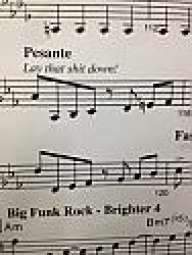
Frank Zappa used to love to draw figures on manuscript that looked neat, and then have an orchestra play them to see what they sounded like.
Steve Howe reads music quite well though. He doesn't do it often enough to sight read well, but he can work through it just fine. He doesn't have a lot of advanced theory but still the basic classical training and theory he possesses is vastly better than the complete lack of theory most guitarists have.
I talked about it with Steve Howe very briefly many years ago and my then band's guitarist (r.I.p.) went into some deep discussions with him about it.
LOL. The guy who told me this claimed he was in a business relationship with Chris Squire. I have no idea. I should not repeat rumors like that anymore.
Untrained musicians can be plenty creative.
They can just be a colossal pain in the hoop to deal with in a band situation.
If you think you can be a phenomenal musician without taking the time to learn the theory, that's cool, good on you. You should instead, then, learn it for the sake of being able to communicate with other musicians. Going "Play your 'thud thud' part when I do that 'wahhhhrah' thing" does nothing to get your point across and will only cause frustration with any trained musicians.
They can just be a colossal pain in the hoop to deal with in a band situation.
If you think you can be a phenomenal musician without taking the time to learn the theory, that's cool, good on you. You should instead, then, learn it for the sake of being able to communicate with other musicians. Going "Play your 'thud thud' part when I do that 'wahhhhrah' thing" does nothing to get your point across and will only cause frustration with any trained musicians.

A lot of great comments. Except the first two really. I have recently learned theory and I'll tell ya, I really enjoy it. Has it made me a better player? Well, yes and no. I come up with some cool ideas based on theory these days. But my chops were there before that. I write songs based on a vocabulary of music that I have HEARD,not seen. That said. I agree with both sides of the argument. One could learn the were's and why's of song structure through theory. But, some cats just kill it based on the records that have blown their minds and create a good vocabulary for them to work with.
A better discussion would be... If I have to sit through a terrible band, does it in turn make me a bad player? Or at least decrease my chops and ideas for the moment? I say yes. Stay away from crappy shows and bad records.
A better discussion would be... If I have to sit through a terrible band, does it in turn make me a bad player? Or at least decrease my chops and ideas for the moment? I say yes. Stay away from crappy shows and bad records.
I think it depends on which path as a musician or artist one chooses, whether theory is important or not.
in some cases it can be crucial, in others, not so much.
in some cases it can be crucial, in others, not so much.
Untrained musicians can be plenty creative.
They can just be a colossal pain in the hoop to deal with in a band situation.
If you think you can be a phenomenal musician without taking the time to learn the theory, that's cool, good on you. You should instead, then, learn it for the sake of being able to communicate with other musicians. Going "Play your 'thud thud' part when I do that 'wahhhhrah' thing" does nothing to get your point across and will only cause frustration with any trained musicians.
there's a long list of famous musicians that don't know theory, that doesn't mean they can't communicate.
I mean do you really need theory to plays blues, country, rock, metal etc.?
there's definitely really technical forms of every genre but in their basic forms, limited knowledge isn't a death sentence.
LOL. The guy who told me this claimed he was in a business relationship with Chris Squire. I have no idea. I should not repeat rumors like that anymore.
it's possible. CS is an interesting cat. He was "generous" enough to offer to help our band get somewhere as they kind of took over our drummer's home/studio in Vancouver where we rehearsed and were recording an album... this was while they were writing what would become The Ladder... anyway I guess we thought he was trying to make it up to us in return.
Turned out he had other motivation besides kindness and generosity, and it wasn't financial either (he's pretty wealthy)... and once that was made clear to our lead singer our business relationship was ended abruptly from our side.
I personally didn't spend much time talking with the guys from YES because I was stupid. Simple as that. Bunch of my idols. Anyhow, my band mates have fed me plenty of interesting info over the years so I feel fulfilled anyway even if I was having one of my moronic personality flaw moments during their tenure at our place.
I even recorded some of our album's bass parts on one of Chris's instruments... but I'd better stop there.
Long time ago now. I'm nobody important.
Untrained musicians can be plenty creative.
They can just be a colossal pain in the hoop to deal with in a band situation.
If you think you can be a phenomenal musician without taking the time to learn the theory, that's cool, good on you. You should instead, then, learn it for the sake of being able to communicate with other musicians. Going "Play your 'thud thud' part when I do that 'wahhhhrah' thing" does nothing to get your point across and will only cause frustration with any trained musicians.
And that sums it up perfectly!


