• TalkBass has been independent since 1998. Add your voice.
    Create a free account to reply to discussions, view embedded media, and browse with fewer display ads.
    Join freeLog in
    Want zero display ads or expanded classifieds tools? Compare plans.

Is restringing really that easy to be bad at?

That. If you have the tools and the Gary Willis setup guide (which relies on feel and "about a credit card height" instead of "0.000102312342341230123100 inches" for measurements), you can do a setup.

Having spent many years in work where close tolerances were required, I'd bet you could show 10 random people a line the thickness of 2 (or even 3) cards stacked and they would say, yes, that looks about the thickness of a credit card.

Point being, there is a whole lotta latitude in setting up a bass that will function, but like anything else, good enough is not always ideal.

I've only been doing setups for a (relatively) short period of time but every bass player who has picked up any bass I've set up for myself wants to know who did it for me, they assume it's a professional set up. I pick up basses set up by their owners and they are all over the map. While this is not a big surprise as set up is an individual preference, strings not matching the FB radius or one sitting significantly lower than the other 3 is something one can't help but notice and wonder why it was set up in such a manner.

I understand the reason a set up method using dimensions on the order of "about the thickness of a credit card" are so popular. It's because most people touting their ability to set up their bass don't know what the proper drag on a feeler gauge feels like, they get confused by numbers expressed in decimals, and like most, can't read a scale graduated in sixty fourths of an inch.

The "about the thickness of a credit card" method is also proof simple that kinda sorta close enough is good enough for most people, but give those same people a bass set up by someone actually capable of doing it to "0.000102312342341230123100 inches" and their first thought is "professional setup".

One of the most common complaints in set up & repair is fret buzz, and the common answer is fret job by a pro. I'd bet a dozen doughnuts to a pint of stale urine a majority of those buzz complaints could be corrected with a better set up than the owner is capable of.
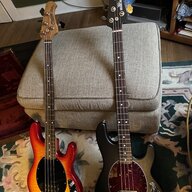
 
Thought I would chime in,In My Experience,in restring my bass,I always tried to make sure,I knew the type gauge string was on there first. And each string I took off of the bass I would stretch the new string out to the length of the old string,and snip the end off the new string to match the old. That way there is no excessive string wrap on the tuning peg. And there is no problem with the intonation,if it was okay with the old strings. I just traded for a bass guitar that had flatwound strings,and I am partial to the round wound. I checked to see what gauge were on there,and replaced them with the same gauge. Intonation was perfect,at the 12th position. Sorry for the length of reply. That is my experience with restringing my bass.
Thanks:bassist:
 
Having spent many years in work where close tolerances were required, I'd bet you could show 10 random people a line the thickness of 2 (or even 3) cards stacked and they would say, yes, that looks about the thickness of a credit card.

Point being, there is a whole lotta latitude in setting up a bass that will function, but like anything else, good enough is not always ideal.

I've only been doing setups for a (relatively) short period of time but every bass player who has picked up any bass I've set up for myself wants to know who did it for me, they assume it's a professional set up. I pick up basses set up by their owners and they are all over the map. While this is not a big surprise as set up is an individual preference, strings not matching the FB radius or one sitting significantly lower than the other 3 is something one can't help but notice and wonder why it was set up in such a manner.

I understand the reason a set up method using dimensions on the order of "about the thickness of a credit card" are so popular. It's because most people touting their ability to set up their bass don't know what the proper drag on a feeler gauge feels like, they get confused by numbers expressed in decimals, and like most, can't read a scale graduated in sixty fourths of an inch.

The "about the thickness of a credit card" method is also proof simple that kinda sorta close enough is good enough for most people, but give those same people a bass set up by someone actually capable of doing it to "0.000102312342341230123100 inches" and their first thought is "professional setup".

One of the most common complaints in set up & repair is fret buzz, and the common answer is fret job by a pro. I'd bet a dozen doughnuts to a pint of stale urine a majority of those buzz complaints could be corrected with a better set up than the owner is capable of.

This post reminds me of a drawing I got a few days ago with a tolerance of +.0007/-.0000. I shook my head just like the machinist was going to.
 
One of the most common complaints in set up & repair is fret buzz, and the common answer is fret job by a pro. I'd bet a dozen doughnuts to a pint of stale urine a majority of those buzz complaints could be corrected with a better set up than the owner is capable of.

While I agree that a fret job is sometimes needed, I don't consider that part of setting up a bass. That's an actual repair. I consider the setup part adjusting the truss rod, setting string height, setting intonation, and setting pickup height. I got good at it because I didn't want to spend $40 every time the weather changes, so I had some incentive.
 
While I agree that a fret job is sometimes needed, I don't consider that part of setting up a bass. That's an actual repair. I consider the setup part adjusting the truss rod, setting string height, setting intonation, and setting pickup height. I got good at it because I didn't want to spend $40 every time the weather changes, so I had some incentive.

I *think* he may have meant a level/recrown.
 
Unless he's admitting to wrapping to the wrong side and overlapping wraps back up the post.

And talking about slotted shaft tuners. Just be glad you're using them on a bass. Getting a 9 or 8 to hold still on a vintage guitar with split shaft tuners is quite an adventure. Not bad once you get the hang of it but frustrating to learn.

Nope, I'm not. And it depends on the bass. Some seem fine without it, so I usually measure one extra tuner length (i.e., extend the E string to the A tuner) and cut there.

As for setups, I would agree that some people are just not precision minded. To do a proper setup you need, in addition to the tools, a six-inch ruler in 64ths and a set of feeler gauges, at a minimum. I also find digital calipers with a depth gauge useful for things like pickup height on a P bass, and I always wear a headlamp. Seriously. It helps!

You have to remember that to many, many people these are just NOT common items, nor is their use intuitive without some guidance. I remember being 13 years old and reading the Fender setup guide and not understanding what a feeler gauge was. (My dad was not mechanical at all.) Of course, all of that was before the friggin' Internet....if I were a 13 year old today, I could have saved myself years of crappy setups with 10 minutes on YouTube.

As for alternate methods, I think they they're fine folks who don't have the tools on hand. Honestly, for a bass I often actually use the corners of business cards to measure nut action, because when the string gets low enough, it strips away a little of the paper at the corner.