well im going to throw my hat in the ring. I may be able to get it for $1000
If it's legit with a good neck, that would be a heck of a deal. Fingers crossed!

TalkBass has been independent since 1998. Add your voice.
Create a free account to reply to discussions, view embedded media, and browse with fewer display ads.
Join free Log in
Want zero display ads or expanded classifieds tools? Compare plans.
well im going to throw my hat in the ring. I may be able to get it for $1000

I don't think this is accurate. From what I recall, they only started the 3 bolt/bullet neck system in '72 on the Tele Bass, then gradually introduced it into the Jazz series in late '74. I'll double check in my Fender history books when I get home to be certain.
Fender wasn't all that concerned about dating continuity, though, and these weren't built with the collector market 41 years hence in mind. There's lots of examples of mix and match instruments from lots of eras, especially in the CBS transition. It's not like they were going to throw out a perfectly good component because the dates didn't match. It wasn't until the 80's (coincidentally when vintage value started to go up) that they started to be bothered about precise dating on their gear.
You know if you look on the end of the neck, it will have written or stamped on it the day the neck was made. Everything else can be kind of iffy and overlapping, but the neck date leaves no question at least of when the neck was made.

I agree I found better info later on look at my later postI don't think this is accurate. From what I recall, they only started the 3 bolt/bullet neck system in '72 on the Tele Bass, then gradually introduced it into the Jazz series in late '74. I'll double check in my Fender history books when I get home to be certain.
Fender wasn't all that concerned about dating continuity, though, and these weren't built with the collector market 41 years hence in mind. There's lots of examples of mix and match instruments from lots of eras, especially in the CBS transition. It's not like they were going to throw out a perfectly good component because the dates didn't match. It wasn't until the 80's (coincidentally when vintage value started to go up) that they started to be bothered about precise dating on their gear.
As I recall, the term "pre-CBS"as a distinction from current production first showed up in the mid-'70's, applied to basses and presumably also to guitars. One could argue this was the first time the market began to distinguish between older and newer Fender basses. By the early '80's, given the appearance of "reissues", it appears Fender figured this out; the rest is history.
Among players, I think you're absolutely right. According to George Gruhn (here), the vintage collectors market really took off in 1984, both in Japan and the US.
 . I remember thinking, but, wait a minute, they're just old!
Had a 72 tele. It was 3 bolt micro-tilt.This makes the most sense. I didn't know '72 Tele basses were 3-bolt. I don't think this suggests that anyone including Fender "swapped" the plate, just that it was used much later than '72.


Regarding maple neck and blocks. Bass in my avatar I am pretty sure is a 73. Serial number around 505K. It has maple neck and pearloid block inlays. 4 bolt neck. I bought it used in 79.If I remember correctly Fender did not offer the maple neck with blocks on the J until late 74 and then 75. I have a Jazz I scored last year with these same features. A 72 or 3 serial number, three bolt tilt neck and maple board with blocks.

Ok so presuming it is a 74-75 ish. What is the max you would pay for it?


If I remember correctly Fender did not offer the maple neck with blocks on the J until late 74 and then 75. I have a Jazz I scored last year with these same features. A 72 or 3 serial number, three bolt tilt neck and maple board with blocks.
Regarding maple neck and blocks. Bass in my avatar I am pretty sure is a 73. Serial number around 505K. It has maple neck and pearloid block inlays. 4 bolt neck. I bought it used in 79.
I recently bought what I thought was a '72 Jazz with maple neck and white pearloid blocks.
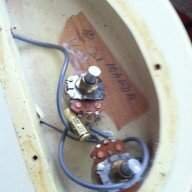
My tech dated it to late '73 from the original electronics. Neckplate had been switched out to a 4-bolt stainless steel blank.

Check out Flaked Beans answer above looks like Fender pulled a fast one on people
My thoughts exactly. Not a fast one. A confusing one but not a fast one. A serial number by Fender is still a serial number by Fender. This has been a really informative thread. Lots of good info cited.I doubt it was a fast one...they were likely just using up remaining stock as suggested. At that time nobody would have thought of a future in which the prices of 73 vs 75 used J basses would matter or represent any higher level of desirability vs the other...