June 17, 2013 by
Best Bass Gear
Although bass guitar necks can be built to any number of different sizes and shapes, more often than not a player does take the letter designation of the neck into consideration when shopping (especially if buying online unplayed).
Letter designations for bass guitar necks is more or less “a Fender thing”, and because Fender terminology is so pervasive in bass builds, Fender’s letter designations are used even for bass guitars they don’t even make. In addition, those same letter designations are often used by luthiers to describe a neck’s feel to someone who hasn’t actually played the instrument yet.
Where it gets
really confusing however is that a letter designation can refer to the neck shape OR the nut width.
The modern Fender American Standard Precision Bass is a guitar with a B neck with a Modern C neck shape, with B referring to nut width, and Modern C referring to the curve shape of the back of the neck.
Nut widths either either A, B, C or D.
A – 1 1/2-inch
B – 1 5/8-inch
C – 1 3/4-inch
D – 1 7/8-inch
…and these were the original letter designations for Fender necks well before the whole neck-shape-by-letter thing came into being.
Fender neck shapes can be C, U, or V, and these letters literally refer to how the back of the neck is not only shaped but also
how it looks. This means a C does have a shape similar to that of a letter C, a V actually looks like a letter V on the back, and so on.
U – Early 1950s or 1970s shape
Soft V – Early 1950s
Hard V or just V – Mid-1950s shape
C – Late-50s oval shape
Modern C – Modern flat oval shape
(Tip: Looking for tuners that will fit your Fender neck?)
It’s a common mistake that some players state all C-shapes are the same. Not true. Old-style C is much different compared to the flatter Modern C.
When a player, luthier or builder says that a neck “feels like a baseball bat” concerning Fender shapes, he is referring to the old-style C or the U. Probably the U.
The chunkiest neck shape is without question the U. You play one of those, and oh yes, you’re holding a whole lot of wood – literally.
IMPORTANT NOTE: The terminology Fender currently uses for the larger old-style C is literally called “Large C”, such as on the American Vintage ’58 Precision. You will know a Large C when you pick one up, because as said above, it’s chunky.
Does neck shape totally dictate how a neck feels?
No. Fingerboard radius and fret wire size also count for a great deal.
A ‘true vintage’ build would probably be a Soft V shape with a 7.25-inch fingerboard radius and tall/skinny frets, meaning a super-round fingerboard with frets that no matter how well-done by the luthier will buzz all over the place because, well, that’s what tall/skinny vintage-style frets do.
In addition, the older 7.25-inch radius can in fact “fret out” when doing bends of at least one semitone. Again, there’s nothing
wrong with the neck when that happens even when properly set up as it’s just the nature of what vintage-spec is like.
Are the letter designations for neck shapes above a complete list?
Nope.
What I did is listed the most commonly known shapes.
For example, there is the lesser-known “Medium V” shape. Not exactly a Hard V and not exactly a Soft, but right in the middle.
You’ve obviously heard some players say something to the effect of, “Only a real ’63 feels like a ’63!” Well, there’s more truth to that than you realize, because it could very well be that in ’63, Fender decided to use a Medium V profile…
…and this can be hell for a luthier trying to recreate that shape if he doesn’t have an actual ’63 for a frame of reference.
For example, if it were the case where a luthier was trying to recreate the exact feel of a ’63 Fender neck with a Medium V profile but didn’t have the original item for reference, he would take his best guess that the neck shape would either be a Soft or a Hard V, which of course doesn’t hit the mark of what a Medium V is supposed to feel like. The instrument would be well-built, but it “wouldn’t feel right” because the profile is off just a tad.
And yes, learned players that know their Fender vintage necks can feel the subtle difference between a Soft V and a Medium V.
Should you call nut width size by its proper letter designation?
Better luthiers know the old-style letter designations for Fender nut widths. But if you tried using the same terminology with your bass player friends or salespeople at the guitar store, you’ll most likely get the deer-in-the-headlights look. In fact, some people might even think you’re just making it up because it’s so rarely used these days.
In other words, when you say “C”, the assumption is that you’re talking about the neck shape and not the nut width, so… best to stick to that. Letter designation in reference to nut width is usually best used when speaking of vintage Fender guitars, because more often than not, that’s where it’s discussed most.







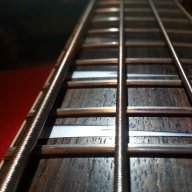



 this is one of them.