
• TalkBass has been independent since 1998. Add your voice.
    Create a free account to reply to discussions, view embedded media, and browse with fewer display ads.
    Join freeLog in
    Want zero display ads or expanded classifieds tools? Compare plans.

jazz pickups aligned vertically

I was about to smugly pontificate on the overly wide sensing aperture causing lousy treble response.

Then I read Bruce's posts.

Now I think maybe I'm not as smart as I thought I was....
 
I think you would end up with too much magnetic pull on the strings, giving you either a very dead thud, or an oscillating 'out of tune warble'. The solution to this would be set the pick up heights as low as you can get them, if you could get them low enough. You might also have to move them all the way to the bridge, where the tighter tension might help resist the effect.

I've been building basses and pickups for many years, and doing all kinds of R & D and testing, and I have yet to see this alleged "too much magnetic pull" thing. The pickups in my basses have 2-4 times the magnetic field strength of a typical Fender pickup, and I set them right up near the strings. There's no dead thud or warble. Clear tone and long sustain. I've even run tests on the bench, holding groups of real powerful magnets close to the string. I can't find any evidence of the magnets causing the strings to slow down or do anything weird.

Try it yourself. Put your bass on a bench, plugged in. Pluck it and listen to it. Then pluck it and hold a powerful magnet as close to the string as you can get it, without sticking to it. See if you can make the string slow down.

As far as I can tell, this is one of those silly technical wives's tales that keeps getting passed around.

 
this but sideways
MrHP3a.jpg
I gotta build a bass like that someday ...
 
Yeah, I've had folks say the magnets were pulling on their strings too hard, so they had to lower the pickups. LMAO!
If you know a fair bit about Physics, you'll know that is rubbish.
Seriously? I am gobsmacked that you would claim any knowledge of physics and say this. Not only have I had this happen on a short scale that I added a pickup right at the neck, but the effect was so strong that I could not eliminate it completely, as the offending pickup could not be set low enough.
 
  • Like
Reactions: JustForSport
You must have had one of the most powerful passive (non-electro) magnets in the world then.
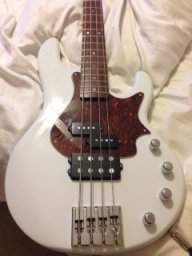
Anything but. Just a Lace Sensor J mounted right at the neck of a SS Jag. I could go into the fact that a short scale would be more susceptible to the effect, especially in that position. I could even speculate that perhaps the magnets were pulling at sympathetic points which might exaggerate the effect. But why? You have your beliefs.
 
I like hearing the thoughts on this. I have heard people say it is not a good idea because of the magnet pull. I think the best way anyone could test this is, take your bolt neck off the body and mount it to a 2X4 and mount the bridge and put the pickup under the strings and slide it around to see what it sounds like. You will need to straight wire the pickup to a cable as well. So someone not as lazy as me needs to try this.
 
I like hearing the thoughts on this. I have heard people say it is not a good idea because of the magnet pull. I think the best way anyone could test this is, take your bolt neck off the body and mount it to a 2X4 and mount the bridge and put the pickup under the strings and slide it around to see what it sounds like. You will need to straight wire the pickup to a cable as well. So someone not as lazy as me needs to try this.
I could test this over the weekend if anyone is interested. I have a test bass I can use to rig up this kind of test in minutes.
 
the Hamer above looks like it uses four Mustang or Fender XII pickup coils. They were about that same shape and size, and had three magnets per coil. Mustang bass coils are a little narrower, and might be a good compromise. Bruce Johnson has a point about finding a balance in the coil size so it will work as intended.

Those were actually custom built for Hamer by Seymour-Duncan. And they were specifically made for that bass. Specification was for a pickup with "quadraphonic" output. So each string got it's own completely independent pickup. Output from each pickup was then routed into it's own channel on the "mini-mixer" panel which provided a separate preamp (for each string!) with its own volume, bass boost&cut, treble boost&cut, and switches to select the center frequency for the bass and treble controls.

Talk about totally insane! But that's exactly what Hamer said they were attempting with that bass. "The crazier the better" is how they characterized the goal when they were working out the design for it.

(Note: If you're interested in 12-string basses, there's lots more info available at The 12-String Bass Website
 
Last edited:
  • Like
Reactions: ctmullins
No real need for a test rig. Here's the simple test that I've done:

First, my AMB-2 Scroll Bass uses a split coil pickup which has a single 3/8" dia x 3/4" long A5 rod magnet under each string. That's a strong magnet. It has about 4 times the field strength of the magnet in a typical P-bass pickup. The pickup is mounted in the middle of the body, and the magnets end up within 0.150" of the strings. The bass has long clear sustain, and no strange warbling. Again, that's with 4 times the field strength of a common pickup.

Now, I lay that bass on the bench, plugged in, pluck a string, and listen to the sustain. Next, I hold another complete AMB-2 pickup above one string, turned so that all four of its magnets are in line with that one string. So, there are now 5 of the 3/8" x 3/4" A5 magnets pulling on the string. I pluck the string again, and move this other pickup as close to the string as possible, without it sticking to the string. I can't hear any difference in sustain or tone. I can do the same thing on any of the strings, or anywhere along the string, with the same result.

I'm not sure how you can argue with this test. I can instantly jump the magnetic field strength in a 5:1 ratio, and not hear any loss in sustain. And remember, those magnets are each 4 times the strength of a common 3/16" pickup magnet. I'm applying field strengths that are 4 to 20 times the strength of a common pickup. If, as the story goes, small changes in the height of a 3/16" magnet cause the string to slow down from magnetic pull, then the test I'm doing should slam the string to a stop. But nothing happens. How do you explain that? What's wrong with this test?

That's why I don't buy this stuff about the magnets slowing the strings down. I completely agree that magnetic fields can slow down strings, but the field strengths needed are much higher than we use in bass pickups. I keep experimenting with building pickups with more and more powerful magnetic fields, and I haven't found the limit yet.

By the way, I am a degreed Mechanical Engineer, and I swear that I will obey the laws of Physics! I spent 25 years in corporate R & D labs before becoming a Luthier.
 
I mounted an Ibanez Powersound jazz single coil that uses a single "rail" style ceramic magnet in my pickup testing rig to provide some audio samples. I used two horizontal positions, and a single vertical position. The pickup is the same distance from the strings in each sample, and I did my best to play a similar sounding riff for each recording using only the E string. The strings are D'Addario black nylon tapewounds, the neck is a fretless maple fingerboard mounted onto a walnut single piece neck, and the scale length is 34". The pickup is wired straight to the jack, and I captured the attached sound clips raw without using an amp or any signal processing.

IMG_20150822_121244359.jpg

IMG_20150822_122155156.jpg

IMG_20150822_121157661.jpg
 

Attachments

No real need for a test rig. Here's the simple test that I've done:

First, my AMB-2 Scroll Bass uses a split coil pickup which has a single 3/8" dia x 3/4" long A5 rod magnet under each string. That's a strong magnet. It has about 4 times the field strength of the magnet in a typical P-bass pickup. The pickup is mounted in the middle of the body, and the magnets end up within 0.150" of the strings. The bass has long clear sustain, and no strange warbling. Again, that's with 4 times the field strength of a common pickup.

Now, I lay that bass on the bench, plugged in, pluck a string, and listen to the sustain. Next, I hold another complete AMB-2 pickup above one string, turned so that all four of its magnets are in line with that one string. So, there are now 5 of the 3/8" x 3/4" A5 magnets pulling on the string. I pluck the string again, and move this other pickup as close to the string as possible, without it sticking to the string. I can't hear any difference in sustain or tone. I can do the same thing on any of the strings, or anywhere along the string, with the same result.

I'm not sure how you can argue with this test. I can instantly jump the magnetic field strength in a 5:1 ratio, and not hear any loss in sustain. And remember, those magnets are each 4 times the strength of a common 3/16" pickup magnet. I'm applying field strengths that are 4 to 20 times the strength of a common pickup. If, as the story goes, small changes in the height of a 3/16" magnet cause the string to slow down from magnetic pull, then the test I'm doing should slam the string to a stop. But nothing happens. How do you explain that? What's wrong with this test?

That's why I don't buy this stuff about the magnets slowing the strings down. I completely agree that magnetic fields can slow down strings, but the field strengths needed are much higher than we use in bass pickups. I keep experimenting with building pickups with more and more powerful magnetic fields, and I haven't found the limit yet.

By the way, I am a degreed Mechanical Engineer, and I swear that I will obey the laws of Physics! I spent 25 years in corporate R & D labs before becoming a Luthier.
I am curious to hear what you results with neodymium magnets have been, or if you have experimented with them.
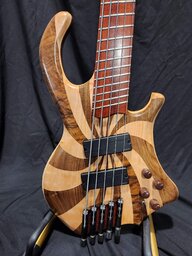
 
I am curious to hear what you results with neodymium magnets have been, or if you have experimented with them.

In terms of this test, it shouldn't make any difference what kind of magnets you use. Hold whatever kind of magnet you have on hand next to the string and see if you can slow it down.

In general, I haven't worked much with Neo's in building pickups. They are very densely powerful; a strong field in a small package. But in pickup design, that can be a problem. There are physical constraints in the size of the coils that you can make, using reasonable wire gauge, turns, impedance, and bobbin parts. For the pickup to work well, you want the magnetic field to be a good fit on the coil, surrounding it and saturating it evenly. Most neo's of the right power range have such small dense fields, that they don't fit well around a practical coil. I'm sure that there are many possible designs that can use them, but for my design pickups, I've been using simple A5 rods. I've had the best results working with tall, narrow, densely wound coils with various combinations of A5 rods inside.
 
  • Like
Reactions: Dadagoboi
I'm surprised how much better the horizontal mounting sounds. The vertical sounds more muddy.
The muddiness is decreased when the pickup is dropped down so that the pickup covers the bridge position better. Here's a clip with it dropped all the way as far as it will go south in the vertical position.
 

Attachments

A couple of other things to note:

1. You get quite a bit more output out of the vertical position
2. The position of the vertical pickup makes a huge difference in the clarity of the sound

Out of the four clips I personally prefer the sound of the vertical pickup located in the south position with this pickup. Results will vary depending on a variety of factors. Based on these initial experiments I could easily see myself building a set of low impedance pickups based on thin neodymium bar magnets that would be slim enough to cover every string. Thanks go out to the OP for bringing this up - I have benefited greatly from this discussion.
 
  • Like
Reactions: JustForSport

Latest posts