
Enjoy the benefits of a premium membership!
Upgrade Account
-
TalkBass has been independent since 1998. Add your voice.
Create a free account to reply to discussions, view embedded media, and browse with fewer display ads.
Join free Log in
Want zero display ads or expanded classifieds tools? Compare plans.
You are using an out of date browser. It may not display this or other websites correctly.
You should upgrade or use an alternative browser.
You should upgrade or use an alternative browser.
Kala UBass Megathread, Part 2
- Thread starter smperry
- Start date
- Status
- Not open for further replies.
More options
Who Replied?

Rechargeables eventually die. Not a problem for say... 5 years, but cross your fingers buying a used one in a decade!
Exactly.
Have a look on the attached foto.
Pieces of a brass tube, outer diameter 6 mm, inner diameter 5 mm.
Flattened with a hammer.
Red rings from the stock strings.
Works for all strings.
Wow. Cool. Where do you get those brass things?
How much do they cost? Can you post a link? Thanks.

I recently acquired a Kala U mahogany fretless and having a issue with the G & D strings. When finger picking the E and A strings the response is warm and clean but when picking the G & D strings it will make a clack sound (almost like fretting out)..
If I barely touch the string or finger pick further up the neck it's better.
Has anyone else noticed that on theirs?
If I barely touch the string or finger pick further up the neck it's better.
Has anyone else noticed that on theirs?

I recently acquired a Kala U mahogany fretless and having a issue with the G & D strings. When finger picking the E and A strings the response is warm and clean but when picking the G & D strings it will make a clack sound (almost like fretting out)..
If I barely touch the string or finger pick further up the neck it's better.
Has anyone else noticed that on theirs?
I have the same fretless Hog model and my string response is equal across all four. If I pull off the board really hard the string bouces off the fret board and clacks but again all four strings do that; these strings would make great sling shots...
Nice work, Justin. Could you please post some photos of the strings at the tuners? I wonder how the '2-3 wind' rule can be satisfied if, as shown in the stringing video, the Thunderguts aren't pulled as tightly as the stock strings need to be to avoid being wrapped at the bottom of the post.Maybe a good time to repost my Thundergut review (with pics and clips!):
justinoscarcary.com - Gear Reviews - -Aquila 'Thundergut' Bass Ukulele*Strings
Also wondering how the strings perform after many hours of playing time. Have you noticed any degradation in their physical properties or any significant loss of tone? It's been said that the stock Pahoehoe strings should last pretty much forever (?!) which I guess means that they'll sound and feel the same after a year or two as they do when they're first played.
We all know how a fresh set of regular bass strings sound tight and bright but we also know that they lose their tone after a few gigs / rehearsals / whatever. I'm wondering whether the 'wow' factor of the Thunderguts isn't the same as the one when we've just restrung our standard electric bass guitars.
I guess I'll find out soon enough as I'll be ordering a set next week but I'd appreciate it if you could share your thoughts on this in the meantime.

scotch
It's not rocket science!
- Nov 12, 2006
- 6,944
- 2,081
- 51
- Disclosures
- Please see Profile for Endorsement disclosures
Nice work, Justin. Could you please post some photos of the strings at the tuners? I wonder how the '2-3 wind' rule can be satisfied if, as shown in the stringing video, the Thunderguts aren't pulled as tightly as the stock strings need to be to avoid being wrapped at the bottom of the post.
Also wondering how the strings perform after many hours of playing time. Have you noticed any degradation in their physical properties or any significant loss of tone? It's been said that the stock Pahoehoe strings should last pretty much forever (?!) which I guess means that they'll sound and feel the same after a year or two as they do when they're first played.
We all know how a fresh set of regular bass strings sound tight and bright but we also know that they lose their tone after a few gigs / rehearsals / whatever. I'm wondering whether the 'wow' factor of the Thunderguts isn't the same as the one when we've just restrung our standard electric bass guitars.
I guess I'll find out soon enough as I'll be ordering a set next week but I'd appreciate it if you could share your thoughts on this in the meantime.
This set of Thunderguts sounds exactly the same as the day I installed them. I have about the same amount of wraps as the old strings. Probably 1 wrap on the 'E' and 'A' strings, 2-3 wraps on the treble strings (including a 'tuck' under like you would an acoustic guitar treble string).
The Thunderguts are inherently stiffer & come to pitch with much less stretching.
If there's one thing to note about the physical durability - it's that if the string becomes deformed, pinched or severely bent, it will retain some 'memory' or physical distortion. For instance, look at the photo below where the pliers I used to tie a knot left a 'crimp' in the 'D' string:
As the strings age & stretch over time, the frets also leave ever-so-slight depressions on the bottom of the string. However, this has not caused any ill-effect of buzzing or tonal change. You really have to look close to see it! I was unable to see it so much as barely feel it.
Great strings!
As far as longevity goes, I've only been playing them a month. So far, so great! BTW, the Pahoehoes lasted me about 6 months before I needed to replace them. They continue to stretch over the life of the string, eventually thinning to the point where they buzz in the nut slots on open notes.

Thanks a lot for the loads of infos!
What about stickiness? I just bought a set of Thunderguts and I think they feel a bit more sticky than the Pahoehoes.
My fingers get stuck on quick runs...
What about stickiness? I just bought a set of Thunderguts and I think they feel a bit more sticky than the Pahoehoes.
My fingers get stuck on quick runs...
This set of Thunderguts sounds exactly the same as the day I installed them. I have about the same amount of wraps as the old strings. Probably 1 wrap on the 'E' and 'A' strings, 2-3 wraps on the treble strings (including a 'tuck' under like you would an acoustic guitar treble string).
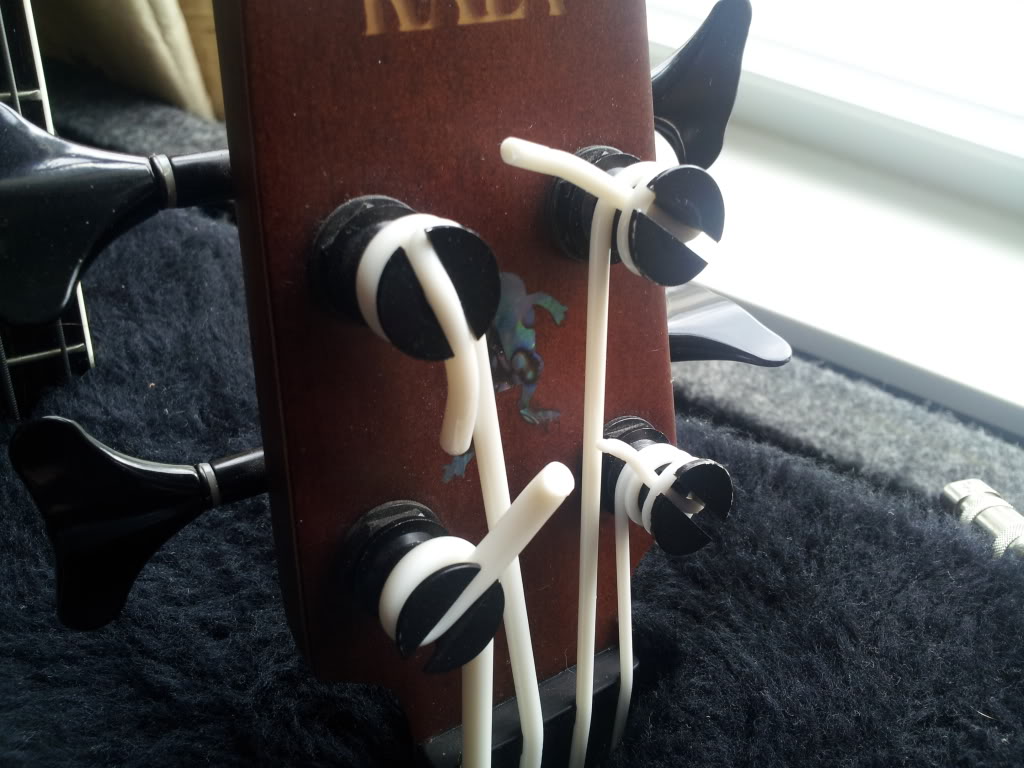
The Thunderguts are inherently stiffer & come to pitch with much less stretching.
If there's one thing to note about the physical durability - it's that if the string becomes deformed, pinched or severely bent, it will retain some 'memory' or physical distortion. For instance, look at the photo below where the pliers I used to tie a knot left a 'crimp' in the 'D' string:
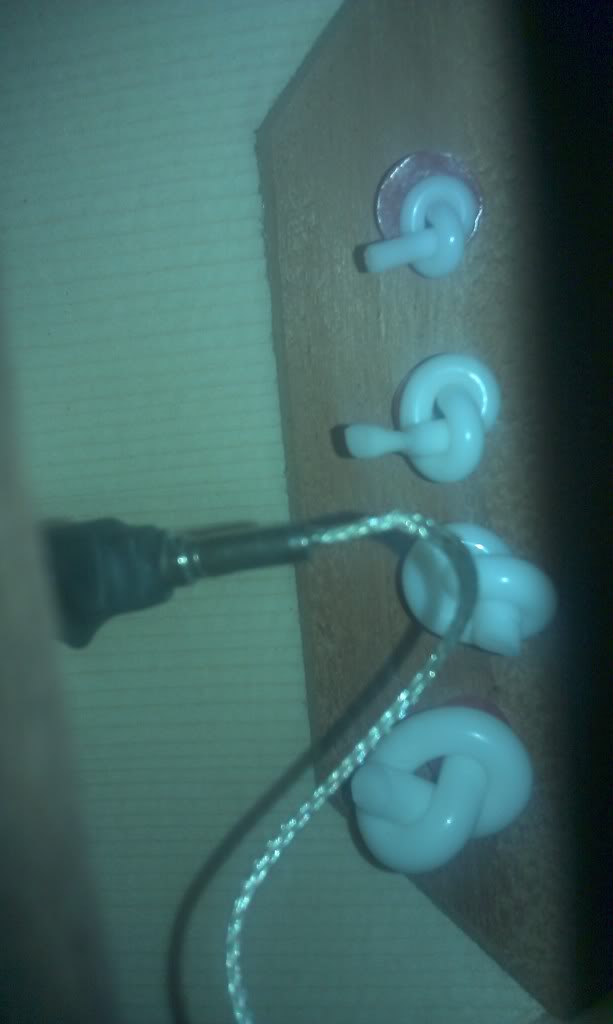
As the strings age & stretch over time, the frets also leave ever-so-slight depressions on the bottom of the string. However, this has not caused any ill-effect of buzzing or tonal change. You really have to look close to see it! I was unable to see it so much as barely feel it.
Great strings!
As far as longevity goes, I've only been playing them a month. So far, so great! BTW, the Pahoehoes lasted me about 6 months before I needed to replace them. They continue to stretch over the life of the string, eventually thinning to the point where they buzz in the nut slots on open notes.

I have had the same thought. At least for the D.
For the G, unless we all move to a different gauge someday,
the G actually fits in the hole of the peg. If you use that, you can actually get it to hold very easily.
For the G, unless we all move to a different gauge someday,
the G actually fits in the hole of the peg. If you use that, you can actually get it to hold very easily.




Just ordered myself a spruce fretted, and contacted AquilaUSA about ordering a set of Thunderguts. Gotta say, I'm extremely excited, I've wanted one since I first saw it online, and played one at Herb David's in Ann Arbor. Now, to find a strap...
Just ordered myself a spruce fretted, and contacted AquilaUSA about ordering a set of Thunderguts. Gotta say, I'm extremely excited, I've wanted one since I first saw it online, and played one at Herb David's in Ann Arbor. Now, to find a strap...
You Should be excited. Especially a few days after putting the Thunderguts on, when it all stabilizes. You're gonna have more fun than you think.
If you're like some of us, you're going to play more because you are going to have that little bass out all the time.
If you haven't done so yet, consider reading the whole megathread. There's a great deal of useful information - especially tuning information.
- Status
- Not open for further replies.


