
Enjoy the benefits of a premium membership!
Upgrade Account
-
TalkBass has been independent since 1998. Add your voice.
Create a free account to reply to discussions, view embedded media, and browse with fewer display ads.
Join free Log in
Want zero display ads or expanded classifieds tools? Compare plans.
You are using an out of date browser. It may not display this or other websites correctly.
You should upgrade or use an alternative browser.
You should upgrade or use an alternative browser.
Kala UBass Megathread, Part 3
- Thread starter smperry
- Start date
- Status
- Not open for further replies.
More options
Who Replied?

It does not work well with my U-Bass directly, the impedance mismatch is too great. Placed after a proper acoustic preamp to get the signal up to normal line level impedance and power, the G4 works okay with the U-Bass. One of the these things that aids a good overdrive pedal is the sustain of an electric bass. The U-Bass has almost no sustain. So, when you pluck the string, you get a brief bit of overdrive, but then the signal dies.
I have been talking to Heath about modifying the input impedance to work with a piezo. He bought a piezo pickup and will be doing some experiments.
I have been talking to Heath about modifying the input impedance to work with a piezo. He bought a piezo pickup and will be doing some experiments.
I can honestly say that I have never maxed out the last three sliders on the MXR 10-band EQ. I play bass. I tend bury those last three at the -12db mark. "Head room" usually refers to the ease with which a pedal can handle a signal. In the video, they are calling extra boost range "head room".

I had to stretch my D string again (the one I replaced), and I've found the best method for stringing/stretching -- way better than the kala video or most of the way discussed. And I can do it all by myself now, after some practice.
Sit on a sofa or lounge chair (with all soft surfaces on its front), and put the UBass between your legs. A carpeted floor is better too, so the bass is in contact with only soft surfaces. Hold the body between your calves. Have a clip on tuner attached. Set all the tuning pegs so the slots are vertical with the bass.
Use vice grips to grab the tip of the string (about a 1/2"), and stretch it over its nut and up next to its tuning post. Hold it in place and reach down and pluck it. Stretch it until you're about 1 to 1 1/2 steps flat from the string's note depending on the string (about 1 1/2 steps for the bigger strings - and less for the smaller ones, they stretch more).
Once you've got the right tension, put the string through its post slot, and with your free hand, start winding. On the E and the A, in several turns you should have enough string around the post for stability, and enough of a bend for the string to stay in place. By time you are in tune only about half of the post should have string around it.
The D and the G are a touch more tricky to do alone, but with practice holding the bass firmly you'll get it just fine. Use the same method, but after one half turn of the post (the end of the slot that was at 12 o'clock is now at 6 o'clock) pull the extra string around one half side of the post and put it through the slot one more time. After another half turn of the post and everything should be stable.
This method is best because:
- it's easy to do on your own
- much easier than trying to pull the strings with your fingers
- you don't get your knuckles chewed up by the posts' sharp edges
- you have more control throughout the process
- you can get to the appropriate tuning more precisely, instead of guessing how much more you need to stretch each time
- you can cut the strings off as soon as you're in tune, without having to worry that you cut them too short or that you won't have enough to grip next time.
Sit on a sofa or lounge chair (with all soft surfaces on its front), and put the UBass between your legs. A carpeted floor is better too, so the bass is in contact with only soft surfaces. Hold the body between your calves. Have a clip on tuner attached. Set all the tuning pegs so the slots are vertical with the bass.
Use vice grips to grab the tip of the string (about a 1/2"), and stretch it over its nut and up next to its tuning post. Hold it in place and reach down and pluck it. Stretch it until you're about 1 to 1 1/2 steps flat from the string's note depending on the string (about 1 1/2 steps for the bigger strings - and less for the smaller ones, they stretch more).
Once you've got the right tension, put the string through its post slot, and with your free hand, start winding. On the E and the A, in several turns you should have enough string around the post for stability, and enough of a bend for the string to stay in place. By time you are in tune only about half of the post should have string around it.
The D and the G are a touch more tricky to do alone, but with practice holding the bass firmly you'll get it just fine. Use the same method, but after one half turn of the post (the end of the slot that was at 12 o'clock is now at 6 o'clock) pull the extra string around one half side of the post and put it through the slot one more time. After another half turn of the post and everything should be stable.
This method is best because:
- it's easy to do on your own
- much easier than trying to pull the strings with your fingers
- you don't get your knuckles chewed up by the posts' sharp edges
- you have more control throughout the process
- you can get to the appropriate tuning more precisely, instead of guessing how much more you need to stretch each time
- you can cut the strings off as soon as you're in tune, without having to worry that you cut them too short or that you won't have enough to grip next time.

scotch
It's not rocket science!
- Nov 12, 2006
- 6,944
- 2,081
- 51
- Disclosures
- Please see Profile for Endorsement disclosures
I had to stretch my D string again (the one I replaced), and I've found the best method for stringing/stretching -- way better than the kala video or most of the way discussed. And I can do it all by myself now, after some practice.
Sit on a sofa or lounge chair (with all soft surfaces on its front), and put the UBass between your legs. A carpeted floor is better too, so the bass is in contact with only soft surfaces. Hold the body between your calves. Have a clip on tuner attached. Set all the tuning pegs so the slots are vertical with the bass.
Use vice grips to grab the tip of the string (about a 1/2"), and stretch it over its nut and up next to its tuning post. Hold it in place and reach down and pluck it. Stretch it until you're about 1 to 1 1/2 steps flat from the string's note depending on the string (about 1 1/2 steps for the bigger strings - and less for the smaller ones, they stretch more).
Once you've got the right tension, put the string through its post slot, and with your free hand, start winding. On the E and the A, in several turns you should have enough string around the post for stability, and enough of a bend for the string to stay in place. By time you are in tune only about half of the post should have string around it.
The D and the G are a touch more tricky to do alone, but with practice holding the bass firmly you'll get it just fine. Use the same method, but after one half turn of the post (the end of the slot that was at 12 o'clock is now at 6 o'clock) pull the extra string around one half side of the post and put it through the slot one more time. After another half turn of the post and everything should be stable.
This method is best because:
- it's easy to do on your own
- much easier than trying to pull the strings with your fingers
- you don't get your knuckles chewed up by the posts' sharp edges
- you have more control throughout the process
- you can get to the appropriate tuning more precisely, instead of guessing how much more you need to stretch each time
- you can cut the strings off as soon as you're in tune, without having to worry that you cut them too short or that you won't have enough to grip next time.
Pretty much how I do it as well! Vise Grips for the win!
This method is best because:
- you can cut the strings off as soon as you're in tune, without having to worry that you cut them too short or that you won't have enough to grip next time.
This is what it looks like when done, using my method. Nice and clean!
Invalid Link Removed
Invalid Link Removed
Invalid Link Removed
When I get around to changing the strings (in a few months?) I'm going to do a video of the process.

I just wanted to log my feedback after using the ThunderGuts on my SUB for a week or so. Generally speaking, it's been positive. The reaction from the bandmates has been that they sound great. The drummer in particular praised them for having a more "immediate" sound with better presence in the mix with the other instruments. I'm leaving them on for the next few gigs.
I generally prefer their performance on the fretted SUB to the stock strings' in terms of sound and tension. The TGs do make it perform more like a small bass guitar, which for me in a cover band doing a broad range of material is a plus. The two areas where I'm still not convinced are the right hand tackiness and the fact that there's sometimes a bit of noise when I slide my left hand between positions or in glissando. Neither is a deal breaker in light of the overall advantages.
I'll post again after using them on some of our 4 set gigs.
I generally prefer their performance on the fretted SUB to the stock strings' in terms of sound and tension. The TGs do make it perform more like a small bass guitar, which for me in a cover band doing a broad range of material is a plus. The two areas where I'm still not convinced are the right hand tackiness and the fact that there's sometimes a bit of noise when I slide my left hand between positions or in glissando. Neither is a deal breaker in light of the overall advantages.
I'll post again after using them on some of our 4 set gigs.

Whenever I feel any tackiness, I sprinkle a little baby powder on my hands, rub my hands up and down the strings, and that's the end of that.
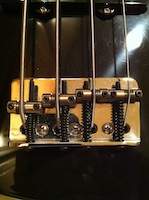
Is the noise from your fingers rubbing the strings? Maybe a touch of baby powder can help that. Or maybe one of the myriad of products guitarists use. The funniest product name that comes to mind is Gorilla Snot.
Mmmm, actually, Gorilla Snot is a gripping aid that guitarists use who have trouble with dropping picks. It adds tackiness to their fingers. Fun name. Different application.
It takes weeks for the Pahoehoe (black) strings to really settle in. They will stretch less after that. Be sure to not let the windings reach the bottom of the post - the posts can break. You'll likely have to rewind & trim them soon.
Is it really a problem to let the strings reach the bottom of the posts and then overlap? I'm trying to understand why this would break the posts.
Is it really a problem to let the strings reach the bottom of the posts and then overlap? I'm trying to understand why this would break the posts.
It traps the post and doesn't allow it to turn. A great deal of stress is created on the post. Another problem with string instruments is when strings get caught at the nut. In the case of the U-bass, more likely to stretch the string behind the nut first.
In reality it is possible in most cases to keep winding string around string as long as you don't trap the string below the post. Therefore not having to redo the winding. On the thinner strings, you can get away with this for a long time. I have one bass that I never restretched a string on.

Hi,
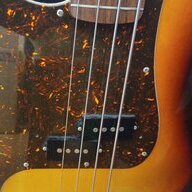
Has anyone modified their nut on the fretted hogs to bring the action down? I know the strings are easy to play and the action is not that high on mine, but surely it must affect intonation? I think the E string can come down easily by 1-1.5mm in the nut.
Has anyone modified their nut on the fretted hogs to bring the action down? I know the strings are easy to play and the action is not that high on mine, but surely it must affect intonation? I think the E string can come down easily by 1-1.5mm in the nut.
scotch
It's not rocket science!
- Nov 12, 2006
- 6,944
- 2,081
- 51
- Disclosures
- Please see Profile for Endorsement disclosures
Hi guys, what's the tension like on these with the poly strings, just a rough comparison with your standard bass with rounds?
Attempting to build something similar to the U Bass and wondering if my tuners will hold out
Tension feels much looser than standard steel strings.
Tension feels much looser than standard steel strings.
Thanks, just what I wanted to hear

Hi,
Has anyone modified their nut on the fretted hogs to bring the action down? I know the strings are easy to play and the action is not that high on mine, but surely it must affect intonation? I think the E string can come down easily by 1-1.5mm in the nut.
Mine could probably do the same, but I like it low. I was wondering why they are wood, wonder if I could replace it with metal or bone?
- Status
- Not open for further replies.


